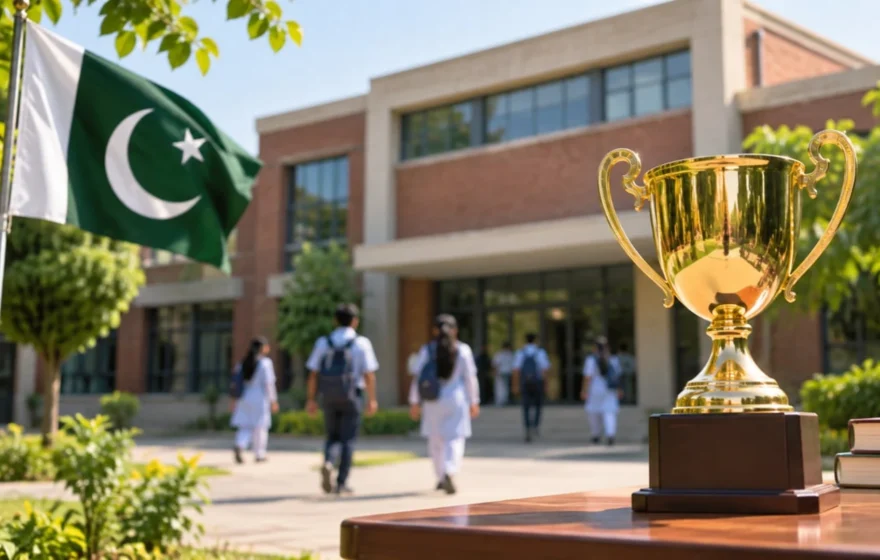
A school in Lahore has won one of the most prestigious prizes in world education. TNS Beaconhouse has been named winner of the World’s Best School Prize for Supporting Healthy Lives 2026, in recognition of a wellbeing-focused model that helps neurodivergent students stay in mainstream education rather than being pushed to the margins. The award, announced on Thursday by T4 Education, places a Pakistani school among six winners chosen from thousands of applicants around the world.
School Recognised for Inclusive Education Model
T4 Education recognised the school for its wellbeing-focused model that supports neurodivergent students and helps them remain part of mainstream education. TNS Beaconhouse serves more than 1,100 students across kindergarten, primary and secondary levels, and its approach begins from a simple idea: that children who learn differently should not have to leave the classroom to get the support they need.
The school has integrated a dedicated Special Educational Needs department into its International Baccalaureate framework. It offers classroom accommodations, targeted interventions and individual support to students based on their learning requirements. The model aims to improve confidence, inclusion and emotional wellbeing rather than forcing every student to follow the same academic pathway. In practice that means a child who struggles with reading can receive extra help without being separated from friends, while a student who needs extra time in examinations can have it as a matter of routine.
Students can choose between the IB Middle Years Programme, the American High School Diploma and a structured Life Skills Programme. They may also combine elements from different pathways according to their abilities and future goals. That flexibility matters because neurodivergent students, a term that covers conditions such as autism, attention deficit hyperactivity disorder and dyslexia, often have uneven profiles. A teenager might be gifted in mathematics yet find written examinations overwhelming, so the school tries to build an education around the child rather than forcing the child into a shape that does not fit.
Model Produces Measurable Results
Awards in education are often given for good intentions. What makes this one stand out is the evidence behind it. According to T4 Education, attendance among students receiving special educational support increased from 84 percent to 93 percent over three years. The number of classrooms using inclusive teaching methods rose from around 40 percent to more than 75 percent, while behavioural incidents declined by 37 percent.
Student surveys also recorded a 44 percent increase in academic confidence, while participation in school activities grew by more than 50 percent. The school’s enrolment also increased from around 700 to more than 1,100 students, while demand resulted in a three-year waiting list. Taken together, the figures describe a school where children who once stayed away now turn up, where teachers have changed how they teach, and where families are queuing to get in.
Another Pakistani School Reached Global Shortlist
Pakistan had two schools on the Top 10 shortlists for the 2026 awards. Along with TNS Beaconhouse, the Government Girls Lower Secondary School Tando Mir Ghulam Hussain was shortlisted in the Community Collaboration category. However, that award went to Swiss Cottage School, Development and Research Centre in London.
The second school’s story deserves attention of its own. A government girls’ school in Sindh, it reached the global top ten through strong partnerships with its local community, awareness campaigns, inventive science and technology activities, and a commitment to the all-round development of its students. It was named among the finalists in June, one of only two Pakistani schools chosen from thousands of applicants worldwide. That a small public school from Hyderabad could stand beside well-funded private institutions on a world stage says something about what is possible in Pakistan’s state sector.
Winners to Present Their Models in London
The World’s Best School Prizes recognise schools in five categories: Community Collaboration, Environmental Action, Innovation, Overcoming Adversity and Supporting Healthy Lives. A separate Community Choice Award is decided through public voting. The 2026 winners will be invited to the World Schools Summit in London in January, where they will present their approaches to policymakers and education leaders.
The prizes were launched by T4 Education in 2022, with a prize fund of 250,000 dollars shared between the winners. Thousands of schools apply each year, fifty make the shortlists, fifteen become finalists and only six take home a prize. The summit in January is where the real work of the awards happens, as winning schools share exactly how they achieved their results so that others can copy them.
For Pakistan, the win is worth more than a trophy. The country’s schools face enormous challenges, from out-of-school children to underfunded classrooms and teacher shortages. A global prize will not fix any of that on its own. But it does show that excellence exists inside the system, that a Pakistani school can set a standard the rest of the world wants to follow, and that inclusion is not a luxury for wealthy countries. If the model from Lahore can travel, the children who benefit will not only be the 1,100 already enrolled there.
