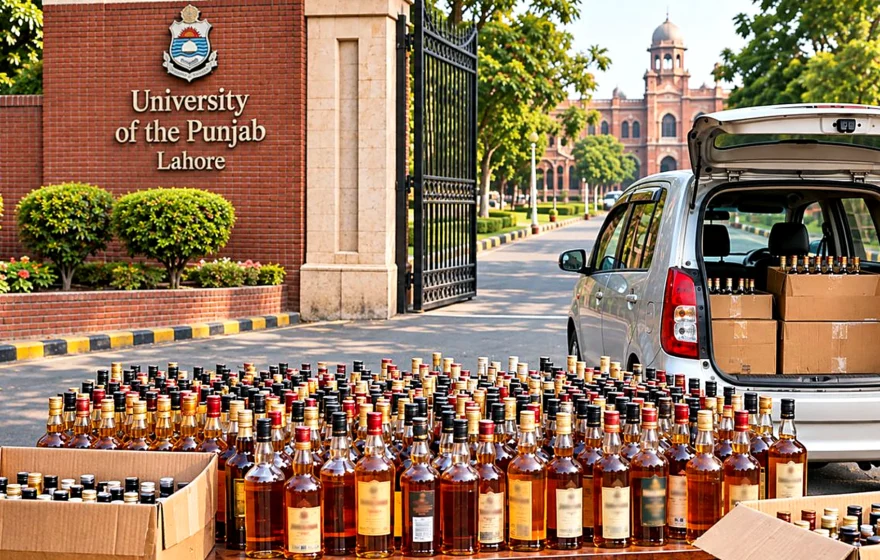
Security staff at the University of the Punjab in Lahore stopped a car at the entrance to the institution’s New Campus on Wednesday and found almost 200 bottles of liquor hidden inside it, in a seizure that the university says shows why its gate checks matter. The three people travelling in the car, including a sanitation worker employed by the university itself, were handed over to police along with the confiscated bottles, and an investigation is now under way.
The incident took place at Gate No. 1 of the Quaid-i-Azam Campus, the university’s main campus on Canal Road, when a security officer on duty became suspicious of a Suzuki Wagon R approaching the entrance. Security Officer Shahbaz stopped the vehicle and asked to inspect it, and the search that followed turned up around 200 bottles of liquor packed inside the car. The discovery was made before the vehicle could pass through the gate and onto university grounds, which meant that none of the bottles reached the campus itself.
A spokesperson for the university later identified the three occupants of the car as Kamran Masih, who works as a sanitation employee at Punjab University, Nabeel Masih and Rebacca Imran. The university did not say where the three were travelling from or where exactly they intended to take the liquor, and it has not released any further detail about the vehicle or its route. What is clear from the university’s account is that the stop was the result of a routine check rather than a tip-off, and that the officer’s decision to look inside the car was what exposed the load.
Once the bottles had been recovered, the university’s security team handed all three people, together with the seized liquor, to Muslim Town Police, whose station serves the area around the campus. Officers there are now carrying out further investigation and legal proceedings, and the university said the matter had been referred to the police for further legal action, which will decide what charges, if any, are brought against the three people involved.
The university administration was quick to frame the seizure as proof that its entry-point checks are doing their job. A spokesperson said the incident demonstrated the importance of security checks at campus entry points, and maintained that strict monitoring would continue in order to prevent unauthorised and illegal activities within the institution. The message was aimed as much at the university’s own community as at outsiders, since the involvement of one of its own employees in the episode will have been an uncomfortable detail for the administration. Punjab University’s Vice Chancellor, Dr Muhammad Ali, also weighed in, appreciating the security personnel for their vigilance and prompt response in stopping the vehicle before it entered the campus.
The episode is a reminder of how seriously Pakistan’s laws treat alcohol. Under the Prohibition (Enforcement of Hadd) Order of 1979, which applies across the whole country, the manufacture, transport, sale and serving of intoxicants is a criminal offence, and simply possessing liquor can also lead to prosecution. Transporting alcohol can be punished with imprisonment of up to five years and a fine, while possession on its own can carry a sentence of up to two years. The law does make a narrow exception for non-Muslim citizens, who may obtain permits to buy and keep limited quantities of alcohol for their own use, but a load of around 200 bottles in a private car would be far outside anything a permit could cover. Whether any of the three people in this case held such a permit is a question for the police investigation, and the university has said nothing on the point.
The case also underlines the scale of the security task at one of the country’s largest universities. The University of the Punjab, founded in 1882, is Pakistan’s oldest public university, and its Quaid-i-Azam Campus, established in 1958, spreads across around 1,800 acres along Canal Road in Lahore. Tens of thousands of students study there, along with thousands of teachers and support staff, and vehicles pass through several gates every day. Checking every vehicle is not practical, which is why the university relies on its guards to spot anything unusual and act on their judgement, as happened in this case. The fact that the officer stopped the car because it looked suspicious, rather than because of any specific intelligence, shows how much the system depends on the alertness of the people manning the gates.
What happens next depends on the police. Muslim Town Police will need to establish where the liquor came from, who it was intended for, and whether the three people were acting on their own or as part of a wider supply chain. If the investigation finds that the bottles were being brought in for sale or distribution, the penalties under the 1979 order would be severe. For now, though, the university’s position is that its guards did their job, the campus stayed clear of the contraband, and the law will take its course from here.
