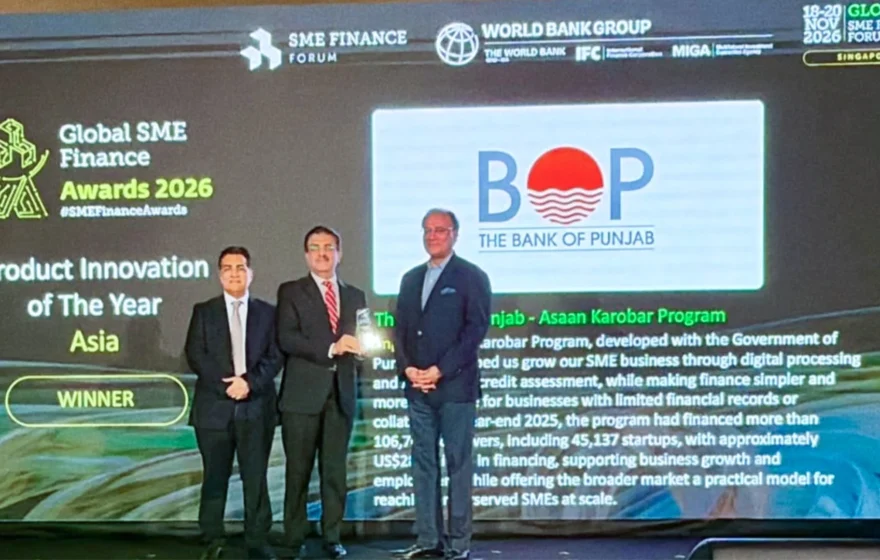
The Bank of Punjab has won the Product Innovation of the Year – Asia award at the Global SME Finance Awards 2026 in Singapore, becoming the first Pakistani institution to receive it. The prize recognises the bank’s transformation of small business lending, built on new lending models and wider outreach to businesses long outside the formal financial system. For a country where small firms carry much of the economy yet have long struggled to borrow, the award is a milestone and a sign of where Pakistani banking is heading.
The recognition rewards a sustained overhaul of how the bank lends to small firms. Where lending was once slow, paper-heavy and dominated by collateral demands, the bank now judges businesses on their cash flows, simplifies credit assessment and uses digital tools to reach borrowers far beyond its branch network. The award citation credits exactly that combination: innovative lending models, unprecedented borrower outreach and financial inclusion, aimed at drawing underserved businesses into the formal system.
The numbers show the scale of the change. The bank now serves around 153,000 small business borrowers, 48 per cent of the entire industry’s SME borrower base, meaning nearly one in two formal small business borrowers banks with it. Borrower numbers have grown by 397 per cent, against industry growth of 73 per cent, adding more than 122,000 new borrowers. Its SME portfolio stands at Rs230 billion, up 146 per cent since December 2024, roughly a quarter of all outstanding SME financing in the country, and it has disbursed Rs164 billion to new borrowers since then, much of it to first-time borrowers.
Unprecedented Growth in SME Financing
State Bank figures cited by the government show SME financing rising from Rs584 billion to nearly Rs854 billion by March 2026, up 46 per cent in a year, while SME borrowers rose 53 per cent to more than 312,000. By June 2026 the industry’s book had reached Rs901.6 billion, and by year-end it had crossed Rs1 trillion for the first time, at Rs1.046 trillion. Small firms still receive only a small fraction of total private credit, but their share is now the highest in at least eight years.
Small firms dominate Pakistan’s economy. The Economic Census of 2023 recorded around 7.14 million economic entities, and the government puts the micro, small and medium enterprise contribution at nearly 40 per cent of gross domestic product and about 30 per cent of exports, employing more than 80 per cent of the non-agricultural workforce. Yet for years most of these businesses could not borrow from a bank at all, relying on family money or informal lenders. Every new borrower is therefore a business entering the documented economy, with a credit history for larger borrowing later.
Advancing Entrepreneurship Through Strategic Partnerships
The bank has not made this journey alone. Its rise has been closely tied to the Government of Punjab, and the award announcement credits the vision of Chief Minister Maryam Nawaz Sharif and the provincial government’s commitment to entrepreneurship and inclusive growth, with the bank turning ambition into loans. The flagship is the Asaan Karobar programme, launched in January 2025 with the bank as principal lender and the Punjab Small Industries Corporation running the scheme. Under its finance window, businesses can borrow Rs1 million to Rs30 million with no markup, the provincial government paying it on the borrower’s behalf, repaid over up to five years. A late-October briefing put the programme’s disbursements at Rs70 billion to around 112,000 businesses.
International Recognition
The SME Finance Forum was established by the G20 and is managed by the International Finance Corporation, a member of the World Bank Group. It brings together more than 250 members and affiliates across 190 countries, and its annual forum and awards are the main stage on which lenders compare approaches to financing small firms. Winning its Product Innovation of the Year award for Asia places the bank’s model alongside approaches being tried by banks and fintech companies across the region. Finance Minister Muhammad Aurangzeb, speaking at its ministerial dialogue, set out a federal ambition to lift SME financing to Rs2 trillion by June 2028, almost double the current level, backed by the State Bank’s SME Connect Portal, launched on 1 November, and a Rs30 billion SME Development Fund.
The award fits that national story, but it also raises the bar for it. The results are unusually concrete: a borrower base growing far faster than the industry, a portfolio more than doubled in eighteen months, and a market share no other Pakistani bank can match. The question now is whether that pace can be sustained without lending quality slipping, whether the businesses brought into the system stay and grow, and whether other banks follow rather than leaving one bank to carry almost half of the country’s small business borrowers. If the answer is yes, the award will be remembered as the moment Pakistani small business finance stopped being a neglected corner of banking and became one of its most competitive arenas. If it fades, the award will stand as a reminder that prizes reward what has been done, not what comes next.
