Pakistan’s first journey into human spaceflight moved a decisive step closer this week, as the crew of China’s Shenzhou-24 spacecraft completed a full pre-launch rehearsal at the Jiuquan Satellite Launch Centre with a Pakistani astronaut among those taking part. The successful drill means the final preparations for a mission that will carry the first Pakistani, and the first foreign national ever, to China’s Tiangong space station are now effectively complete, with the launch expected within days.
According to Radio Pakistan, the rehearsal was held at the launch centre in north-western China, where all three astronauts worked through their operational procedures together in a joint pre-flight exercise. Zhou Lu, an official at the China Astronaut Research and Training Center, said the crew showed determination throughout the drill and carried out every assigned task accurately. The exercise is the last full run-through before the real thing, a chance to test the crew, the ground teams and the spacecraft’s systems in sequence, and its clean completion leaves the mission on schedule.
The flight itself will be a landmark for both countries. The China Manned Space Agency announced on November 7 that a Pakistani astronaut would join the Shenzhou-24 crewed mission as a payload specialist, the crew member responsible for the scientific experiments carried into orbit. It will be the first joint spaceflight involving Chinese and foreign astronauts in the history of China’s manned space programme, and the Pakistani crew member will become the first foreign national to visit the Tiangong station. According to Gwadar Pro, the astronaut will spend only a short period in orbit before returning to Earth aboard the Shenzhou-23 spacecraft, while Shenzhou-24 remains attached as the new crew’s return craft.
Neither government has yet named the astronaut who will fly. Two men are in line for the seat. Pilots Muhammad Zeeshan Ali of the Pakistan Air Force and Khurram Daud of the Pakistan Navy were chosen as Pakistan’s first astronaut candidates after a selection process that ran through three stages of screening and assessment, and both have spent months training at the China Astronaut Research and Training Center in Beijing. One will make the flight and the other will serve as backup. The Space and Upper Atmosphere Research Commission, SUPARCO, said this week that both astronauts have completed their training in China.
The road to this point began in February 2025, when Pakistan and China signed a cooperation agreement in Islamabad covering the selection and training of Pakistani astronauts for missions to the Chinese space station. The agreement formally launched the selection process, and the two candidates entered training in China in April 2026. As a payload specialist, the Pakistani astronaut will not be responsible for flying the spacecraft or for spacewalks. The job is a scientific one: operating Pakistani experiment hardware in the microgravity environment of Tiangong’s science modules and carrying out the research protocols set for the flight. Reports of the mission plan say the experiments cover food security, climate resilience, life and biological sciences, and materials science, a compact programme designed to fit a stay of about a week.
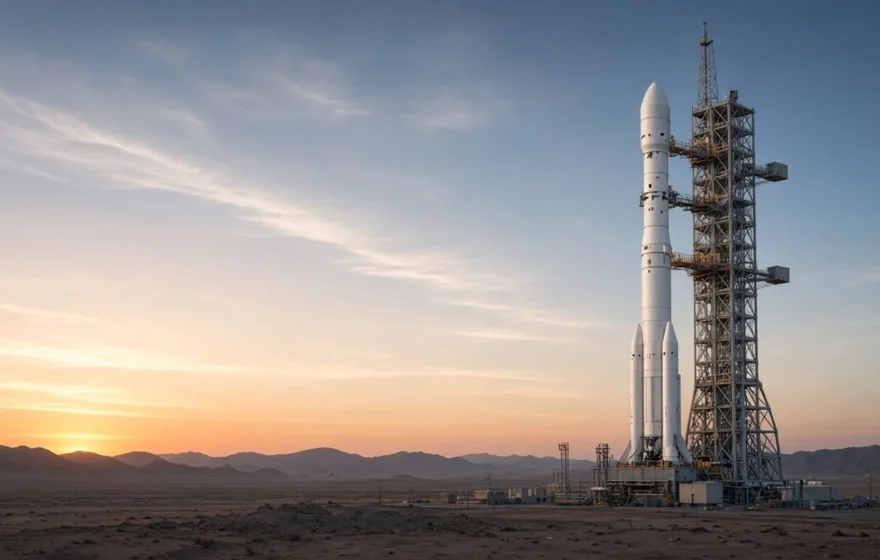
The launch date has not been formally confirmed by the China Manned Space Agency, which has said only that the mission is expected before the end of the year. Planning Minister Ahsan Iqbal, however, announced in October that the flight would take place on November 25, and the completed rehearsal suggests that timetable is holding. The spacecraft will lift off from Jiuquan on a Long March 2F rocket, the combination China has used for all of its crewed Shenzhou missions, before docking with the Tianhe core module of the Tiangong station.
For Pakistan, the flight is the most visible milestone yet in a space programme that has been quietly gathering pace. In May 2024, the country’s first lunar mission, the iCube-Qamar CubeSat, travelled to the Moon aboard China’s Chang’e-6 mission, giving Pakistani scientists their first experience of deep-space operations. The astronaut flight takes that cooperation much further, putting a Pakistani in orbit and giving the country’s researchers direct access to experiments in space. China has also said its space agency will deploy Jinnah-1, Pakistan’s first lunar rover, as part of the wider partnership, and Ahsan Iqbal has said Pakistan aims to achieve a lunar landing by 2035 through cooperation with China.
The mission also carries weight beyond science. Tiangong has so far been an exclusively Chinese station, and opening it to a foreign crew member marks a deliberate step by Beijing towards building a coalition of partners around its space programme, with Pakistan first in line. For Islamabad, the flight is a powerful symbol of a relationship that already runs through trade, infrastructure and defence, now extended into orbit.
Questions remain before launch day, most obviously which of the two candidates will fly and the exact date and time of lift-off. But the rehearsal at Jiuquan has answered the most important one for now: the crew is ready. When Shenzhou-24 rises from the Gobi Desert, a Pakistani will be aboard, and the country’s space programme will have crossed a line it has been working towards for decades.
