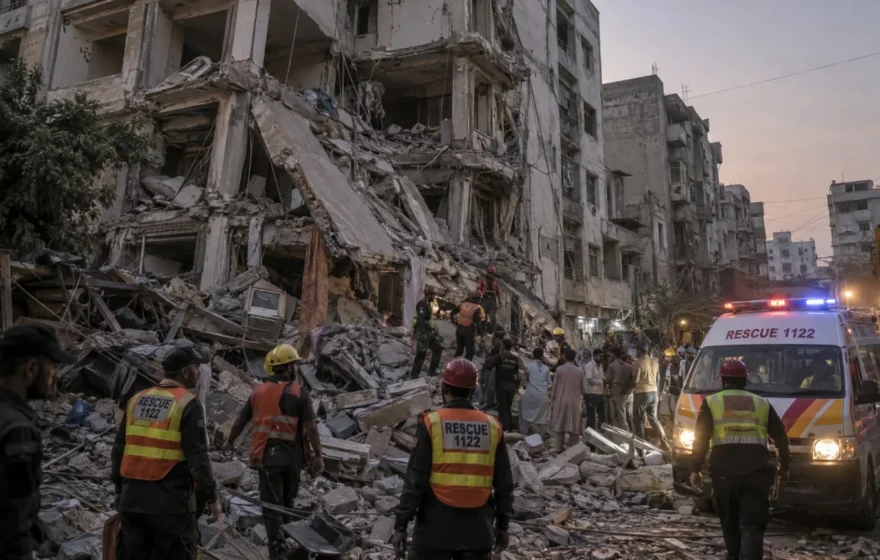
A newly built six-storey building came crashing down in Karachi on Wednesday, killing one person and injuring three others, in the latest reminder of how fragile construction safety remains in Pakistan’s largest city. The collapse happened in Admin Society near Baloch Colony, a crowded neighbourhood close to Shahrah-e-Faisal, and within minutes the whole structure had been reduced to a mound of broken concrete, twisted steel and dust. Rescue workers spent the rest of the day picking through the rubble, unsure whether anyone else was still buried underneath.
The building had stood for barely a fortnight. Residents said construction had finished only about two weeks before the collapse, which immediately raised questions about the quality of the work and the supervision it received. A structure that new should not have fallen at all.
Building Completed Just Two Weeks Ago
People living nearby described a sudden, thunderous fall. One moment the six-storey block was standing beside the road in Admin Society, and the next it had folded in on itself, sending a cloud of dust over the street and burying the cars and motorcycles parked alongside it. Little of the original shape of the building remained visible, only slabs of concrete stacked at odd angles.
That short life span sets this collapse apart from the many Karachi has suffered before, which usually involve old, visibly crumbling blocks. This one was new, in a neighbourhood filling up with multi-storey blocks as land grows scarcer and more expensive. Whether it was formally approved, whether its foundations and columns matched the approved design, and whether anyone inspected it before completion are questions the authorities must now answer.
Rescue 1122 Pulls Victims from Rubble
Rescue 1122 teams reached the scene soon after the collapse and began working through the debris. They recovered one body from the rubble and pulled out three injured people, who were taken to a nearby hospital for treatment. A spokesperson for the service said the building had collapsed completely, but added that no one was living in it at the time. Even so, the spokesperson said it was too early to say with certainty how many people might still be trapped, and the search went on through the day.
Vehicles and motorcycles parked nearby were crushed, and the street was closed off while heavy machinery cleared the wreckage. The Edhi Foundation sent ambulances to the spot, and police moved in to keep crowds back and traffic moving. Sindh Inspector General of Police Javed Alam Odho directed officers to reach the site at once and to work closely with Rescue 1122, the fire brigade and other agencies, while Sindh Chief Minister Murad Ali Shah also took notice and ordered the authorities to speed up the rescue. Prime Minister Shehbaz Sharif later expressed grief over the loss of life.
The uncertainty over whether more people were trapped hung over the whole operation. Workmen may still have been coming and going at a building finished only two weeks earlier, and passers-by could have been caught by the falling debris, so rescue teams kept digging and officials were careful not to declare the search over until every part of the rubble had been checked.
What happened in Baloch Colony fits a pattern that Karachi knows all too well. The city has lost dozens of people to collapsing buildings in recent years, and the deadliest cases have usually exposed the same weaknesses: weak regulation, illegal additions and officials looking the other way. The worst recent disaster came in July last year, when a five-storey residential block known as Fotan Mansion collapsed in Lyari’s Baghdadi neighbourhood, killing 27 people. The Sindh Building Control Authority had declared it hazardous as far back as 2023, and investigators found two extra floors had been added illegally to a structure already in poor shape. Nine people, including eight building control officials and the owner, were arrested, and the authority’s director general was suspended.
That tragedy led to a fresh survey of dangerous buildings across the city. Officials said at the time that around 600 buildings in Karachi had been declared unsafe, with dozens of them in extremely dangerous condition. Yet the problem has never really gone away, because the city’s housing shortage keeps pushing people into blocks built quickly and cheaply, and enforcement of building rules remains patchy. Collapses have also struck newer construction before, which is why the Baloch Colony case will worry regulators even more than the usual collapse of an old block.
The questions now are the familiar ones, and they deserve straight answers. Who approved this building, and was the work checked at each stage, from the foundations to the final floors? If it was finished only two weeks ago, there should be a paper trail from the approved plan to the completion certificate, showing exactly where things went wrong. Until approvals are enforced properly and dangerous structures are dealt with before they fall, Karachi will keep counting its losses in the rubble of buildings that should never have come down.
