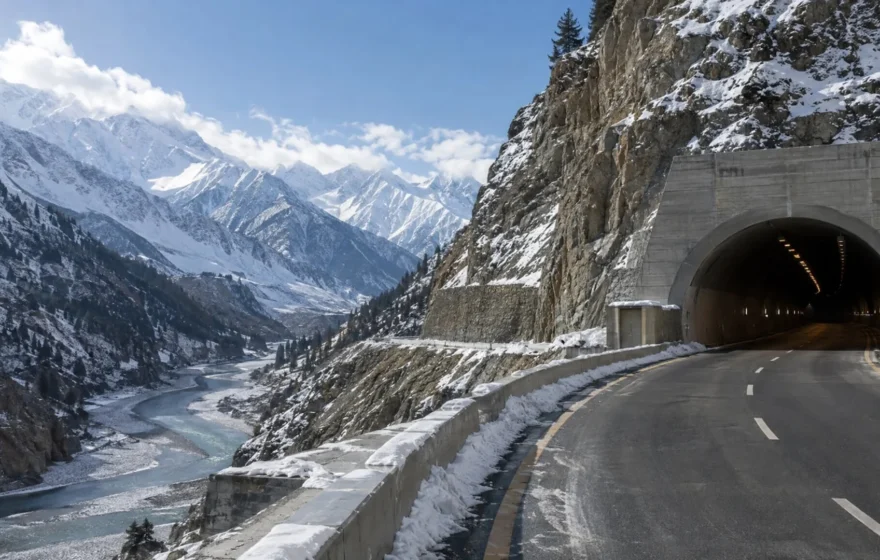
Federal Minister for Communications Abdul Aleem Khan has ordered the early completion of the remaining works on the Lowari Tunnel and the Chitral Highway, saying the projects should be finished quickly so local people benefit and tourism in the region can grow. The minister gave the instruction during a visit to the tunnel and to Chitral, where he inspected the work under way, the safety arrangements and the problems people face in staying connected with the rest of the country.
Pakistan’s Longest Tunnel
On the first day of the visit, the minister reached the Lowari Tunnel, the longest road tunnel in the country, which runs for more than ten kilometres in two separate tubes. He went inside the tunnel and looked around the surrounding area, examining the condition of the facility and the progress of the work still to be done. The tunnel is made up of two tubes, one of 8.5 kilometres and the other of 1.9 kilometres, giving a combined length of about 10.4 kilometres. Each tube carries two lanes of traffic, and the tunnel carries the N-45 National Highway between Dir and Chitral through the mountains of the Hindu Kush. It is operated by the National Highway Authority, and it opened to traffic in July 2017 after a construction history stretching back decades. Work first began in 1975, stopped within about a year for lack of money, resumed in 2005, stalled again, and picked up pace in 2014 before the project was completed at a reported cost of around Rs26.95 billion.
A Lifeline for Chitral
The importance of the tunnel becomes clear when the old route is remembered. Before it opened, the only road to Chitral crossed the Lowari Pass, a high crossing at 3,118 metres that heavy snow closes to vehicles from about late November to late May each year. For months at a time, the district was cut off from the rest of Pakistan, and travellers sometimes had to detour through Kunar in Afghanistan to reach their destination. The tunnel changed that completely. By taking the N-45 under the pass instead of over it, it cut the drive between Chitral and Peshawar from around fourteen hours to about seven, and it gave the district an all-weather link for the first time. Traders could move goods in winter, patients could reach hospitals in Peshawar and Islamabad, students could travel to their colleges, and families separated by the mountains could stay in touch through the coldest months of the year.
Tourism is the other reason the tunnel matters so much. Chitral is one of the most beautiful valleys in the north, with the old fort and bazaar of Chitral town, the Shahi Mosque, the polo ground, and the snow-capped peak of Tirich Mir rising above the valley at 7,708 metres. The Kalash valleys of Bumburet, Rumbur and Birir draw visitors from across Pakistan and abroad, especially for the Chilam Joshi festival in spring, while Chitral Gol National Park protects forests and markhor close to the town. None of that can grow into a proper tourism economy if visitors cannot be sure of reaching the valley. That is why the minister linked the completion of the remaining works directly to tourism, and why local hotel owners, transporters and shopkeepers watch every announcement about the tunnel so closely.
Safety and the Road Ahead
The minister’s inspection also covered safety, which has been a recurring concern for people who use the tunnel. Heavy snow can still block the approach roads even when the tunnel itself is open, and queues of vehicles at the portals have raised questions about ventilation inside the long tubes. In August this year, the National Highway Authority notified a plan to close the tunnel for twelve hours a day in rotating three-hour blocks, a proposal that residents of Chitral rejected, and the tunnel remained open round the clock. The episode showed how sensitive any change to the tunnel’s timings can be, and how much the district depends on it staying open. Against that background, the minister’s order to finish the remaining works quickly reads as an attempt to settle the project properly rather than leave it half done. The works include the approach roads and the facilities around the tunnel, which shape the journey just as much as the tunnel itself.
For Chitral, the promise of an early finish will be judged on what actually happens on the ground in the weeks ahead. The district has waited a long time for this road, through decades of stops and starts and through winters when the pass closed and the valley was on its own. A finished tunnel and a finished highway would not just shorten a journey. They would give Chitral the reliable link it needs to trade, to study, to seek medical care and to welcome visitors in every season. The minister has now set the direction. The test will be whether the remaining works are completed on the timetable he has ordered, and whether the people of Chitral feel the difference on their next journey through the mountains.
