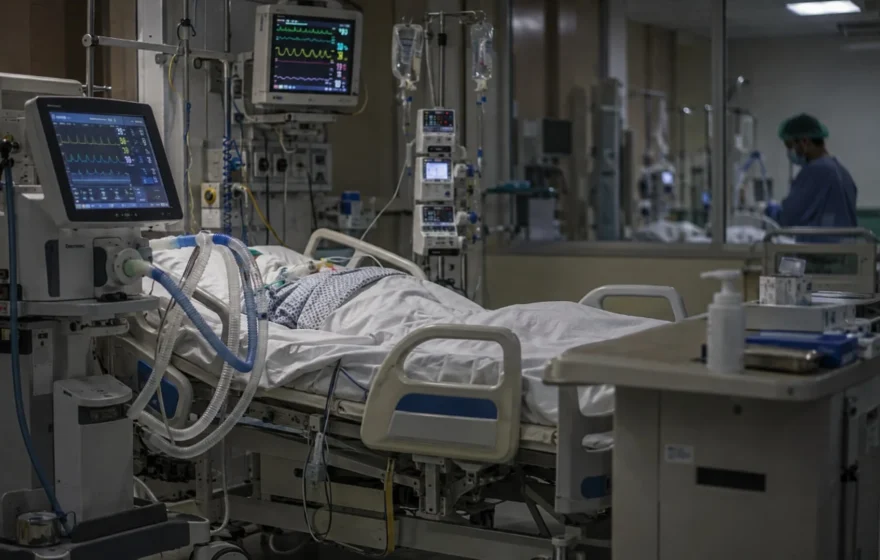
Public teaching hospitals across Punjab are facing a shortage of around 1,600 ventilators, leaving intensive care units across the province under severe strain and critically ill patients struggling to get the breathing support they need. The scale of the gap, reported by 24NewsHD TV, underlines how thin the province’s critical care capacity has become, even as demand for intensive care keeps rising.
A ventilator is often the difference between life and death for a patient who cannot breathe on their own. It takes over the work of the lungs, pushing oxygen into the body while doctors treat the underlying illness. When no ventilator is free, a patient who needs one may be kept in an emergency ward on makeshift arrangements, or moved from hospital to hospital while their family waits for a bed to open. That is the position many families in Punjab now find themselves in.
The figures behind the crisis have been building for some time. Health department records reported earlier this year showed that only 1,709 ventilators were operational across Punjab, against a requirement of 3,406 worked out from bed capacity and international standards. The World Health Organisation recommends that at least 10 per cent of hospital beds should be supported by ventilators, a benchmark Punjab falls far short of.
The condition of the machines the province does own makes the picture worse. Of the ventilators in government hospitals, 431 intensive care ventilators were found to be non-functional, with 191 awaiting repairs, 185 declared beyond repair and 55 officially condemned. A further 374 ventilators supplied during the coronavirus emergency were found to have failed to deliver effective clinical results. So the shortage is not only about machines never bought. It is also about machines that broke down, were never repaired, or never worked properly in the first place.
The pressure is most visible in Lahore, where the province’s largest hospitals carry the heaviest load. Services Hospital, Mayo Hospital, Sir Ganga Ram Hospital and General Hospital have been operating far beyond their capacity, with intensive care and emergency areas overwhelmed by patients in critical condition. Doctors have described days when several patients needed ventilator support or intensive monitoring and there was simply no space for them. In some cases, written recommendations for transferring a seriously ill patient to intensive care could not be carried out because no bed was available. Attendants have waited for hours in hospital corridors in the hope that a bed would fall vacant.
Purchase Plan
The Specialized Healthcare Department, which runs the teaching hospitals, had a plan to buy ventilators during the previous fiscal year, but that plan could not materialise. The procurement process for 450 new ventilators has now been started for the current fiscal year, and the department has also approached the federal government to secure the foreign exchange allocation needed for the purchase. Ventilators are largely imported, so foreign exchange approval can decide how quickly machines actually arrive.
This is not the first purchase to be promised. Earlier this year, the government approved the buying of 300 ventilators, with Rs2.7 billion sanctioned for the purpose, after the scale of the breakdowns became public. Even that approval became stuck in procurement and tendering, delaying relief for hospitals that were already stretched. In April, the health department told the Lahore High Court that teaching hospitals had 1,785 ventilators and that work had begun on procuring 500 more in the financial year 2025-26. The court case remains pending, and the department’s figures have been questioned in court, with the petitioner’s counsel arguing that the numbers fall below World Health Organisation standards and should be physically verified.
Shortfall
Even if the planned purchase of 450 ventilators goes through, public teaching hospitals will still face a shortfall of around 1,200 units. That is the hard arithmetic of the crisis. Four hundred and fifty new machines would cut the gap, but it would not close it, and the hospitals would still be operating with far fewer ventilators than the standards require. The shortage would continue to put additional pressure on intensive care facilities across the province, and the same scenes of families waiting for beds would continue.
The deeper difficulty is that buying machines is only part of the answer. A ventilator needs trained staff to run it, technicians to maintain it and an intensive care bed to stand beside. Health experts have pointed out that the number of intensive care beds has not kept pace with Lahore’s population growth, and that staff shortages compound the problem. Expanding intensive care capacity, recruiting specialised staff and fixing the maintenance system matter as much as the purchase orders.
For patients and their families, the test of any plan is simple: whether a ventilator is available when it is needed. The province’s hospitals have been living with this shortage for years, through court hearings, promised purchases and emergency supplies that did not work. The 450 ventilators now being procured are a step forward, but the remaining gap of around 1,200 machines means the strain on Punjab’s intensive care units is far from over.
