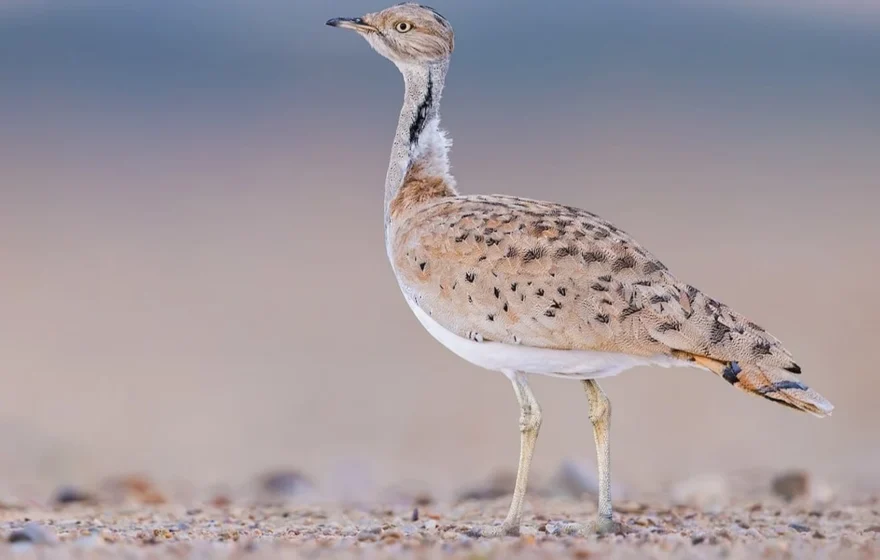
The Punjab government has approved a two-month relaxation in the legal protections for the migratory Houbara bustard this winter, allowing limited falconry hunting by visiting Arab dignitaries during the 2026-27 hunting season. The decision, reported by The News, revives a debate that has repeatedly reached the Supreme Court.
The decision was approved at the 42nd meeting of the Standing Committee of Cabinet on Legislative Business and Privatization, chaired by Punjab Finance Minister Mujtaba Shuja-ur-Rehman. The Punjab Wildlife and Parks Department had proposed the temporary change to facilitate the hunting season for Arab sheikhs. Under existing provincial law, the Houbara bustard is listed in the Third Schedule and remains protected throughout the year. Its transfer to the First Schedule under Section 45(i), through a gazette notification, allows regulated hunting during a specified period. The decision comes ahead of expected hunting area allocations by the Federal Ministry of Foreign Affairs for the 2026-27 season.
Arab dignitaries traditionally visit the deserts of south Punjab during the winter migration of Houbara bustards from Central Asia, and several have established residences there. The bird, officially known as MacQueen’s bustard, is a shy, ground-dwelling species that migrates to Pakistan in the autumn, settling in the arid lands of Sindh, southern Punjab and Balochistan. It was once common in the deserts of the United Arab Emirates and Saudi Arabia, but by the early 1970s it had been hunted to near-extinction there.
That changed in the mid-1970s, when rich Arab sheikhs began arriving with trained falcons, shotguns and dogs, drawn by a bird whose meat they believed contained a potent aphrodisiac. The practice began in earnest under Zulfikar Ali Bhutto, whose government in 1974 began courting the oil-rich Gulf states in the hope of attracting petro-dollars, and one of the schemes used was to invite the sultans to hunt the bustard, with permits issued for a hefty fee. Sheikh Zayed bin Sultan Al-Nahyan of Abu Dhabi had first come to Pakistan’s deserts to hunt houbara with his falcons in the 1960s, and palaces rose to house the visitors, including one in Rahim Yar Khan.
The issuing of hunting permits continued after the Bhutto government was removed in 1977, and it grew. It was not until the early 1990s that the concerns of conservationists began to draw sustained public attention. The bird’s population was considered vulnerable and declining, and the scale of the hunting alarmed those who tracked it. In January 2014, a member of the Saudi royal family, Prince Fahd bin Sultan, killed 2,100 houbara bustards in Balochistan over three weeks, far beyond the bag limit of 100 birds for a ten-day hunting period. The episode became the trigger for a petition to the Supreme Court.
In August 2015, a three-judge bench of the Supreme Court headed by the then Chief Justice, Jawwad S. Khawaja, ordered the federal and provincial governments not to grant any more licences or permits to hunt the houbara bustard, and directed the provinces to amend their wildlife laws to comply with the Convention on International Trade in Endangered Species, known as CITES, and the Convention on Migratory Species. Pakistan is a signatory to both. The judgment, written by Justice Qazi Faez Isa and reported as 2016 SCMR 48, stands as one of Pakistan’s landmark environmental law decisions, and it held that neither the federation nor any province could issue licences or permits to hunt the bird.
The victory for conservationists did not last. In January 2016, a five-member Supreme Court bench, by a four-to-one majority, set aside the complete hunting ban in review proceedings, with Justice Isa dissenting. The review bench held that the judiciary’s role was to interpret the law rather than legislate a permanent ban. The original judgment therefore remains a landmark environmental decision, but it has not been the final operative legal position since the review.
The provinces have also handled the bird differently. Sindh once tried to convert it from a protected animal into a game animal, Punjab treated it as game, and Balochistan’s law was internally contradictory, protecting the bird while also allowing dignitaries to hunt up to 100 birds for a fee. Under the Balochistan Wildlife Act of 1974, all bustards are listed as protected animals, and the houbara is officially the provincial bird of Balochistan.
The Punjab government’s decision follows that established pattern. By moving the bird from the Third Schedule to the First Schedule for two months, the province has created a defined window in which regulated hunting can take place, and the Foreign Office will now allocate the hunting areas for the visiting dignitaries. The arrangement is presented as hospitality and diplomacy towards guests whose countries have long-standing ties with Pakistan, a gesture governments here have made, with brief interruptions, for fifty years.
Conservationists see it differently. For them, the bird is a vulnerable species whose numbers have never recovered from decades of hunting, and the two-month window falls in the very season when the birds are present in Pakistan. The tension between diplomatic hospitality and conservation has never been resolved, and this winter’s decision ensures it will be argued over once again.
