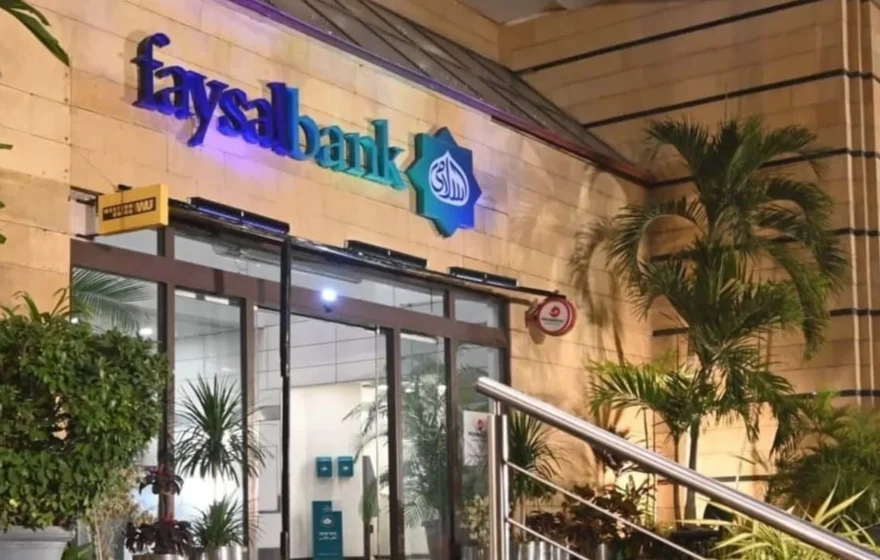
Faysal Bank Limited has joined hands with the State Bank of Pakistan’s Banking Services Corporation to take financial literacy to persons with disabilities. The two institutions held an awareness session for deaf students at the National Institute for the Deaf in Satellite Town, Gujranwala, built around a simple idea: banking should be within reach of everyone, including people who are routinely left out because branches, forms and mobile apps were never designed with them in mind.
The session was practical from the start. Faysal Bank’s team demonstrated the bank’s digital banking channels, showing participants how an account can be operated from a phone without repeated trips to a branch. Staff also helped eligible participants open accounts on the spot, removing the paperwork and waiting that so often puts first-time account holders off. For many of those present, it was their first structured introduction to formal banking, and the fact that it happened in their institute, in a setting they were comfortable with, mattered as much as the information itself.
Health was part of the day as well. The bank introduced free digital healthcare services for its customers with disabilities through Oladoc, the platform that connects patients with verified doctors and hospitals across Pakistan. Medical check-ups were also arranged at the venue, so the session addressed two everyday needs at once: managing money and looking after health. For people who often have to fight for both, that combination was deliberate rather than incidental.
Faysal Bank’s President and Chief Executive, Yousaf Hussain, said the bank saw financial inclusion as a question of equal access rather than charity. “At Faysal Bank, we believe that financial inclusion means ensuring equal access to opportunities and essential services for everyone,” he said. “We remain committed to empowering Persons with Disabilities through accessible banking solutions, digital innovation, and initiatives that support their financial independence and overall well-being.”
The Gujranwala session sits inside a much larger effort. The State Bank has been issuing guidance on banking access for persons with visual impairment since 2009, telling banks to open individual accounts for blind customers rather than insisting on joint accounts, and to offer the same services without discrimination. A more comprehensive framework followed in 2014, covering account opening, ATM cards, Braille documentation and internet banking. By 2021 the central bank had a policy for the financial inclusion of persons with disabilities in place, and disability inclusion now features in the National Financial Inclusion Strategy for 2024 to 2028, which targets 75 percent inclusion by 2028.
The reason such policies exist is that the gap they address is still wide. A study by the Pakistan Institute of Development Economics, based on interviews in Charsadda and Islamabad, found that only 15 percent of respondents were financially included. The rest were held back by problems with usage, documentation, affordability, trust and physical access to branches. A more recent survey of blind and low-vision banking users found that only 17 percent could use an ATM without help, and only a quarter rated their bank’s mobile app as fully accessible. More than half said they had been refused an accessible banking service at a branch at least once.
The State Bank has also tried to open the door to credit. It announced a concessionary financing facility for special persons under which banks provide finance of up to Rs 1.5 million for setting up or expanding a small enterprise, at 5 percent a year, for up to five years including a six-month grace period, with the central bank refinancing the full amount and covering 60 percent of the risk. Yet a loan on paper is only useful if the person who needs it knows it exists, can reach a branch, can complete the forms and can operate the account that comes with it.
Faysal Bank itself has been changing rapidly. The bank completed its conversion from conventional to Islamic banking on 1 January 2023, a shift the International Islamic Rating Agency has described as the largest such conversion in the world. Today it is Pakistan’s second-largest fully Islamic bank, with around 900 branches in more than 360 cities and towns and deposits of about Rs 1.43 trillion at the end of 2025. Only days ago it was named Best Bank of the Year 2025 in the mid-sized banks category at the CFA Society Pakistan annual excellence awards.
What happens next will decide whether the Gujranwala session was a one-off event or the start of something durable. One session cannot fix inaccessible ATMs, apps that screen readers cannot read, or branch staff who turn a disabled customer away. The State Bank’s own record shows that progress has depended on sustained pressure: accessible infrastructure at branch entrances and ATM cabins, forms and documents in Braille, and accessibility audits of branches. For the students in Gujranwala, the practical test is simpler. Those who opened accounts will now find out whether the app works for them and whether the branch answers their questions. If the answer is yes, the session will have done its job: giving people the tools to manage their own money and their own lives.
