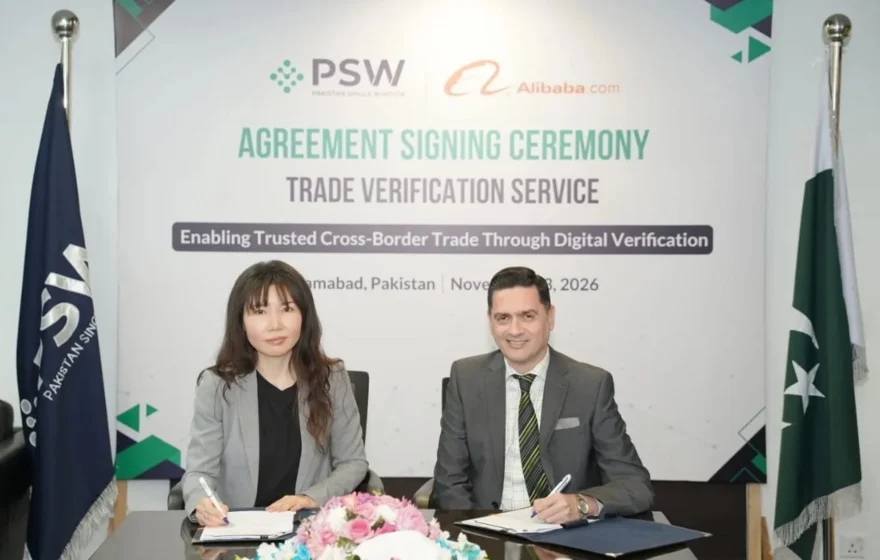
Pakistan Single Window and Alibaba.com have signed an agreement to introduce a Trade Data Confirmation Service designed to make foreign buyers trust Pakistani exporters more. The service combines Pakistan’s national digital trade infrastructure with Alibaba.com’s global business-to-business marketplace, and it tackles an old problem in cross-border trade: a buyer thousands of miles away must believe the supplier on the screen is real and the shipment it promises is genuine.
The service will give Alibaba.com and its global buyers an extra layer of assurance about the Pakistani businesses listed on the platform. Verification will take place through API-based requests and responses, exchanging confirmations rather than the underlying trade data itself. No export declarations or commercially sensitive records will be handed over. Instead, the system will confirm, digitally and independently, that a supplier’s declared trade data matches the official record held in Pakistan.
Alibaba.com already gives Pakistani businesses access to a marketplace, connecting them with international buyers and offering digital tools to discover new markets. The new service is expected to strengthen buyer confidence further by letting a buyer check that a supplier’s export declarations are real before placing an order. For small and medium-sized exporters in particular, that kind of independent confirmation can be the difference between winning a first order from a cautious buyer and being passed over.
Syed Aftab Haider, the chief executive of Pakistan Single Window, said the partnership showed what the country’s digital trade infrastructure could now do. “Our collaboration with Alibaba.com demonstrates how Pakistan’s digital trade infrastructure can enable innovative services that strengthen trust in cross-border trade,” he said, adding that the API-based service would make the supply chain for Pakistani businesses more transparent and reliable.
Summer Gao, Head of Pakistan Business at Alibaba.com, said the service would help Pakistani exporters do business more smoothly with global buyers and set a new benchmark for transparency and reliability in international e-commerce.
Trust has always been the hard currency of export trade, and it is especially hard for suppliers from countries that buyers know less well. A factory in Sialkot making footballs or surgical instruments may produce world-class goods, but a buyer who has never visited it has to take a great deal on faith. Alibaba.com already offers tools to reduce that risk, including business verification and Trade Assurance, which gives buyers some payment protection. The new service adds a government-held check to that mix, without forcing exporters to hand over their private commercial data.
Pakistan Single Window itself is the backbone that makes this possible. It is the country’s integrated electronic platform for cross-border trade, established under the Pakistan Single Window Act of 2021. Instead of visiting the Federal Board of Revenue, Customs and dozens of separate agencies one by one, traders submit documents, permits and declarations through a single online portal. The platform links Customs, the State Bank of Pakistan and the other government agencies that regulate trade, and it has now engaged more than 88,000 traders, integrated 29 banks and 20 government departments, and processed over one million goods declarations and more than 634,000 licences, permits and certificates.
The Alibaba agreement is the latest in a run of steps that have pushed Pakistan’s trade infrastructure onto the international stage. In May, Pakistan Single Window signed an agreement with the Trade Development Authority of Pakistan to digitise the trade ecosystem and bring the authority’s Pakistan Trade Portal and Exporters Directory into the single-window environment. In September, Pakistan became the first country to connect its trade platform to ValidAP, Hong Kong Customs’ blockchain system for verifying trade documents, so documents issued through the platform can now be checked anywhere in seconds.
Alibaba.com has been deepening its bet on Pakistan for some time. Around 4,000 Pakistani exporters and sellers now operate on the platform, and the company aims to train 10,000 small and medium-sized businesses in digital trade, working with more than 20 local partners. Most Pakistani sellers on the platform today come from the garments sector, roughly 60 to 70 percent of them, but the company sees room to grow in surgical instruments, leather goods and sports equipment, where Pakistan already has a strong reputation. Pakistan accounts for about 23 percent of the global offline market in surgical instruments, yet only around 7 percent of surgical instrument sellers on Alibaba.com are from Pakistan, a gap the company clearly wants to close.
For Pakistan’s exporters, the test of the new service will be whether it actually brings in orders. A verification backed by official trade data should help a small manufacturer in Faisalabad or Sialkot stand out, and give a first-time buyer the confidence to place a trial order that might otherwise never have happened. It will matter most to small firms without the brand names, trade-fair budgets or long-standing buyer relationships that larger companies rely on. What to watch now is how quickly the service goes live, how many suppliers sign up, and whether buyers treat the confirmation as a real mark of reliability. If it works, Pakistan will have turned its single-window system from a back-office compliance tool into a selling point for its exporters.
