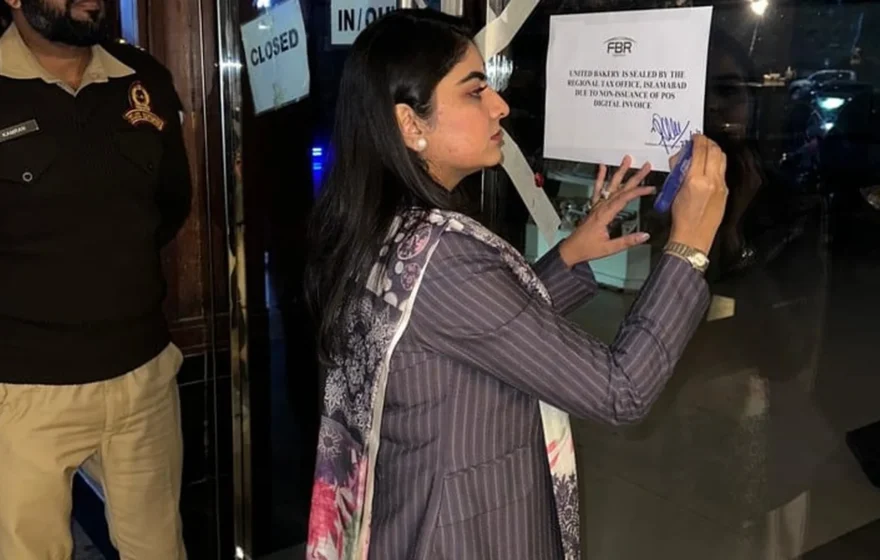
The Federal Board of Revenue has sealed United Bakery in Islamabad, one of the oldest and most loved bakeries in the federal capital, after finding that the outlet was not issuing Point of Sale digital invoices to its customers. The action was taken on Monday, November 24, 2026, when a notice was pasted on the bakery’s glass door and regulars arriving to buy bread, cake or patties found a CLOSED sign instead.
The notice, signed by an Assistant Commissioner, stated that United Bakery had been sealed by the Regional Tax Office in Islamabad because it had failed to issue POS digital invoices. A tax official was photographed signing the notice on the door while a uniformed colleague stood nearby. Within hours, pictures of the sealed outlet were being shared widely on social media.
Karachi Outlet Also Sealed
The action was not limited to the capital. According to posts shared on X, the Commissioner Inland Revenue for Zone-IV at the Regional Tax Office-I in Karachi ordered enforcement action against the bakery’s outlet in Saddar the same day, and that branch was sealed as well. The two closures, carried out hundreds of kilometres apart on the same day, point to a coordinated enforcement drive rather than a single local inspection, and a clear message to a business with outlets in three cities.
A Bakery Dating Back to 1948
United Bakery is far more than an ordinary shop, which is why the news travelled so fast. Its signboard says the business was established in 1948. It was founded by Kamaluddin, who migrated to Pakistan at Partition and later wrote about his journey in his autobiography. From those beginnings the bakery grew into a familiar name with outlets in Karachi, Islamabad and Rawalpindi. Its first outlet in Islamabad opened in the Super Market area of F-6 in 1976, and over the decades it built a near-cult following, known for oven-fresh seasonal fruit cakes, its rich plum cake, lemon and walnut tarts, and chicken patties.
For generations of Islamabad families, United Bakery has been part of the city’s daily rhythm: birthday cakes ordered a day ahead, patties picked up on the way home, and fruit cake at Eid and Christmas. That long history is what made Monday’s sealing so striking. The bakery is not a fly-by-night trader that can vanish and reopen under another name; it is a landmark business, and its closure shows the tax department’s enforcement net now reaches even the most established names in the city.
Why POS Invoices Matter
Under the tax rules, large retailers classed as Tier-1, a category covering chain stores, shops in air-conditioned malls, businesses with large electricity bills and those with annual turnover above Rs200 million, must connect their billing systems directly to the Federal Board of Revenue’s computerised system. Every sale has to produce a digital invoice carrying an FBR invoice number and a QR code, which a customer can check on the FBR’s Tax Asaan app. The idea is simple: when every sale is recorded and reported in real time, it becomes far harder for a business to understate its sales and pay less tax than it owes.
The FBR laid down the procedure for sealing retailers that break these rules in SRO 252 of 2022, and tightened it further in 2025, when it told around 40,000 outlets belonging to some 11,000 Tier-1 brands that their sales data had to reach the tax department within 24 hours. Under the updated rules, a shop can be sealed for issuing unverified invoices, for staying disconnected from the FBR database for 48 hours, or for failing to enter offline sales into the system within a day. The penalties are steep: fines, a 60 per cent cut in the input tax a business can claim back, and sealing of the premises until the matter is settled.
This is not the first time the tax department has used these powers. In January 2023, the FBR sealed three outlets for failing to install the point-of-sale system. Customers also have a part to play: anyone handed a receipt without a proper FBR invoice number or QR code can verify it on the Tax Asaan app and report the outlet to the tax department, which runs a reward scheme for such reports.
What happens next for United Bakery will follow the usual path. The business will need to settle the penalty, bring its billing system into line with the FBR’s point-of-sale requirements, and satisfy the tax office before the seal is removed, a process the rules say should be completed within a day of payment. For other retailers, the lesson is clear: the tax department is no longer limiting enforcement to small or unknown traders, and it is willing to close the doors of a household name. For customers, the takeaway is simpler still: the next time a shop hands over a receipt, it is worth a glance to check that the FBR invoice number and QR code are actually there.
