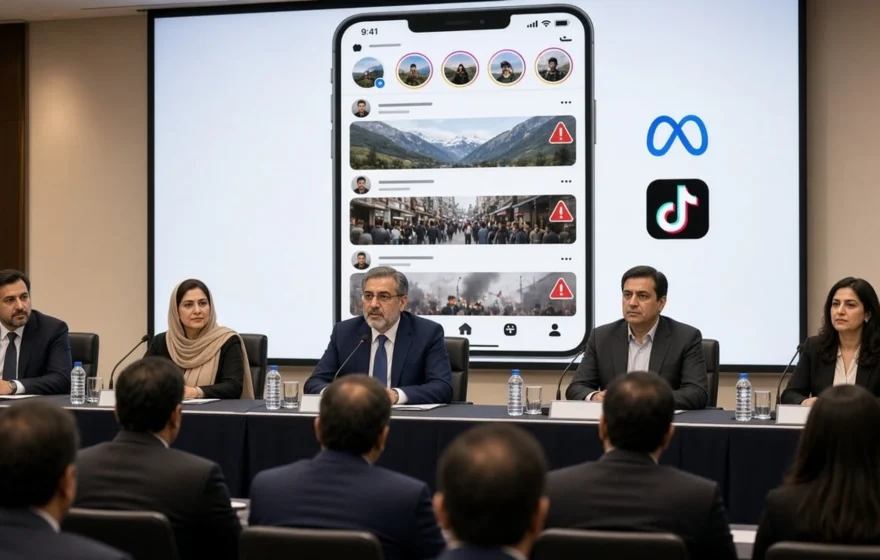
Federal ministers have told the world’s biggest social media companies that they cannot wash their hands of the fake news and harmful content spreading on their platforms in Pakistan. The message was delivered at an international seminar in Islamabad on Tuesday, where ministers, journalists, international experts and representatives of Meta and TikTok discussed disinformation, platform accountability and how global companies should follow local laws.
The seminar, titled Social Media Platforms and the Post-Truth Era, was organised by the Sustainable Development Policy Institute, known as SDPI. With nearly 100 million social media users and around 160 million smartphone users in Pakistan, according to Federal Minister for Information Attaullah Tarar, a single false claim can now reach millions of people before anyone has had a chance to check it.
Fake News Is Like a Bullet
In his keynote address, Federal Minister for Law and Justice Azam Nazeer Tarar said fake news now spreads within seconds and its damage cannot be undone once it is out in the open. He compared a false story to a bullet, saying that once it is fired it cannot be recalled. He spoke from personal experience, recalling how a publisher once mistakenly reported his declared assets as Rs 32 billion instead of Rs 320 million, forcing him to issue a clarification.
Tarar stressed that freedom of expression must be balanced with the protection of citizens’ privacy, honour, reputation and dignity, a balance he said the Constitution itself demands. Articles 4, 9 and 14 guarantee the protection of life, liberty, honour, reputation and dignity, while Articles 19 and 19-A make the rights of expression and information subject to reasonable legal restrictions. He said Pakistan had revamped its regulatory framework after 18 months of consultations with journalists, experts and tech companies, including Meta and the Asia Internet Coalition.
That reform took its most concrete form in the PECA Amendment Act 2025, passed by Parliament in January 2025. The amendment added a new section, 26A, which makes deliberately spreading false information online punishable by up to three years in prison, a fine of up to Rs 2 million, or both. It also created the Social Media Protection and Regulatory Authority and a new National Cyber Crime Investigation Agency. The law remains controversial and has been challenged in the Lahore High Court.
Tarar’s message to the platforms was blunt: they cannot absolve themselves of responsibility. He said international law recognised the primacy of domestic legislation, and he urged the companies to remove content immediately when it is clearly false or scandalous. SDPI Executive Director Dr Abid Qaiyum Suleri made the same point, noting that while social media has democratised access to information, terrorist groups are also using these platforms to spread propaganda and recruit supporters.
Bans Should Be the Last Resort
Not everyone at the seminar wanted a heavier hand. Federal Minister for IT and Telecom Shaza Fatima Khawaja called for better coordination with platforms through specialised bodies such as the Pakistan Telecommunication Authority and the National Cyber Crime Investigation Agency. She said banning or shutting down digital platforms should remain a last resort, pointing out that Pakistan’s tech exports have crossed 4.6 billion dollars and the country cannot afford to restrict innovation.
Sindh Senior Minister Sharjeel Inam Memon took a similar line, urging platforms to use artificial intelligence tools to filter terrorism-related and violent content before it is published. He too spoke from personal experience, telling the seminar that he had approached the National Cyber Crime Investigation Agency after false videos were circulated about him in connection with a murder case in Karachi. National security expert Laurie A. Watkins added that major platforms operating in Pakistan should appoint local representatives able to respond to complaints and lawful requests, and provide complaint mechanisms in local languages.
What Meta and TikTok Said
The companies were given their chance to answer. Dania Mukhtar, Head of Public Policy at Meta Pakistan, said government requests are first reviewed against Meta’s own policies and then go through legal and human rights assessments before any content is restricted in the country. It was a careful answer, and it underlined the gap between the two sides: for the ministers, the law of the land comes first, while for the companies, their global policies come first.
Fahad Muhammad Khan Niazi, who leads public policy for emerging markets at ByteDance, the owner of TikTok, offered numbers instead. He said the platform had removed 33 million pieces of content in Pakistan during the second quarter of 2026, which was 1.1 per cent of all content uploaded during the period, and he added that TikTok has signed a memorandum of understanding with the PTA. The figure is large, but it also shows the scale of the problem: no moderation system can catch everything.
The seminar ended with a promise rather than a decision. Dr Suleri said SDPI would consolidate the day’s deliberations and develop practical policy recommendations. The real test will come the next time a false video goes viral or a rumour puts someone’s safety at risk, and the question will be whether the platforms act quickly enough.
