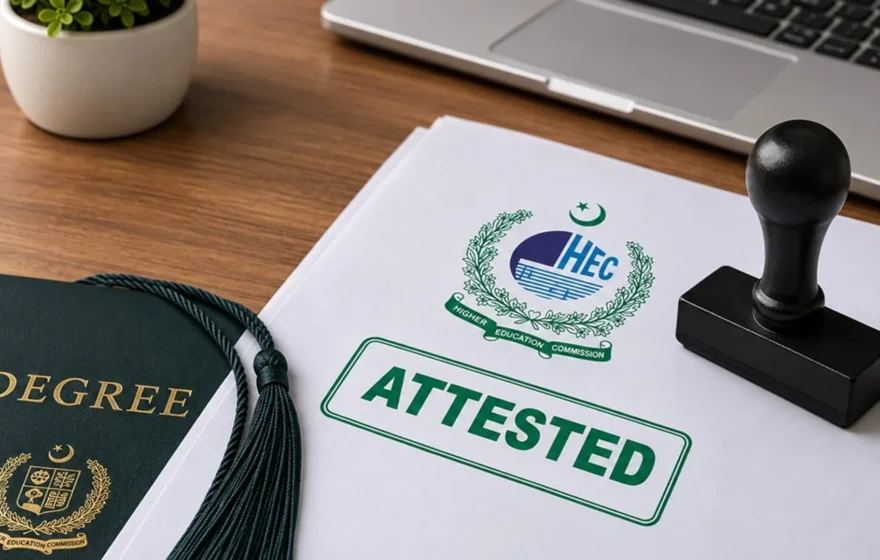
The Higher Education Commission is preparing to fold the Ministry of Foreign Affairs attestation step into its own online degree attestation system, a change that could spare graduates one of the most drawn-out parts of getting their qualifications recognised abroad. Under the plan, students applying through the HEC portal will be able to say at the outset whether they also need their documents attested by the foreign ministry, instead of treating the two steps as entirely separate chores.
The Commission has decided to build the MOFA option directly into its online portal, so that a single application can cover both stages. At present, a graduate who needs a degree verified for use overseas must first complete the HEC process and then begin a fresh round of paperwork with the foreign ministry. Bringing the two together is meant to cut the repeated form-filling, the extra visits and the waiting that students have long complained about.
The move is part of a wider effort inside the HEC to move student services online. The Commission has spent the past year rebuilding attestation around a digital portal, and officials describe the MOFA option as the next step in that programme. The aim is a service that is more accessible and more efficient, where students can follow their case without standing in queues or chasing paper files. The facility is expected to help thousands of students who apply for degree attestation every year, many of them preparing to leave Pakistan for jobs or further study.
For those graduates, attestation is not a formality. A Pakistani degree carries little weight with a foreign employer or university until it has been verified by the issuing country’s own bodies. The first link is the HEC itself, which confirms that the degree is genuine and was issued by a recognised university. Only then can the foreign ministry add its own attestation, and for many Gulf countries a further stamp from the destination country’s embassy follows. Each link has traditionally meant a separate application, a separate fee and a separate wait, so any step that joins two of them together is welcome news.
The HEC side of the process has already changed a great deal this year. In May 2026, the Commission launched a fully online and paperless degree attestation system, built on blockchain technology, which removed the need for graduates to visit HEC offices or hand over physical originals. That system is the foundation for the MOFA option. Applicants register on the HEC e-services portal, upload scans of their degree, transcript and identity card, and pay online. The Commission then sends the credentials to the degree-issuing university for electronic verification, which takes most of the processing time, before its own final review. When everything checks out, the applicant is notified by text and email and can download an e-attestation certificate. The fee is Rs. 3,000 per document, and the process generally takes ten to fifteen working days.
The foreign ministry’s step has also begun moving online. MOFA launched its own online attestation service in October 2026, operating from Islamabad and offices in Lahore, Karachi, Peshawar, Quetta and Gujrat. Applicants apply through the ministry’s portal and receive an electronic certificate by email, although some documents can still require a visit for physical checks. Even so, the two systems have remained separate, with the student acting as the link between them. That is the gap the HEC now intends to close by letting applicants flag their MOFA requirement while they are still inside the HEC portal.
The benefit will be felt most keenly by graduates heading abroad for work, above all to the Gulf states, where employers routinely ask for degrees attested by both the HEC and the foreign ministry before a visa or a job offer can proceed. Students from smaller cities, who once had to travel to Islamabad or a provincial capital for each stage, stand to gain the most from a single online application. It should also help those applying to universities overseas, where admission often depends on attested documents arriving before a deadline. For families that have already paid for tests and tickets, a shorter process can mean the difference between catching a semester and losing a year.
What remains to be seen is how quickly the combined option will be available and exactly how it will work. The announcement gave no launch date, and it did not say whether applicants will pay a single combined fee or two separate charges, or whether the MOFA step will be handled automatically once the HEC stage is complete. Until the new feature goes live, graduates must continue with the existing two-step route, applying to the HEC first and then to the foreign ministry.
Even with those questions unanswered, the direction of travel is clear. Pakistan’s degree attestation system, once notorious for long queues and repeated visits, is steadily becoming a digital service that students can use from home. If the HEC delivers on this promise, a graduate may soon submit one application and receive a degree ready for use anywhere, without ever leaving their own city.
