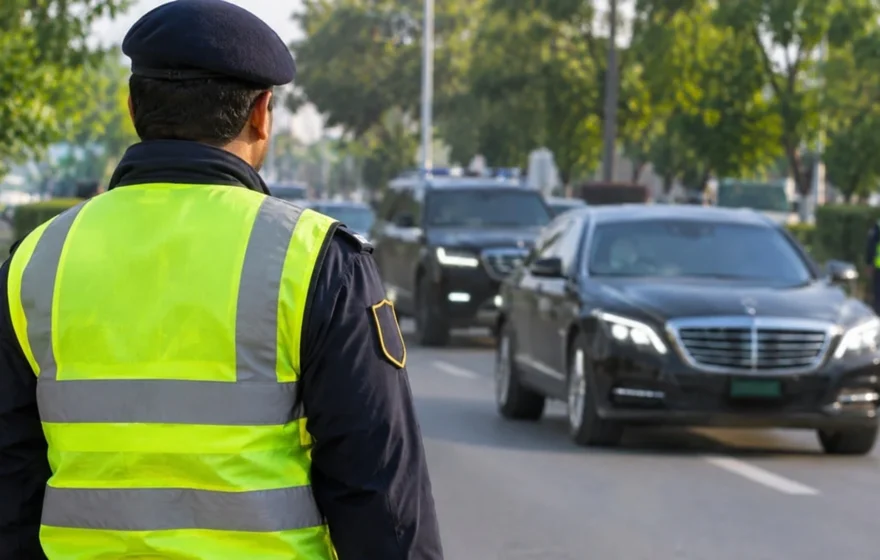
Rawalpindi Police have made high-visibility reflective vests compulsory for officers deployed on VIP and VVIP route security duties, in a move aimed at keeping personnel safe on the road and making them easy to recognise at a glance. The new instruction applies to every officer posted along the routes used by senior officials and visiting dignitaries.
The order was issued by the Superintendent of Police (Security), who has written to the superintendents of police of the Rawal, Potohar and Sadar divisions, as well as the SP Headquarters, directing them to pass the instructions to every officer and station house officer under their command and to make sure they are followed. During VIP and VVIP movements, officers must wear jackets of the prescribed police design, and those assigned to route security must wear a reflective vest over the jacket.
The reason for the change is a practical one. During the winter months, police personnel on route duty had taken to wearing jackets and caps of different colours and designs to keep warm, and the result was a patchwork of clothing that made it difficult to tell a police officer from an ordinary passer-by. In a city where VIP convoys move frequently and route security depends on every officer being instantly identifiable, that confusion was more than a matter of appearance. It slowed down recognition on the ground and, at night or in poor light, left officers standing in live traffic without anything to mark them out to drivers.
The reflective vest is designed to solve both problems at once. Made from fluorescent material with strips that bounce headlights back towards the driver, it makes the wearer visible from a considerable distance, even after dark or in fog and low light. For officers standing on the road while a convoy passes, that extra visibility is the difference between being seen in good time and being noticed too late. The police say the measure is intended to reduce the risks officers face on security duty, particularly at night.
Rawalpindi is a city where such duties are far from rare. As the twin city of Islamabad and home to the Nur Khan airbase, it sits on the route of almost every senior official and foreign delegation travelling between the airport and the capital. When the second round of talks between the United States and Iran was held in Islamabad earlier this year, more than 10,000 Rawalpindi police personnel were deployed on security duty. Route security is a long line of officers posted along miles of road, each one needing to be recognised instantly, and when every officer is dressed differently, that recognition depends on guesswork.
The idea of making officers more visible is not confined to Pakistan. In many countries, police and emergency workers must by law wear high-visibility clothing when they work on or near a road, under standards such as the American ANSI/ISEA 107. The danger is real: in the United States, being struck by a vehicle remains the second leading cause of traffic-related deaths among police officers, according to the National Law Enforcement Officers Memorial Fund, and at least 531 American officers died while working near a roadway in the decade to 2018. Those figures come from a different country, but the hazard is the same one Rawalpindi’s officers face every night on Murree Road and the Grand Trunk Road.
The timing of the order is also significant. Winter is now setting in across Punjab, bringing the season of dense fog and smog that regularly cuts visibility on the province’s roads to a few metres. It was in winter, when officers reached for whatever warm clothing they had, that the problem of mismatched dress first became obvious, and it is in winter that a reflective vest is of most use. The police have in recent weeks been tightening up other aspects of their readiness as well, inspecting official vehicles and keeping unfit units off the road until they are repaired. The vest order fits the same pattern, a small and inexpensive step taken before the worst of the season arrives rather than after an accident forces the issue.
Whether the order works will depend on enforcement. The instruction must reach every station house officer and every constable posted on a route, which is where such orders are most often lost. Officers will need to be issued with vests of a standard design, and supervisors will need to check that they are actually being worn. The test will come on the next VIP movement, when it will be plain to see whether officers are dressed alike and visible from a distance, or whether the old patchwork has returned. For the officers themselves, the vest is modest protection against one of the most ordinary dangers of police work. If the order is enforced as written, Rawalpindi’s routes will look more orderly, its officers will be safer after dark, and the next convoy through the city will be guarded by men and women who can be seen clearly, from a long way off, by everyone who needs to see them.
