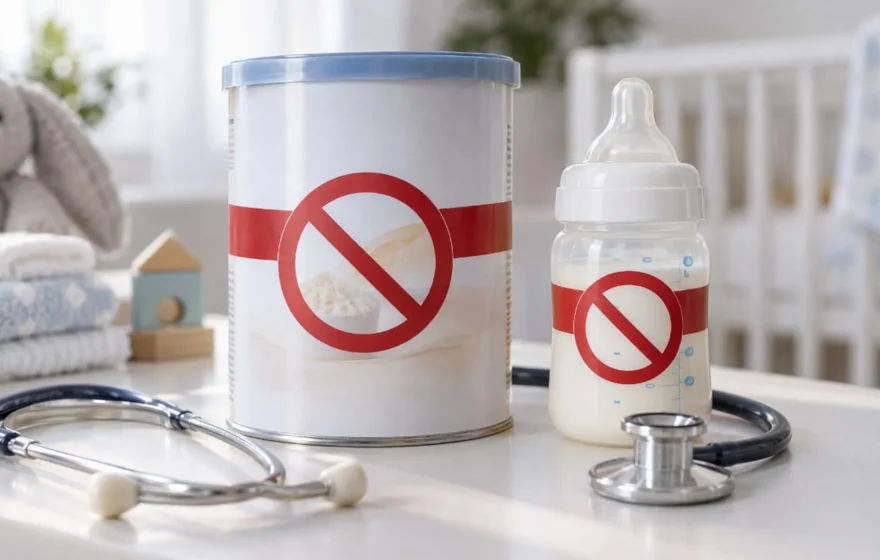
The Senate Standing Committee on Health has ordered a ban on advertisements for formula milk from November 24, with action promised against violators. The decision puts one of the country’s most heavily advertised products under fresh scrutiny and revives a law that has been on the books for almost a quarter of a century.
The committee’s chairman, Senator Aamir Waliuddin Chishti, directed the Pakistan Electronic Media Regulatory Authority, known as PEMRA, to stop the advertisements and report back. The message was blunt: the law already exists, the advertisements breach it, and the time for delay is over.
PEMRA moved swiftly, barring television and radio stations from airing infant formula advertisements. The decision put a lucrative market under renewed scrutiny in a country of more than 241 million people, where formula imports were worth around 60 million dollars in 2024 and domestic sales stood at 124 billion rupees.
Formula Milk as a Drug, Not Food
At the heart of the decision is a question of classification. The committee directed that formula milk be brought under the Drug Regulatory Authority of Pakistan, known as DRAP, rather than treated as an ordinary food item, and that boxes should carry the label “Infant Formula” instead of simply “milk”.
Chishti made the stance explicit: formula milk is not an ordinary food item, so it should be regulated under DRAP rather than a food authority, and companies should be bound to write “Infant Formula” on their packaging. A drug faces far stricter rules on advertising, labelling and sale than a food product.
The legal basis is the Protection of Breast-Feeding and Child Nutrition Ordinance of 2002, which prohibits the marketing of breast-milk substitutes. Section 7 bars advertisements, promotional activities, free samples and direct marketing of designated infant products. The committee pointed out that the law has been in force for 24 years, and asked why advertisements were still being shown when PEMRA needed no fresh instructions to enforce it.
The health argument is stark. Dr Jamal Raza, director of the National Institute of Child Health, told the committee that children fed on formula are 15 times more likely to die from infections such as pneumonia and diarrhoea, and that inadequate breastfeeding contributes to around 33,700 child deaths every year in Pakistan.
PEMRA’s Position
PEMRA’s chairperson, Ambreen Jan, told the committee the matter was sub judice, meaning it is before a court, and that no representative of the Health Ministry had appeared at the last hearing. She added that PEMRA would implement Parliament’s directives, and noted that the advertisement aired had been sent by the Health Ministry itself.
Four importers challenged DRAP’s jurisdiction over infant formula in the Sindh High Court in March 2024, and earlier this month a multinational manufacturer obtained a stay from the Islamabad High Court against an earlier directive requiring formula advertisements to carry the warning “Mother’s milk is the best for a child.” PEMRA officials said they had asked DRAP to take part in the court proceedings to defend the policy and the law.
The senators rejected the argument that the court cases blocked enforcement, noting that the stay applied to two regulatory letters, not to the 2002 ordinance itself, and that a notification could not override an Act of Parliament. The committee also sought the notification that reportedly moved jurisdiction over formula milk from DRAP to another division.
Chishti said the issue was linked to vested business interests and pressure on various institutions, but he stressed that he was answerable to the public and would not bow to any pressure. Federal Health Minister Syed Mustafa Kamal and the committee members backed stronger restrictions, while questioning the roles of DRAP, PEMRA and the Health Ministry in enforcing the law.
A Law That Has Existed for 24 Years
Senator Shahzaib Durrani said the legislation had existed for 24 years and should be enforced without further delay. The committee expressed serious concern at the failure of the authorities to enforce the legislation covering formula milk for infants and children up to 36 months old. The committee has demanded written clarification on who regulates the product, and a National Infant Feeding Board under the existing legislation.
What Happens Next
The committee has given the Health Ministry 15 days to prepare a nationwide breastfeeding awareness campaign for major television channels, using the available five per cent free airtime. PEMRA assured the committee that prohibited advertisements would not air, and the regulator has said all infant formula advertising is prohibited with immediate effect until the required legal approval is obtained.
The committee will also summon representatives of the Pakistan Medical and Dental Council to its next meeting, and invite provincial healthcare commissions and the Islamabad Healthcare Regulatory Authority to a future meeting about medicine availability and pricing.
Whether the ban holds will depend on the courts, the regulators and the companies. The stay orders cover only part of the dispute, and the committee regards the 2002 ordinance as fully in force. If PEMRA enforces the ban and the Health Ministry delivers the awareness campaign, the coming weeks could mark a genuine shift in how infant formula is sold and advertised. If enforcement falters, as it has before, the same law will still be waiting to be applied.
