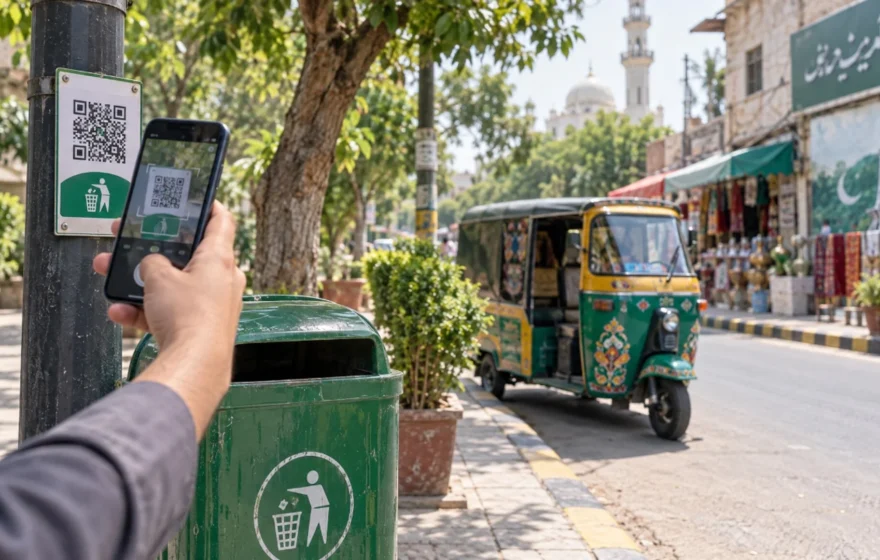
Punjab is taking its province-wide cleanliness drive online. Residents will soon be able to scan a QR code in their street or neighbourhood to find out which sanitation workers are assigned to their area and to lodge a complaint about uncollected rubbish or a dirty street on the spot, without visiting a government office or waiting on a helpline.
The decision was taken at a special meeting chaired by Chief Minister Maryam Nawaz Sharif, who reviewed the performance of the Suthra Punjab programme and ordered officials to make the system faster, more visible and easier for ordinary people to use. The meeting also reviewed the availability of sanitation workers and machinery in 15 districts, including Dera Ghazi Khan, Rajanpur, Layyah, Muzaffargarh, Kot Addu, Gujranwala, Sialkot, Narowal, Gujrat, Mandi Bahauddin, Hafizabad, Multan, Vehari, Lodhran and Khanewal, along with Faisalabad, Jhang, Chiniot and Toba Tek Singh.
How the QR Code System Will Work
Under the new system, QR codes will be displayed at various locations across the province. A citizen who scans one will be able to see details of the sanitation workers deployed in that area and submit a complaint about cleanliness there and then. Public feedback will be collected through the same system, so officials will have a running record of which areas are being reported and how quickly each complaint is dealt with.
The move builds on a programme that already leans heavily on technology. Suthra Punjab, launched in 2024 under Maryam Nawaz, covers all 36 districts and 141 tehsils, serves more than 138 million people, collects over 50,000 tons of waste a day with a workforce of more than 140,000, and tracks its fleet and field operations through mobile monitoring and official portals. The QR codes put that digital oversight directly in residents’ hands rather than leaving it to supervisors and dashboards.
Before the programme began, organised waste collection existed in only two or three major cities of Punjab, while smaller towns and villages were largely left to fend for themselves. The new system replaced that patchwork with a single province-wide operation built around door-to-door collection, the desilting of drains and sewerage lines, and the clearing of open plots and dumps. A dedicated helpline, 1139, was set up alongside it, and more than 339,000 complaints have been registered through it so far, with action taken immediately on over 300,000 of them and the rest resolved within a week.
Complaints to Be Resolved Within Hours
The chief minister told officials at the meeting that sanitation complaints must now be resolved within hours, and that waste bins must be installed at designated locations so that rubbish has somewhere proper to go in the first place. She ordered cleanliness operations in villages at least twice a week, faster door-to-door waste collection, and an anti-littering squad that is visible in every district.
Repeat offenders who dump waste in streets and drains will face fines, she directed, while waste bins and drums are to be placed in commercial markets and around roadside vending areas, where litter tends to pile up fastest. She stressed that urban and rural areas must receive equal attention under the drive, a point the programme has made central to its identity since it began, and one by which the government itself invites the drive to be judged.
The Numbers Behind the Programme
A briefing at the meeting set out the scale of what has been done so far. More than 93,000 sanitation beats have been established across Punjab, and over 51,000 vacant plots have been identified, with waste cleared from around 30,000 of them. A total of 8,376 drains have been cleaned, covering a combined length of 7,843 kilometres. The meeting was also told that the target for paying the salaries of all Suthra Punjab workers has been achieved, a detail that matters because regular pay is one of the things that keeps a workforce of this size turning up for work.
The programme’s backers describe it as one of the largest integrated waste management systems in the world, and it has drawn attention well beyond Punjab, including recognition from Forbes. More than 120,000 jobs have been created under it, and over 9.5 million tons of waste have been disposed of since it began. Collection is run by private operators under four-year concessions, with the government keeping ownership and oversight, and a 50-megawatt waste-to-energy plant backed by 175 million dollars in foreign investment is part of the longer-term plan to turn collected waste into electricity.
Whether the system lives up to its promise will depend on what happens after a complaint is scanned in. A code on a wall is only useful if the complaint behind it is answered, and the instruction that complaints be resolved within hours sets a clear test. If it works in villages as well as in Lahore, residents will have a direct line into a service that touches their street every day. If complaints pile up unanswered, the codes will quickly become decoration.
