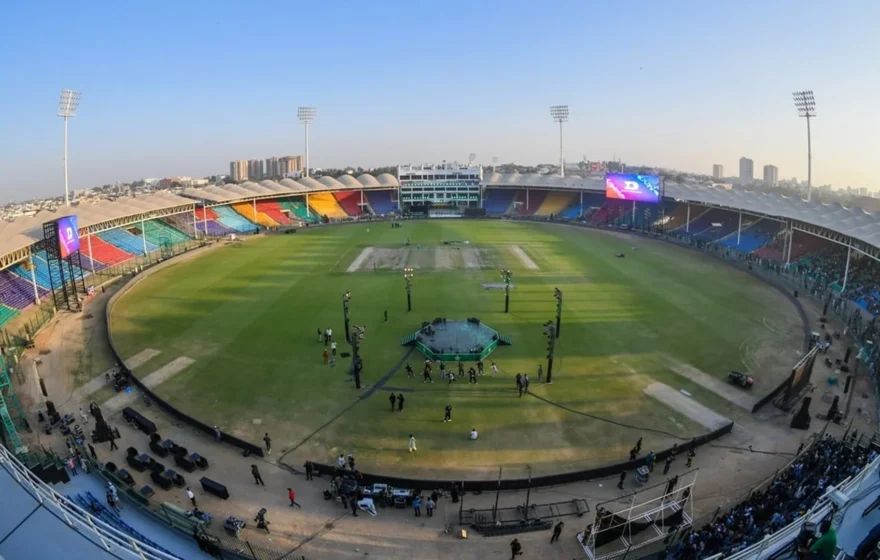
Karachi’s National Bank Stadium is in line for another major rebuild, with the Pakistan Cricket Board putting Rs. 5.062 billion towards a second phase of renovation work that will tear down the ground’s ageing stands and finally remove the railings that have spoiled the view for spectators for years.
The plan, set out in the board’s annual budget, centres on giving fans a clearer look at the action. The steel railings that currently separate the crowd from the field will come out and be replaced by a dug-out moat and protective netting, a design used at modern grounds around the world that keeps spectators off the playing area without putting bars across their line of sight. Every enclosure in the ground will then be demolished and rebuilt to a modern design, with better seating and facilities for the people who turn up to watch.
It is a recognition, in bricks and concrete, of a problem Karachi cricket has lived with for a long time. The National Bank Stadium has struggled to draw large crowds even for international matches and Pakistan Super League fixtures, and supporters have complained for years that poor seating and restricted views made the trip to the ground a frustrating experience. The board is betting that a more comfortable ground, where every seat offers a proper view, will bring the crowds back.
The money is part of a wider spending programme. The PCB has allocated Rs. 6.702 billion for capital expenditure in its annual budget, of which Rs. 5.686 billion is earmarked for infrastructure projects. The stadium work accounts for the largest share of that figure at Rs. 5.062 billion, while Rs. 624 million will go towards upgrading the National Cricket Academy in Lahore.
The ground has already been through one round of rebuilding. The first phase of the renovation was finished in time for the ICC Champions Trophy in early 2025, and it changed the face of a stadium that had not seen a major overhaul since the 1996 World Cup. A new five-storey pavilion went up, with 24 hospitality boxes, upgraded dressing rooms, LED floodlights and digital screens, and more than 5,000 new seats were fitted around the ground. The work was completed in about four months, the stadium was formally reopened on February 11, 2025, and eight days later it hosted the opening match of the Champions Trophy between Pakistan and New Zealand.
That tournament was a homecoming for the ground. The stadium, which opened in April 1955 with a first-class match between Pakistan and India, has been part of Pakistan cricket from the very beginning, and for decades it carried a reputation as a fortress where the home side rarely lost. Viv Richards’ 181 against Sri Lanka at the 1987 World Cup is among the famous innings played there. In October 2022 the ground took its current name under a five-year naming-rights agreement with the National Bank of Pakistan, and it remains the home ground of the Karachi Kings in the PSL. Its capacity now stands at around 30,000.
Yet the first phase left the most persistent complaint untouched. The railings and the old stands stayed, and so did the sense among many Karachi fans that watching cricket at the ground meant watching it through a fence. The second phase is meant to finish the job, and the board hopes to have it done before the twelfth season of the PSL next year, although no official completion date has been announced. Work on the stadium’s roof will follow at a later stage.
The Karachi project is part of a broader renewal of Pakistan’s cricket grounds. Lahore’s Gaddafi Stadium was also rebuilt for the Champions Trophy, with new stands, floodlights and screens lifting its capacity to around 34,000, and the PCB has made modernising its venues a central part of its planning. The thinking is straightforward enough: international cricket has returned to Pakistan on a regular basis, the PSL is the board’s biggest commercial product, and grounds that look and feel modern are part of keeping both healthy.
For Karachi, the stakes go beyond one ground. The city has produced generations of Pakistan cricketers, but its main stadium has too often looked half empty on television, a poor advertisement for a city that loves the game. If rebuilt stands and open views can fill the seats again, the investment will have done more than smarten up a venue; it will have restored the link between Karachi’s crowds and its team. The test, as ever with such promises, will be whether the work is finished on time and whether the fans who have stayed away decide it is worth coming back.
