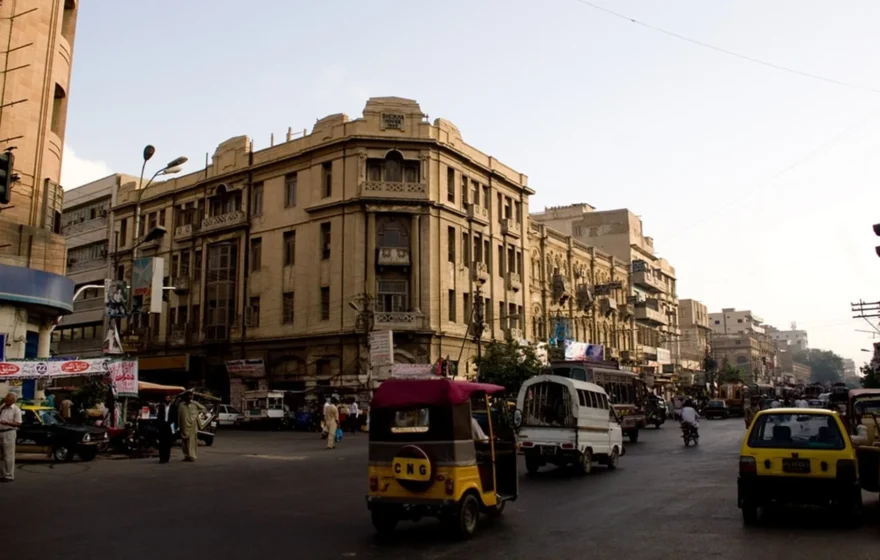
Karachi’s historic Bolton Market has been given some breathing space after municipal teams cleared illegal stalls, pushcarts and merchandise from its footpaths and roads, reopening congested passageways in an anti-encroachment drive that shoppers have welcomed but say must be sustained if it is to make a lasting difference.
The Saddar Town Municipal Corporation carried out the operation after growing complaints that unauthorised stalls and goods displayed outside shops had narrowed the walkways, disrupted traffic and made shopping increasingly difficult. The issue had also been highlighted in a report by Express News. During the drive, municipal teams removed the encroachments and loaded confiscated items onto official vehicles, reclaiming public spaces that had been taken over piece by piece over the years.
The corporation’s assistant director, Zafar Noor, said the operation at Bolton Market had been under way for the past three months. He urged shopkeepers to keep their merchandise inside their premises instead of spilling out onto footpaths and roads, a habit that has choked the market’s narrow lanes for as long as most traders can remember.
Shoppers welcomed the action, saying the encroachments had made it difficult to move through the market at all. But they also sounded a note of caution, calling for regular enforcement to stop the problem from returning. That is the familiar pattern with such drives in Karachi: a burst of activity, a few days of clear passageways, and then a slow creep back to the way things were.
Some residents also raised concerns about the way the operation was carried out, arguing that damaging vendors’ equipment and confiscating their goods could hurt the livelihoods of people who depend on daily earnings. They urged the administration to balance the removal of encroachments with protecting the small traders who work in and around the market, a tension that runs through every anti-encroachment drive in the city.
The market at the centre of the operation is one of the oldest in Karachi. Bolton Market, also spelled Boulton Market, was built in 1883, when Karachi was part of British India, as a fruit and vegetable market. It was named after Colonel C. F. Boulton, who was the city’s municipal commissioner at the time. Within three years it had been expanded to make room for meat and fish stalls, and it grew from there into one of the city’s great wholesale markets, a dense maze of lanes and specialist trading zones along M. A. Jinnah Road near Kharadar, in the heart of Saddar.
More than 140 years later, it is still one of the busiest commercial districts in the city, drawing wholesale buyers from across Karachi and beyond. Its age is part of its charm and part of its problem. The market was laid out for a different century, and its narrow lanes were never designed for the volume of people, pushcarts and vehicles that now squeeze through them every day. When stalls spread onto the footpaths, there is simply nowhere left for pedestrians to walk.
The operation at Bolton Market is part of a wider campaign across the city. In October, Karachi’s mayor, Murtaza Wahab, gave the city’s departments a 15-day deadline to clear encroachments, but the drive struggled to get off the ground, with less than a tenth of the illegal structures and occupations reportedly removed in the first twelve days. Encroachments continue to plague many parts of the city, from Liaquatabad Super Market to the areas around Empress Market, Bohri Bazaar and Jama Cloth Market in Saddar itself.
Saddar’s troubles with encroachment go back much further. In 2018 the Supreme Court ordered the clearance of Empress Market and its adjoining areas, including the footpaths of Saddar, and the operation that followed demolished scores of stalls and illegal shops across the district. Yet the problem kept returning, because the demand for trading space in the city’s busiest commercial quarter never went away, and enforcement rarely lasted long enough to change habits for good.
That history is why the shoppers’ reaction to the latest drive matters as much as the drive itself. They are not asking for a single operation, however thorough, but for the kind of steady enforcement that keeps the passageways open week after week. Without it, the stalls and pushcarts will be back, and the market will return to the congestion that made the operation necessary in the first place.
The challenge for the Saddar Town Municipal Corporation is to hold the line without turning the market into a battleground. Bolton Market has survived for more than a century because it works as a place to trade, and the traders who spill onto the pavements are part of the same commercial life as the shopkeepers inside. Clearing the footpaths is the easy part. Keeping them clear, while finding room for the small vendors who depend on the market for their living, is the harder task, and it is the one on which this operation will ultimately be judged.
