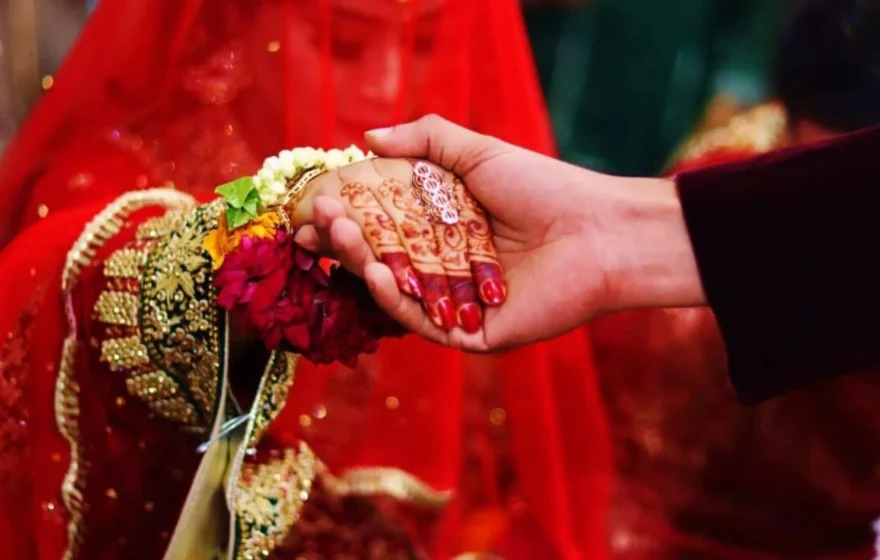
An Italian woman has travelled to Jhelum, a city in Punjab, to marry a Pakistani man she first met on social media, after an online friendship slowly grew into a relationship and then into a decision to spend their lives together. The story, reported in Pakistani media, has drawn attention because it began not with a meeting in person but with messages exchanged across thousands of kilometres, and because it ended, for now, at a government office in Jhelum rather than at a wedding hall.
The woman has been identified in media reports as Jasmine. The man she plans to marry is Haider, a resident of Jhelum. According to those reports, the two became friends through social media and stayed in touch as their conversations continued. Over time, the friendship deepened, and what had started as casual contact between two people in different countries became a serious relationship. The distance between Italy and Pakistan did not end the connection. Instead, the couple decided that Jasmine would travel to Pakistan so that they could marry.
JASMINE TRAVELS TO PAKISTAN FOR MARRIAGE
Jasmine later made the journey from Italy to Jhelum, where Haider lives. Her arrival marked the point at which a relationship conducted largely through screens became a real, shared life in the same place. Before the marriage, she also embraced Islam. That step came before the wedding itself, and it was part of the preparations the couple made as they moved towards marriage in Pakistan.
For a foreign national who converts before a Nikah in Pakistan, the conversion is normally recorded with documentation from a recognised religious authority, so that the religious and legal record of the marriage is complete. The details of Jasmine’s own conversion have not been made public, and neither has the question of what faith she followed before. What the reports do make clear is that the decision to embrace Islam was her own step on the way to the marriage, taken before the couple began the official process.
LEGAL FORMALITIES COMPLETED
The couple then turned to the formal side of the marriage. The necessary legal steps were completed at the Deputy Commissioner’s Office in Jhelum, the district office that handles official matters of this kind. With those formalities done, the couple is now expected to proceed with the marriage itself, having cleared the official process that Pakistani law requires.
That process matters more than it may appear. Under Section 5 of the Muslim Family Laws Ordinance of 1961, every Muslim marriage solemnised in Pakistan must be registered, and the Nikah Registrar who performs the ceremony is responsible for seeing that it is recorded with the relevant Union Council. The Nikah Nama, the written marriage contract signed at the ceremony, becomes the foundation of the official record. From it, the local authority issues a computerised Marriage Registration Certificate through the NADRA system, usually within a week or so, and that certificate is the document banks, immigration authorities and foreign missions accept as proof of the marriage.
For a foreign spouse, the paperwork also includes a valid passport and visa, and proof of marital status, so that the marriage can later be recognised outside Pakistan as well. Registration is what unlocks the practical steps that follow a wedding: a spousal visa, a change of marital status on official documents, and recognition of the marriage by the foreign spouse’s own country. A Nikah performed without that registration may be religiously valid, but it leaves a couple without the papers that institutions actually ask for.
Stories like this one surface in Pakistan with some regularity. Social media has made it far easier for people in different countries to meet, and cross-border friendships that turn into marriages are no longer unusual. Jhelum itself, a city on the river of the same name in northern Punjab, is the kind of place where such a story stands out, and the arrival of a visitor from Italy has naturally attracted local attention. Yet the pattern is familiar: two people meet online, the relationship survives the distance, and one of them eventually travels to close it.
What happens next for Jasmine and Haider will follow the ordinary course of a marriage in Pakistan. The Nikah ceremony, the registration of the Nikah Nama and the computerised marriage certificate will give the marriage its legal standing, and the couple will then face the longer questions that any cross-border marriage raises, from residence and visas to how two people from different countries build a shared life in one place. For now, though, the part of the story that mattered most has already happened: a friendship that began on social media brought Jasmine from Italy to Jhelum, and the formalities at the Deputy Commissioner’s Office have cleared the way for the wedding to go ahead.
