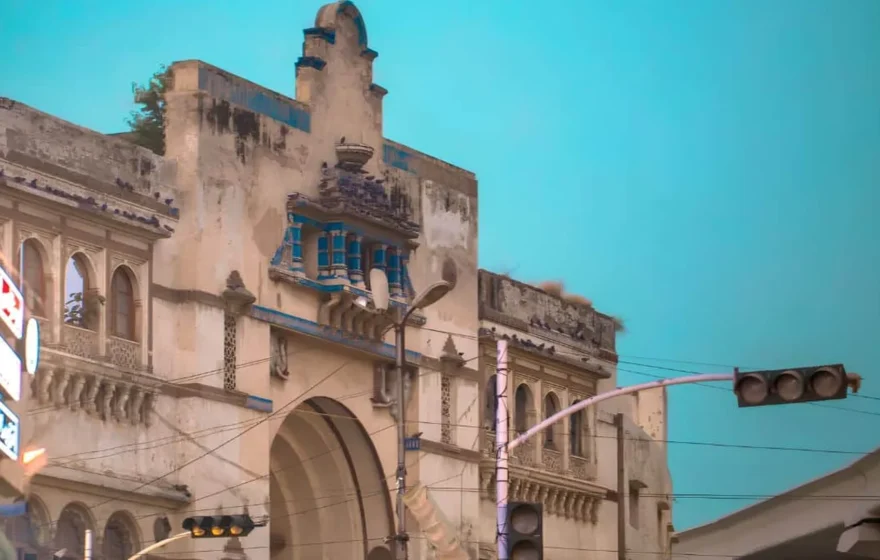
Lahore is preparing to give one of its most familiar old squares a new lease of life. The Punjab government has decided to launch a large restoration and beautification project at Lakshmi Chowk and the streets around it, aiming to bring back the area’s original architectural character and protect its heritage buildings and monuments. The decision was taken at a meeting at Town Hall on Saturday, chaired by the Chief Minister’s Adviser, Zeeshan Malik, and followed by a visit to the chowk itself.
Lakshmi Chowk sits at the heart of old Lahore, on McLeod Road where it meets Mall Road and Abbott Road. The square takes its name from the Lakshmi Building, a block built in the mid-1930s that was later declared a protected building under the Punjab Special Premises (Preservation) Ordinance of 1985. For decades the chowk was the city’s popular entertainment hub, but in recent years its historic facades have been altered and repainted, and conservationists have argued that much of their original charm has been lost. The new project is meant to reverse that decline.
Historic Buildings and Facades to Be Restored
The Town Hall meeting was attended by Lahore Deputy Commissioner retired Captain Muhammad Ali Ijaz, Lahore Development Authority Director General Tahir Farooq, Local Government Special Secretary Syed Moosa Raza, Lahore Metropolitan Corporation Chief Officer Kaleem Yousaf and other senior officials. After the meeting, the group visited Lakshmi Chowk to inspect the proposed work on the ground. Officials reviewed plans to restore historic buildings, monuments and archaeological structures in and around the chowk, and the government also plans to improve the facades of buildings on both sides of the road and to beautify the bridge of the Orange Line Metro Train, which passes through the area.
Original Architectural Character to Be Preserved
Zeeshan Malik directed the departments concerned to protect the original design and structural features of historic buildings while the restoration work is carried out. He stressed that the authorities must maintain consistent standards for facade improvements and beautification, so that the area does not end up with a patchwork of mismatched repairs. According to Malik, Chief Minister Maryam Nawaz directed the government to undertake the project to revive the area’s historic character and to protect Lahore’s cultural and architectural heritage. He said the government wants to restore Lakshmi Chowk’s old identity, and he added that beautifying the Orange Line bridge would also improve the overall appearance of the locality.
British-Era Construction Techniques to Be Used
Deputy Commissioner Muhammad Ali Ijaz said the authorities would ensure high-quality construction and finishing while improving roadside facades and restoring historic buildings. He said the government is providing resources for the conservation of heritage structures and that departments will coordinate to complete the project on time. Speaking to Dawn, Ijaz said the government would make every effort to use engineering and architectural techniques similar to those used during the British era. That matters because the buildings around the chowk were raised with the materials of their time, including lime plaster, brickwork and timber details that behave very differently from modern cement and concrete.
Modern and Traditional Designs to Be Combined
LDA Director General Tahir Farooq said preserving the original appearance of historic buildings and monuments remains essential. He said the facade improvement project would combine modern design elements with traditional architecture. Farooq added that restoring historic buildings could also help promote tourism in Lahore, a city that already draws visitors to the Badshahi Mosque, the Lahore Fort and the Walled City, and where a revived Lakshmi Chowk could become another stop on that route.
Public Entry Banned at Walled City Construction Sites
Separately, Lahore Commissioner Muhammad Jahanzaib Awan directed the authorities to impose a complete ban on public entry at ongoing construction and restoration sites in the Walled City. He said citizen safety must remain the top priority during development work. The commissioner issued the directive while visiting several development and conservation projects with Walled City of Lahore Authority Director General Najamus Saqib. He inspected work at Delhi Gate, Masala Bazaar, Dry Fruit Bazaar and areas outside Delhi Gate, where officials briefed him on infrastructure upgrades, conservation projects and urban improvement work being carried out by the authority.
Jharokhas, Sewerage and Heritage Sites Under Restoration
During the visit, the commissioner inspected the installation of traditional cultural jharokhas, the ornamental overhanging balconies that are a hallmark of the old city’s architecture, along with sewerage works, conservation activities and other construction projects. Earlier, a meeting chaired by the commissioner reviewed progress on several restoration and development schemes across the Walled City, including work at Anarkali, the Old Steam Pump House, the Old State Bank, Ewing Hall, Neela Gumbad Parking and Circular Road.
Taken together, the two announcements point to a government that is trying to treat heritage as a living part of the city rather than a museum piece. The test will be in the execution: the promises will only matter if the work is finished to a high standard and maintained afterwards.
