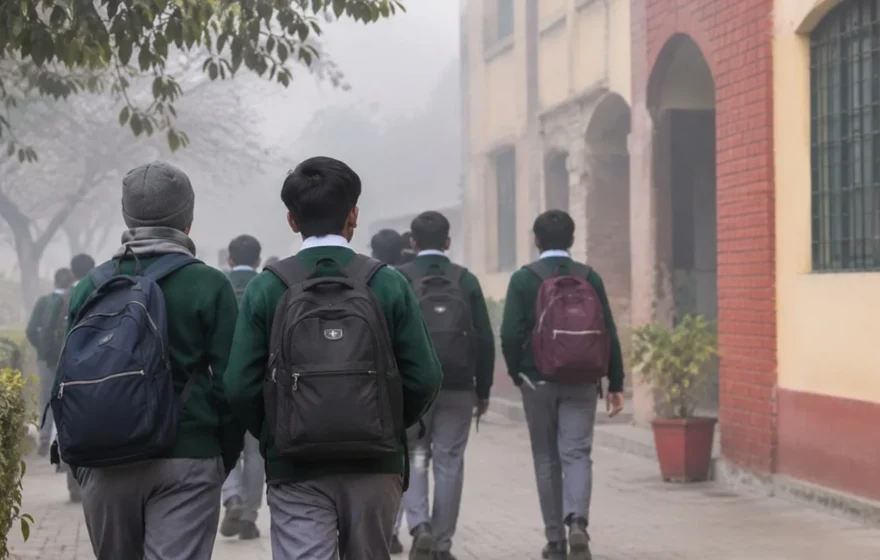
Every student in Lahore must now wear a face mask at school. The District Education Authority has made masks compulsory for pupils in all public and private schools, to shield children from the thick smog that has settled over the city once again. School administrations have been told to enforce the order strictly, and to make sure no child sits in class without a mask.
The instruction goes further than masks alone. Schools must follow the official smog prevention guidelines in full, and the authority’s chief executive has asked them to encourage children to drink plenty of water through the day. They must also hold awareness seminars, so pupils understand what smog is and how to protect themselves.
The order comes as Lahore’s air has turned dangerous. On the morning of 2 November, the city’s Air Quality Index stood at 535 at around eight o’clock, with PM2.5 at 343 micrograms per cubic metre, at the hour children travel to school. On 9 November the index reached 563. On 10 November the citywide average was 303, and on 11 November it climbed to 453, with some neighbourhoods above 690. Lahore has topped the world’s most polluted cities ranking several days this month.
Any reading above 300 is classed as hazardous. The World Health Organization advises that average PM2.5 over a year should stay below five micrograms per cubic metre, with daily levels below 15. On 10 November, Lahore’s fine particle pollution was 37.2 times the WHO annual guideline. PM2.5 particles are so small they pass deep into the lungs and the bloodstream, and heavy exposure is linked to coughing, eye irritation, asthma attacks and long-term lung damage.
Children face a sharper risk than adults. Their lungs are still developing, they breathe faster, and they take in more air relative to their body size. The morning journey adds to the risk, when cold air traps pollution close to the ground. The Punjab Environmental Protection Agency advises that once the index passes 150, children should stay indoors and anyone outside should wear a mask; above 200, a fitted N95 is advised; above 300, stay indoors.
A mask is only as good as its fit. Health guidance points to a well-fitting N95 or KN95 respirator as the best everyday protection, because it filters most PM2.5 when it seals properly. A loose cloth mask offers far less protection, and ordinary respirators are not designed for small children’s faces, so experts say young children should stay indoors on hazardous days rather than rely on a mask. Schools must check masks are worn properly, help children who arrive without one, and cut back outdoor assemblies and sports when the air is worst.
The smog is no accident. Farmers burn leftover rice straw after the harvest, and the smoke drifts across Punjab in October and November. Millions of vehicles pour out exhaust daily, while brick kilns, factories and construction sites add smoke and dust. Winter weather then traps it all: cold air near the ground sits beneath a warmer layer above, a temperature inversion that leaves pollution nowhere to rise to. The season runs from late October into January, with November and December the worst months.
Lahore has shut schools for smog before. In November 2023, the Lahore High Court ordered all Punjab schools and colleges to close for a day. The winter of 2024 was far worse: readings passed 1,000, schools in the main Punjab cities closed until 17 November, and about 900 patients were admitted to Lahore hospitals in a single day as PM2.5 peaked at 610. Last year schools closed from 3 November for a week, then for a second week. UNICEF warned in November 2024 that over 11 million children under five in the worst-affected districts were breathing toxic smog, and closures had disrupted the learning of almost 16 million children.
That cost is why the government is reluctant to close schools this time. Punjab Education Minister Rana Sikandar Hayat has ruled out additional holidays, saying no such decision is under consideration and schools will continue as normal. His office also dismissed social media messages claiming extra holidays or new timings, warning parents to rely on official announcements. Winter timings for government schools already changed under a 14 October notification running to 31 March 2027, with single-shift schools open from 8:45am to 1:30pm, and to 12:30pm on Fridays.
The mask order fits into wider preparations. Under the province’s Pre-Smog Action Plan for 2026, schools were told in August to limit outdoor activities, check the Air Quality Index first, require masks and keep doors and windows closed. Longer term, a 300 million dollar World Bank-backed clean air programme runs until June 2030 and aims to cut PM2.5 by 35 per cent over the next decade. It is a middle course between closing schools and doing nothing: children keep learning, with some protection. Whether it works depends on things the order cannot guarantee, above all that masks reach families who cannot easily afford them. If readings fall, it will look proportionate; if they climb towards 2024 levels, the question of closing schools will return.
