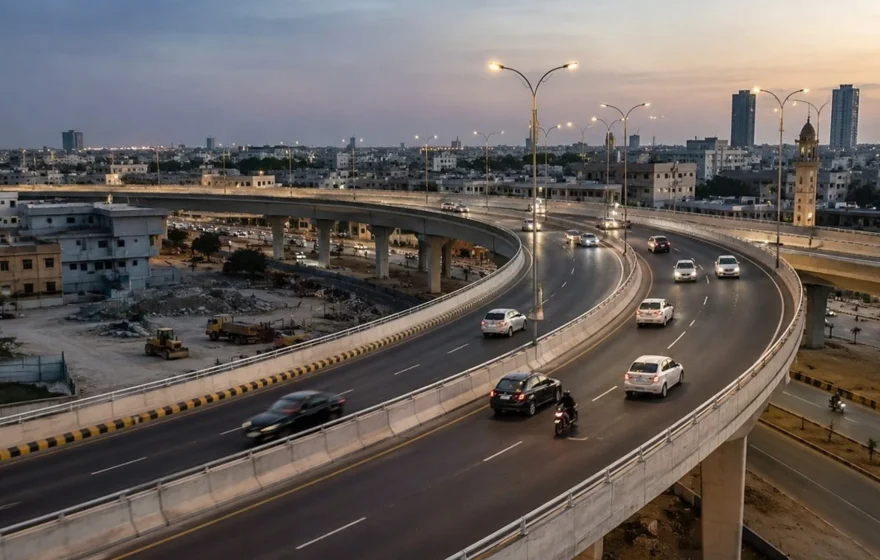
The federal government has approved the construction of an eight-lane flyover bridge at the Imamia Colony Railway Crossing on National Highway N-5 in Shahdara, Lahore, at an estimated cost of Rs7.492 billion. The project, cleared by the Central Development Working Party, also includes the construction and rehabilitation of connecting roads around the crossing.
The aim of the scheme is straightforward: to ease the traffic congestion that builds up in Shahdara Town where the highway meets the railway line. Railway crossings are among the worst bottlenecks in any busy city, because every passing train brings road traffic to a standstill and the queues that form take a long time to clear, long after the gates have reopened. Vehicles pile up in both directions, and a single crossing can throw an entire journey out of schedule. A flyover that carries the highway over the crossing removes that interruption altogether, allowing traffic to keep moving whether or not a train is passing below, and separating two very different kinds of traffic that were never meant to share the same patch of road at the same moment.
That separation is also a safety question. At a level crossing, pedestrians, cyclists and motorcyclists must thread their way through stopped and slow-moving heavy vehicles. Grade separation, the engineering term for lifting one stream of traffic above another, is used around the world precisely because it takes that conflict away. It does not remove the need for careful driving, but it does remove the daily gamble of a gate, a train and a queue of vehicles all arriving at once.
The project was among the development schemes reviewed by the Central Development Working Party at a meeting chaired by Planning Minister Ahsan Iqbal. The forum considered fourteen projects across the country with a combined estimated cost of Rs226.48 billion, covering a range of sectors. Alongside the Shahdara bridge, the meeting reviewed several major infrastructure and development proposals, including road, irrigation, and solar energy projects in Khyber Pakhtunkhwa, a reminder that the flyover is one part of a much wider programme of public investment rather than a one-off announcement.
The role of the working party itself is worth understanding, because its approval is a milestone rather than the finish line. In Pakistan’s public investment system, the Central Development Working Party examines development schemes, tests their costs and scope, and clears those it considers ready to move forward, with larger projects going on to higher forums. Its clearance therefore signals that a proposal has passed a serious review, but it is not the same as a contractor on site. Further stages, including detailed design, procurement and construction, will affect how quickly residents see any benefit.
For the people who live and travel through Shahdara, the difference could still be substantial once the work is done. The N-5 is one of the country’s principal highways, carrying freight and passenger traffic through Lahore’s northern edge, and the delays at its railway crossings affect commuters, traders, and transporters alike. Shorter and more predictable journey times would mean less fuel wasted in queues, fewer missed appointments, and a safer crossing for pedestrians and motorcyclists who currently have to navigate one of the city’s busiest junctions.
Shahdara’s position makes the crossing especially sensitive. It sits on the northern approach to Lahore, where city traffic, intercity buses and freight movement all converge, and where a blockage in one place quickly spreads to surrounding streets as drivers search for alternative routes through residential areas. A bridge that keeps the highway flowing should therefore ease pressure not only at the crossing itself but on the streets around it, provided the connecting roads included in the project are delivered to the same standard.
The approval, however, is only the first step, and two important details remain unknown. The source report gives no construction start date and no expected completion timeline for the Shahdara bridge, so residents cannot yet know when work will begin or how long the disruption of construction itself will last. Large flyover projects can transform an area, but they can also bring dust, diversions, and narrowed roads before the benefits arrive, and that interim period is often when public patience is tested most.
The test of this project will therefore be not just whether it is built, but whether it is built on a clear timetable, with the connecting roads finished alongside it, so that Shahdara’s traffic problem is genuinely solved rather than simply moved a little further down the highway. An eight-lane bridge is a significant commitment of public money, and its value will be judged in everyday terms: whether the morning commute becomes shorter and steadier, whether freight moves through the area without the old stop-start crawl, and whether the streets around the crossing feel safer and calmer than they do today. If those tests are met, the flyover will have earned its place; if not, it will serve as a reminder that approval is only the beginning, not the conclusion.
