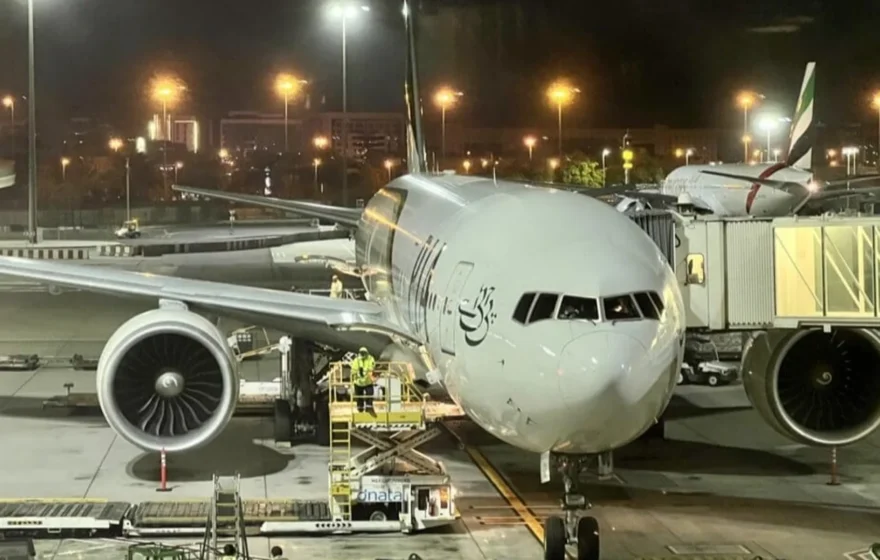
Pakistan International Airlines has now carried 104,845 passengers on its two routes out of Manchester, a figure that shows how quickly direct air links between northern England and Pakistan have found their feet again. The services link Manchester with Islamabad and Lahore, and alongside the passengers they have also moved 1,541 tonnes of cargo, a reminder that these flights carry far more than holidaymakers and visiting families. For a carrier working to rebuild its international presence, a six-figure passenger total on just two routes is a milestone worth noting, and it says as much about the communities at either end of the journey as it does about the airline itself.
The story began with the Manchester to Islamabad service, which started in October 2025 with two flights a week. The response from travellers was strong enough that the airline soon doubled the frequency, and the route now operates four times a week, on Mondays, Tuesdays, Thursdays and Saturdays. That kind of growth, driven by bookings rather than by a launch promotion, is the clearest sign an airline can get that a route is working. In July 2026, PIA widened its Manchester offering further by adding a weekly Wednesday flight to Lahore, giving passengers in the north of England a direct choice between two of Pakistan’s most important cities.
The cargo carried on the two routes adds another layer to the picture. Of the 1,541 tonnes moved so far, 1,412 tonnes were brought into the United Kingdom, while 129 tonnes travelled in the other direction to Pakistan. The goods coming into Britain were led by fresh fruit and vegetables, nuts, pharmaceutical products, clothing and fabrics. That mix will be familiar to anyone who shops in the markets and high streets of northern England, where Pakistani produce and textiles have long been part of everyday life. It also points to the commercial ties that run alongside the family ties, with traders and small businesses depending on reliable space on the aircraft to keep goods moving without the delays of indirect routings.
Manchester Airport’s managing director, Chris Woodroofe, has framed the services in exactly those terms, describing the direct links as a way of connecting communities across northern England with Pakistan while also supporting economic development in the region. The airport serves as the main international gateway for the north, drawing passengers from well beyond Greater Manchester, and a direct service gives the surrounding region a departure point close to home, keeping spending and jobs in the north rather than pushing travellers south to London or through a hub elsewhere.
That community dimension was echoed by the members of parliament who spoke about the milestone. Yasmin Qureshi, the MP for Bolton South and Walkden, welcomed the return of direct flights, saying they had made travel more convenient for British Pakistanis and given families greater flexibility when planning visits. Afzal Khan, the MP for Manchester Rusholme, described the routes as a boost for local communities and the regional economy. Both represent constituencies where the links with Pakistan are lived realities rather than abstractions, and their comments underline a truth that passenger numbers alone cannot capture: for many people, these flights are not about tourism in the usual sense, but about maintaining the bonds of family across thousands of miles.
Northern England, including Manchester and Bradford, is home to a large British Pakistani community, and for many families the direct flights have replaced long journeys that once involved a connection at another airport. A non-stop service does more than save a few hours in transit: it makes the journey manageable for elderly relatives travelling alone, for parents taking young children to meet grandparents, and for families who need to travel at short notice for a wedding or a funeral, as well as for business travellers and students working to a tight schedule.
The milestone also matters for PIA itself, which has been working to rebuild its international network route by route. A service that grows from two flights a week to four on passenger demand, and then proves strong enough to support a second destination from the same airport, suggests that demand for direct travel between Pakistan and the north of England is real and sustained rather than a brief surge after launch. If it holds through quieter months as well as holiday peaks, the Manchester routes could become a template for how the airline rebuilds other long-haul services, built around the communities they serve.
Looking ahead, the question for PIA and for Manchester Airport will be whether this early momentum can be sustained and deepened. Passenger growth has already justified more seats on the Islamabad service, and the Lahore addition shows a willingness to broaden the offer rather than simply consolidate it. For the families and businesses who use these flights, the hope will be for reliability, fair fares and a schedule that fits real lives, with departures spread across the week. If the airline can deliver that, the next milestone on these routes may arrive sooner than the first one did.
