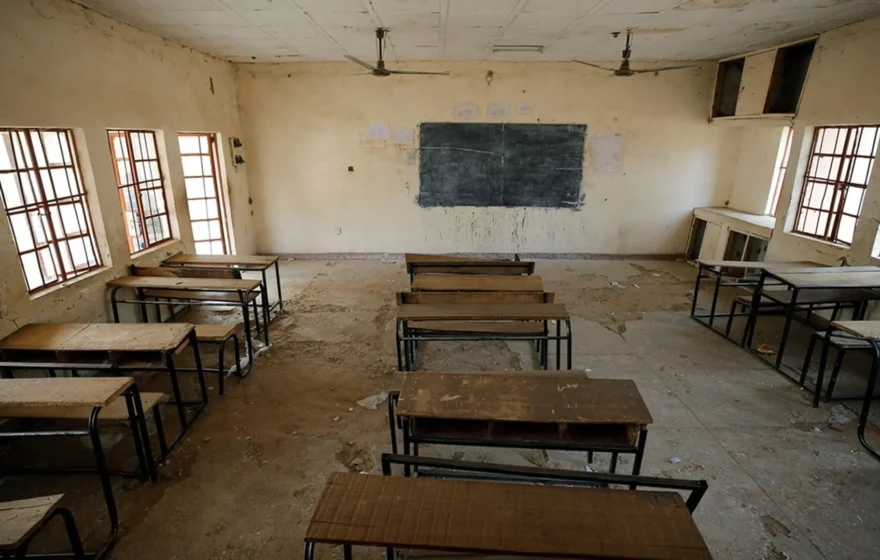
Education officials in Khyber Pakhtunkhwa have now put a number on a problem parents and teachers have lived with for years, identifying 4,049 government schools that need rebuilding or rehabilitation without delay because their buildings are no longer considered safe. The Elementary and Secondary Education Department puts the cost at Rs16.2 billion, covering 8,088 classrooms, 2,949 group toilets and 48 examination halls, a total that leaves little doubt about the scale of the task or what is at stake if the work is put off.
The province-wide survey followed a tragedy still fresh in public memory. After a private school building collapsed in Dir Colony in Peshawar, killing 31 students and a female teacher, district and tehsil education offices examined government school buildings across the province, and the results have now been compiled into this district-by-district picture. The government has also directed the Elementary and Secondary Education Authority to inspect private schools, and an official said it had already checked more than 6,000 of the 12,493 private schools registered with the Private Schools Regulatory Authority, with the rest expected within another week.
The district figures show the damage is widespread, not confined to one or two areas. Swat tops the list with 488 schools in poor condition, where work on 518 classrooms, 301 washrooms and five examination halls is estimated at around Rs1 billion, while Mardan has 350 affected buildings, where 728 classrooms and 272 washrooms need rehabilitation at a similar cost of about Rs1 billion. In Haripur, 332 schools need work, including 130 girls’ schools and 202 boys’ schools, covering 811 classrooms, 336 washrooms and five examination halls, again at around Rs1 billion.
The same pattern repeats elsewhere. Lower Dir has 271 affected schools, where repairs to 689 classrooms, 128 washrooms and one examination hall will require Rs1.48 billion, while Abbottabad needs Rs1.098 billion for 245 schools, including 130 girls’ schools and 115 boys’ schools. In Charsadda, 174 schools need repairs to 430 classrooms and 23 group toilets at Rs874.7 million, and in Kohat, 168 schools need work on 522 classrooms and 24 washrooms at Rs1.7 billion. Malakand needs Rs690 million for 368 classrooms and 80 washrooms across 162 schools, and Upper Dir needs Rs368 million for 249 classrooms and 52 washrooms across 161 schools.
The remaining districts complete a province-wide picture. Karak has 132 schools, with 327 classrooms and 83 washrooms to rehabilitate at Rs727 million, while Hangu has 116 schools, including 92 boys’ schools and 24 girls’ schools, where 468 classrooms, 10 washrooms and two examination halls will cost Rs438 million. Buner has 71 schools, with 285 classrooms and 75 group toilets estimated at Rs386 million, and Battagram has 59 schools, where 53 classrooms, 29 group toilets and one examination hall will cost about Rs130 million. The department also identified 454 schools in Peshawar, 202 in Nowshera, 174 in Mansehra, 160 in Swabi, 110 in Lower Kohistan and 47 in Kolai-Palas, plus 38 in Upper Chitral and Upper Kohistan, 35 in Lower Chitral, 33 in Shangla and 30 in Torghar.
Behind those totals is a human reality numbers alone cannot capture. A classroom is where a child spends most of the school day, and a weakened structure turns attendance into a quiet worry for pupils, teachers and parents. Usable toilets matter just as much, and for girls, a school without safe, working washrooms can become a reason to stay away, however keen a pupil is to learn. Examination halls must hold large numbers together when concentration matters most, and a hall that cannot safely do that undermines the examination itself. Together, these are not separate repair items but the basic conditions that let a school function.
That is why the survey itself matters, apart from the repairs that must follow. Poor school buildings could previously be spoken of in general terms, as a familiar complaint easy to acknowledge and equally easy to set aside. A survey that counts the damage district by district and classroom by classroom is much harder to ignore, because it gives parents, teachers and officials shared facts to measure progress against. It also makes the choices ahead more honest, since no province could rebuild thousands of schools at once. The schools in the worst condition must come first, and so must those where safe facilities decide whether a girl attends regularly or drops out.
The question on which this survey will be judged is whether the Rs16.2 billion estimate becomes real, lasting work rather than another report noted and forgotten. Funding on this scale needs sustained commitment, careful sequencing and visible progress communities can check school by school, not general promises. Teachers and parents will look for the first repaired classrooms, working toilets and safe examination halls, and will expect the worst-affected districts to move first. If work begins promptly and continues steadily, the Dir Colony tragedy will at least have forced a reckoning that protects other children. If it stalls, the survey will stand as a record of a danger measured in full and still left unaddressed.
