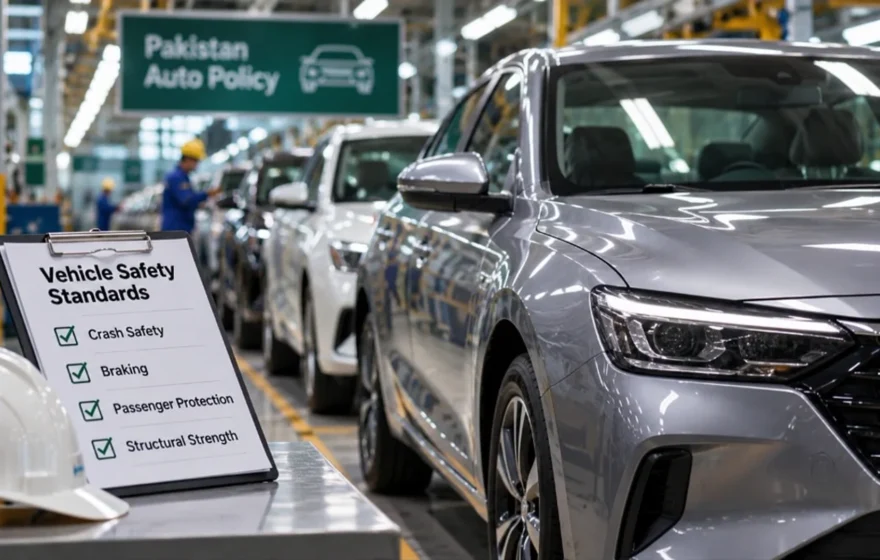
Pakistan has taken its biggest step yet towards safer cars, with 45 additional international safety standards now set to apply to vehicles made and used in the country. The move sits at the centre of a new auto policy unveiled in Islamabad on Saturday, and the government says it will bring local cars in line with the safety rules followed by the world’s leading car-making nations.
Adviser to the Prime Minister for Industries and Production Haroon Akhtar Khan announced the measures at a press conference alongside Information Minister Attaullah Tarar. He said the government had added the 45 standards in line with the United Nations’ WP.29 code, the UN framework for common vehicle rules. “When our vehicles will go through these safety codes, they will be considered the world’s safest vehicles, both manufactured and used,” Akhtar told reporters. He added that much work had gone into drafting the policy and that Prime Minister Shehbaz Sharif had personally devoted considerable time to it.
Safety is one of six pillars of the new policy. The others are making vehicles more affordable, especially for middle-class and lower-middle-class families, encouraging exports, increasing the share of parts made in Pakistan, promoting electric vehicles, and bringing greater transparency to the way the industry is run. Together, they are meant to reshape an industry long criticised for high prices, limited choice and cars that lag behind international models on safety.
For ordinary buyers, the safety changes could matter more than any other part of the policy. For years, many locally assembled cars sold in Pakistan have come without safety features that are standard elsewhere, such as multiple airbags, electronic stability control and stronger crash protection. Buyers have often had to pay extra for higher variants to get basic protection, or gone without it. The new standards are designed to close that gap by requiring locally made cars to meet the same technical rules that govern vehicles in Europe, Japan and other major markets.
The framework behind the change is the World Forum for Harmonization of Vehicle Regulations, known as WP.29, under the United Nations Economic Commission for Europe. Pakistan joined the UNECE 1958 Agreement in April 2020 and has since adopted 62 vehicle regulations under WP.29, covering braking, steering, seat belts, airbags, child safety, collision protection, tyres, lighting, emissions, noise and electric powertrains. The draft of the new policy, the Automotive and Auto Parts Manufacturing Policy 2026-31, proposed adding 45 more regulations during the policy period, with adoption envisaged by late 2028.
The Engineering Development Board issued a notification on September 30 applying the existing 62 standards to commercially imported used vehicles as well, a step the Karachi Chamber of Commerce and Industry welcomed for consumer protection and road safety. The new policy extends the same logic to cars assembled in Pakistan, so that a vehicle bought from a local showroom will be judged against the same safety rules as one brought in from abroad.
Enforcement will be the central test of whether the policy delivers. The draft policy proposed setting up a dedicated Pakistan Automotive Testing Institute, with a proposed allocation of Rs1.7 billion spread over three financial years, to check vehicles against the required safety, quality and environmental standards before approval. The institute would be established by the Ministry of Industries and Production and the Engineering Development Board, alongside a legal framework covering safety standards, conformity assessment and recalls. Until it is running, the question of who tests the cars and how strictly the rules are applied will remain open.
The policy also aims to make cars cheaper and to turn Pakistan into a car exporter. The government has set an ambitious target of raising vehicle exports from around 200 million dollars to 6 billion dollars, a thirty-fold increase, while gradually bringing down prices for local buyers. Tariff protection for local assemblers is set to come down gradually by 2031, alongside enforceable localisation targets that require manufacturers to source more parts from within Pakistan. Electric vehicles get a prominent place too, with incentives for new-energy vehicles in the draft, and used car imports face tighter rules, including mandatory pre-shipment inspections. The government has also abolished the Personal Baggage Scheme after widespread misuse and added checks for vehicles brought in under the Gift Scheme.
What happens next will determine whether the announcement becomes a genuine turning point or another policy that fades in implementation. The draft was presented to the Prime Minister again in September and was being finalised by a committee headed by the Minister for Law and Justice, with officials saying in October that it would be presented to Parliament within two weeks. The industry will now watch for the formal notifications, the timetable for adopting each of the 45 standards, and the testing institute that gives the rules their teeth. For Pakistan’s roads, where crashes claim lives every day, the stakes are high. If the standards are enforced as promised, the next generation of locally made cars could be safer than the ones on the road today, and buyers would no longer have to choose between an affordable car and a safe one.
