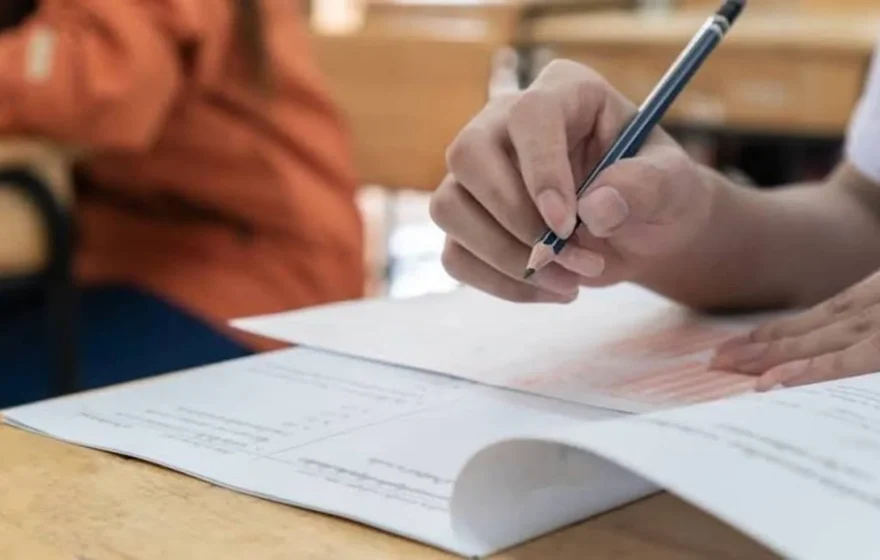
Punjab has settled how its youngest board-level pupils will be assessed this year. Class 8 pupils will sit examinations in four major subjects, in the same format used last time, while Class 5 pupils will go through a broader assessment instead of a formal board examination. The announcement was made by Punjab Education Minister Rana Sikandar Hayat, who said the arrangements would be fair and transparent, and that the changes were designed to take pressure off children who are still starting out at school.
For Class 8, very little is changing. The minister confirmed that the examination will cover four major subjects, following the pattern of the previous session, and that the papers will be answered on special electronic sheets, with on-screen marking used to check them.
The four subjects at the heart of the Class 8 examination are the ones that have long anchored middle-school assessment in the province: English, Mathematics, Urdu and General Science. Between them they cover language, numbers and the first serious encounter with scientific thinking, and they are the papers on which a pupil’s readiness for high school is most often judged.
Class 5 is where the real change sits. The formal board examination for fifth-graders has been put off for this year, and in its place the Punjab Education, Curriculum, Training and Assessment Authority, known as PECTAA, will carry out an assessment of the children. A regular board examination will return next year, so this is a pause rather than an abolition, and the minister described the assessment as a holistic exercise, one that looks at a child’s learning more broadly than a single set of papers in a single week can. The idea is to ease the weight of examinations on children who are around ten years old, an age at which a board examination can feel less like a measure of learning and more like a test of nerves.
The decision fits into a wider shift that Punjab has been making in how it judges its schoolchildren. Back in August, the provincial education department announced that board examinations would be introduced for Grades 5 and 8 from 2026. The Grade 8 examination had already been revived in March this year, after a gap of six years, and the scale of that exercise showed just how large the undertaking is. Close to one million pupils sat the papers across more than 5,700 centres, watched over by nearly 26,000 invigilators, with the examinations running from March 9 to March 12 and the results announced on April 9. Alongside them, school-based assessments covered around 6.8 million children.
What made that revival stand out was not only its size but the technology wrapped around it. For the first time, answer scripts carried only a secure QR code, so the people marking them could not see whose paper they were reading, and the marking itself was done online through a central system. No two pupils sitting side by side received the same paper, because four different versions were generated digitally from secure question banks, and a live dashboard tracked attendance, staff presence and paper delivery at centres across the province.
That is the system the Class 8 pupils will meet again, and the minister’s announcement suggests the government believes it worked well enough to repeat without change. When a paper is scanned and marked on a screen, with the candidate’s identity hidden behind a code, there is less room for the kind of interference that has damaged trust in examinations in the past. When several versions of a paper are in circulation in the same hall, copying from a neighbour stops being a useful strategy.
For Class 5, the details of the assessment are the question parents will now be asking. A holistic assessment usually means judging a child across a wider range of work than a single examination can capture, including classroom performance and learning over time rather than a few hours of writing under pressure. PECTAA will be the body running it, which gives it an official shape, but how it will be carried out, and how its results will be shared with schools and parents, have yet to be spelled out. The government has said a regular board examination will follow next year, so this year’s fifth-graders will be assessed now and examined later, in a phased system that introduces formal testing gradually rather than all at once.
For now, the position for families is clear enough to plan around. Class 8 pupils should prepare for four papers, in English, Mathematics, Urdu and General Science, answered on electronic sheets and marked on screen, in the same way as the last session. Class 5 pupils will not sit a board examination this year, and will instead be assessed by PECTAA in a process the minister has promised will be fair and transparent. The date sheet for the Class 8 papers, along with roll number slips and any further guidance on the Class 5 assessment, will be the next things to watch for, and they are expected to come from PECTAA in the weeks ahead.
