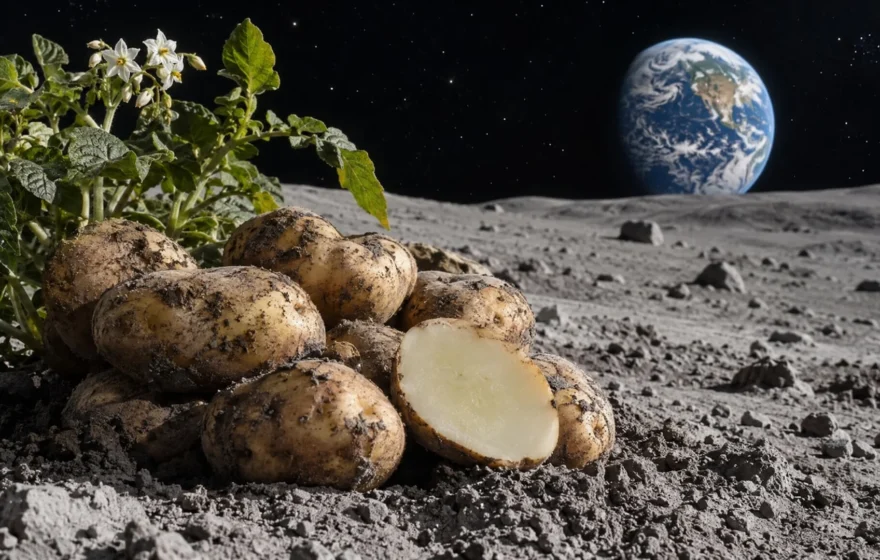
The humble potato may be the first crop to feed people living on the Moon. Scientists in the United States have grown potatoes in simulated lunar soil and found that, with the right help, the tubers came out nutritious, safe to eat and just as productive as potatoes grown in ordinary soil on Earth. The work, published in the journal npj Microgravity and supported by NASA, brings the idea of farming on the Moon a step closer to reality, as both the United States and China plan long stays on the lunar surface.
The experiment was led by plant biologist Aymeric Goyer at Oregon State University, and it used a variety called Modoc, an early-maturing potato with red skin and white flesh. The team did not plant in real Moon dust, which is far too scarce for large experiments. Instead they used five different simulated lunar soils, known as regolith simulants, made to match the samples brought back by the Apollo missions. Some represented the darker plains known as the lunar maria, others the lighter highland regions.
Real lunar regolith is a difficult place to grow anything. It is crushed rock, ground fine over billions of years by meteorite impacts, its grains sharp and glass-like. It contains no organic matter at all, and it holds none of the nitrogen that plants need to grow. It also carries high levels of heavy metals such as copper, which can damage roots. Without something added to it, nothing would grow there at all.
The Secret Ingredient
The answer turned out to be worms, or rather what worms leave behind. The researchers mixed the simulated regolith with vermicompost, a rich organic material produced when earthworms break down organic waste. They tried several blends, from just 5 per cent compost up to 30 per cent, and compared the results with potatoes grown in soil from Hermiston in Oregon, a region known for high potato yields.
The difference was dramatic. Potatoes planted in pure simulant, with no compost at all, produced almost no roots or tubers. A mix with as little as 5 per cent compost allowed some growth, and blends up to 15 per cent brought only partial recovery. At 30 per cent compost, though, everything changed. The plants grew just as well as those in the Oregon soil, completing their full life cycle and producing tubers of comparable quality. “We found that potatoes can complete their entire life cycle in simulated lunar soil when supplemented with organic matter,” Goyer said.
The team grew the plants in a greenhouse, under sunlight and artificial light, with daytime temperatures of 22 degrees Celsius and nights at 18 degrees. Because the plants grew in small pots, the tubers were small, generally less than 10 grams even in the Earth soil, but the lunar mix held its own on the comparison that mattered.
Safety was as important as yield. The researchers checked the potatoes for glycoalkaloids, the naturally occurring toxins that can build up in potatoes and are often linked to the green colouring under the skin. They found no statistically significant increase in the potatoes grown in the lunar simulants, and the tubers kept their nutritional quality. The compost, the team believes, helps bind the heavy metals in the regolith, shielding the roots from their worst effects. “We believe the compost helps balance some of the toxicity we see in lunar regolith,” said David Handy, a postdoctoral scholar at Oregon State who worked on the study.
Why It Matters
The result matters because carrying food from Earth will not work for a permanent Moon base. Every kilogram launched from Earth is expensive, and a crew living on the Moon for months or years would need far more food than any rocket could reasonably deliver. A local food supply is therefore seen as essential, and NASA’s Artemis programme aims to establish a sustained human presence on the Moon in the 2030s. China has similar ambitions for a lunar base of its own.
Potatoes are a strong candidate for that role. They deliver more calories per unit of land than many other crops, and they are nutritious in ways that matter on a long mission. “Potatoes provide more calories per land area than many other crops,” Goyer said. “They are nutritious, they provide more potassium than a banana, are rich in vitamin C, have good protein, and they have a high satiety index.”
The work is not finished. The Oregon State team is already planning a follow-up comparing ten potato varieties in lunar simulants, to find the most nutritious and resilient. There are also practical questions still to answer, including how the compost itself would be produced on the Moon, since the regolith there contains no organic matter to start with. The researchers are cautious: regolith farming may not suit the very first crews, when organic matter is scarce, but it should improve steadily as compost builds up over time. Even so, this study shows that the Moon’s dust is not a dead end for farming. With a little help from Earth, it can grow dinner.
