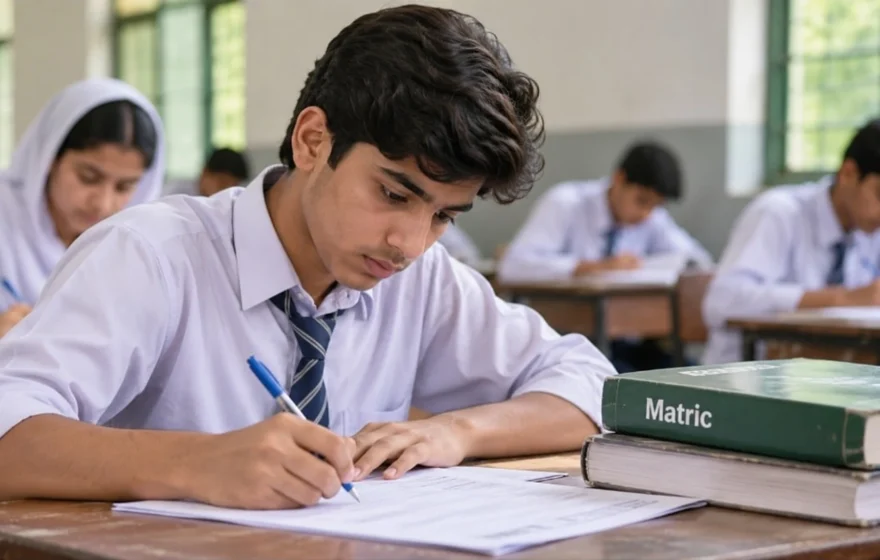
Students in Punjab who are preparing for their Class 10 board examinations in 2027 have a new syllabus to follow. The Punjab Education, Curriculum, Training and Assessment Authority, known as PECTAA, has issued a revised smart syllabus for the 2027 annual examinations, replacing the version it had announced earlier. The change affects every student due to sit the Matric examinations next year, and the authority has told students plainly to prepare from the updated syllabus rather than the one released before it.
The revised syllabus comes under the Accelerated Learning Programme, or ALP, and covers the 2026-27 academic session for both Matric General and Matric-Tech students. Alongside the syllabus itself, PECTAA has released revised pairing schemes and model papers, so that students can see not only what to study but also how the papers will be put together. Separate notifications and documents have been issued for the two streams, and students are expected to follow the set that matches their own group.
A smart syllabus is not a new textbook. It is a shortened version of the existing course in which selected topics, textbook exercises and less essential content are taken out of the examination, so that students revise a smaller, clearly defined portion of each book. The idea was first introduced in Punjab in 2020, when the pandemic closed classrooms and the Punjab Curriculum and Textbook Board, PECTAA’s predecessor, brought in the Accelerated Learning Programme to limit the learning students had lost. Six years on, the same approach is still used to focus examination preparation, and the authority has applied it again for the 2027 Matric examinations.
The paper trail behind the revision shows how quickly it has moved. The smart syllabus and pairing schemes for Grade 10 were notified under PECTAA notification number PECTAA/C&C Unit/2026/1257, dated 14 November 2026, and further model paper notifications followed on 20 November. The syllabus applies across all nine boards of intermediate and secondary education in Punjab — Lahore, Gujranwala, Rawalpindi, Sargodha, Faisalabad, Sahiwal, Multan, Dera Ghazi Khan and Bahawalpur — so a student in any district of the province is preparing for the same papers under the same rules.
The key point for students is how the examination is actually set. Under the smart syllabus, the paper is drawn from the whole textbook except for the topics and exercise questions listed as deleted, which means everything else remains examinable and there is no shortcut around the rest of the book. The pairing scheme then shows how the paper is assembled, chapter by chapter. In Physics, for example, the paper carries 60 marks, with 12 marks of objective questions and 48 of subjective questions, and one multiple-choice question comes from each of the twelve chapters. Pakistan Studies carries 100 marks, with 20 objective marks and 80 subjective marks over three hours, while English carries 75 marks, Mathematics 75 marks over two and a half hours, and Computer Science 50 marks.
For students, the practical steps are straightforward. The revised syllabus, pairing schemes and model papers are available through PECTAA’s official website, with separate downloads for Matric General and for Matric-Tech, and students should check that they have the revised documents rather than the earlier release. Teachers, too, will need to adjust their revision plans, since a topic dropped from one version may be back in the other, and a question pattern that looked settled may have changed. Anyone preparing from notes or guess papers shared on social media should cross-check them against the official documents before trusting them.
Late changes to a syllabus are never easy, and this revision will have caused a jolt for students who had already planned their revision around the earlier version. Some will have studied topics that no longer count, and others will have skipped material that is now back in the paper. That is the risk of a system that revises its syllabus close to the examination, and it is why the authority’s instruction to follow the updated documents matters so much. The model papers are the best guide to what the change means in practice, because they show the new pattern in full rather than describing it.
The 2027 Matric examinations will shape the next step for hundreds of thousands of young people in Punjab, whether that is intermediate college, a technical diploma or work. A clear syllabus, fairly applied across all nine boards, is the least they should be able to expect, and the revised smart syllabus at least gives them a single, official document to prepare from. The responsibility now lies with students to download the right version, with teachers to teach to it, and with the boards to set papers that match it. If all three happen, the revision will be remembered as a correction rather than a disruption.
