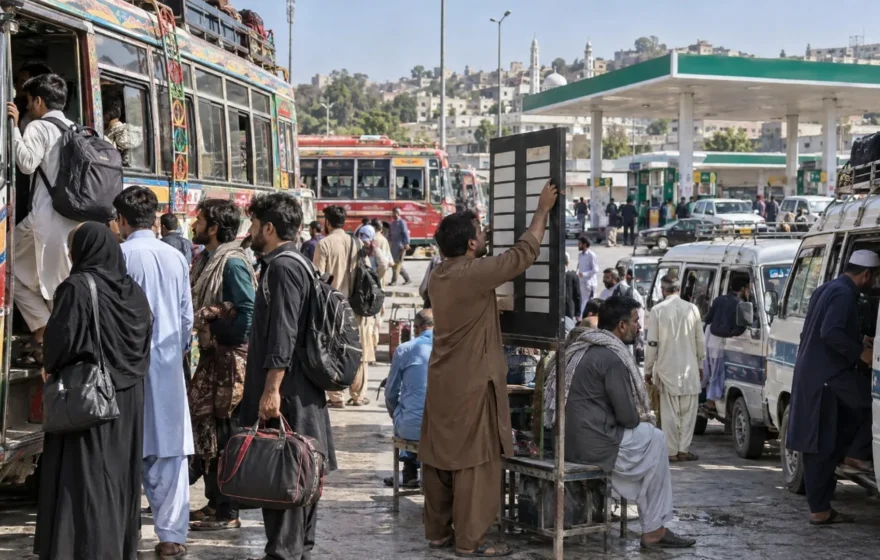
Commuters in Rawalpindi are seeing some relief at the bus stop. Transport fares in the city have started coming down after a steep fall in fuel prices over the past ten days, with local fares cut by 12 per cent, intercity fares by 5 per cent and freight charges by 10 per cent. Fuel is the single biggest running cost for transport operators, so when petrol and diesel become cheaper, passengers have every right to expect cheaper tickets. The district administration has now stepped in to enforce the new rates.
The fare cut follows a remarkable run of reductions at the pump. Petrol now sells at Rs338 a litre, down from Rs377.91 on October 31, a fall of Rs39.91 a litre, or about 10.6 per cent. High-speed diesel, which powers most buses and trucks, has come down to Rs371 a litre from Rs402.96, a reduction of Rs31.96 a litre. Petrol fell by Rs8 a litre and diesel by Rs7 on November 11, following earlier cuts on November 3 and November 7. Together they are the sharpest fall in months, driven by easing tensions between the United States and Iran.
Rawalpindi Deputy Commissioner Nadeem Nasir ordered fares cut in line with the fall in fuel prices, and Regional Transport Authority Secretary Syed Asad Abbas Shirazi met operators to press them to apply the new fares at once. The administration has also urged citizens to report overcharging through its helpline, 1071. The step was needed because local operators were still charging the old fares on November 8 despite five straight fuel cuts, saying they doubted the fall would last.
Intercity operators, by contrast, had already begun to pass on some of the benefit. Fare lists issued on November 7 show Kohistan Express cut its Rawalpindi to Peshawar fare from Rs1,200 to Rs1,150, while its executive-class fare to Lahore came down from Rs2,500 to Rs2,400. Crystal Lines cut its Rawalpindi to Karachi fare from Rs7,600 to Rs7,300, and Safe Way Travel cut its executive fare to Karachi from Rs8,000 to Rs7,000. Those cuts showed that lower fuel prices could be passed on quickly when operators chose to do so.
The fall in fuel prices is the result of both international markets and a changing pricing system at home. For years, Pakistan revised fuel prices every fortnight, with the Oil and Gas Regulatory Authority setting new rates twice a month. That system changed after the conflict involving Iran began on February 28, when the government first moved to weekly revisions and then to daily price changes. The regulator now works on a seven-day rolling average of international oil prices, the petroleum minister has told the National Assembly. On October 31 the government also changed the formula: the import price of petrol is now worked out from the actual cost of cargo imported by Pakistan State Oil, while refineries receive an ex-refinery price based on costs fixed at their March 7, 2026 levels for 30 days.
Even with prices falling, fuel in Pakistan still carries heavy taxation. Every litre of petrol carries Rs114 in taxes and charges, while diesel carries Rs100. The petroleum levy alone stands at Rs80 a litre on both fuels, with a climate support levy of Rs5 a litre on top. Those fixed charges mean that much of the pump price has nothing to do with the world oil price. That question of who gains when oil prices fall has become heated. Petroleum dealers, led by chairman Malik Khuda Bakhsh, held an emergency meeting in Karachi on November 3 and demanded a forensic audit of the country’s oil refineries, arguing that a transparent review could reveal room to cut petrol by as much as Rs50 a litre.
The dealers pointed to figures from Topline Securities showing that refinery sector profits jumped to Rs32.2 billion in the first quarter of the current financial year, from Rs1.6 billion in the same quarter a year earlier. He said refineries had earned in just three months profits equal to a full year’s earnings. Anwar Kamal said consumers could get relief of Rs40 to Rs50 a litre if the matter was properly examined. The refineries have pushed back strongly. Attock Refinery, National Refinery, Cnergyico and Pakistan Refinery wrote jointly to the federal government asking for the revised pricing mechanism to be withdrawn, warning that it could cost domestic producers Rs49.02 a litre.
For now, the people of Rawalpindi have something concrete to hold on to. A 12 per cent cut in local fares and a 10 per cent cut in freight charges will ease the daily cost of work travel and moving goods, if the new rates are actually charged. The real test will be whether passengers actually pay less in the days ahead. Karachi is still waiting for similar relief, a reminder that cheaper fuel only helps ordinary people when the benefit is passed on. If the new fares are enforced and the argument over refinery profits leads to a fairer pricing system, this month’s fall in fuel prices could mark the start of a lasting improvement rather than a brief pause before the next increase.
