For most families, clean water is something they notice only when it stops coming out of the tap. In Pakistan, though, it is a daily health emergency. More than half the population has no access to safe drinking water, and the illnesses that follow fill hospital wards, keep children out of school and drain household incomes. Diarrhoea, cholera, typhoid, hepatitis A and E, and even polio all travel through dirty water, so in a country where the supply itself cannot be trusted, prevention begins not in the clinic but at the pump, the tap and the toilet.
The numbers behind the crisis are stark. Pakistan ranks third in the world, after India and Nigeria, for child deaths from diarrhoea and pneumonia. Globally, about 72 per cent of diarrhoea deaths among children under five are linked to unsafe drinking water and poor sanitation, and in Pakistan alone UNICEF estimates that around 53,000 children under five die every year from diarrhoea caused by unsafe water and poor sanitation. About 70 per cent of households drink water contaminated with bacteria, and 79 million people have no proper toilet while 25 million still practise open defecation.
The burden falls hardest on the poorest families. A child who keeps falling ill with diarrhoea misses school, falls behind in class and faces a higher risk of stunting, a condition already affecting almost 44 per cent of children in Pakistan. Mothers lose hours every day fetching water and nursing sick children, while hospitals spend beds and medicine on illnesses clean water would have prevented. With the population growing fast, the pressure on already thin water and sanitation services only increases, and every year of delay leaves more families exposed.
It is against this background that Rotary members in Pakistan, working with donors and partners, have made clean water, sanitation and hygiene a central part of their work. The effort runs alongside the polio eradication campaign, shaped by what communities themselves say they need. Ashar Ali, Rotary International District 3271’s ambassador for water, sanitation and hygiene and a project manager with the Pakistan PolioPlus Committee, describes the logic plainly: vaccines protect a child against infectious disease, but clean water and sanitation stop waterborne illness from spreading in the first place.
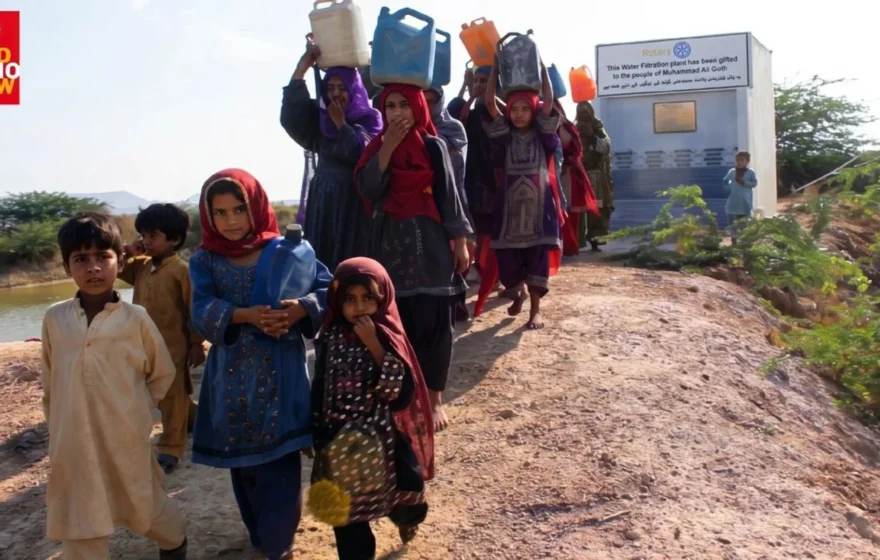
The most visible part of the work is a network of water filtration plants, many of them run on solar power so that they keep working even where electricity is unreliable and running costs stay low. Rotary has installed about 53 plants so far, eight of them using reverse osmosis. Those plants take salty groundwater, heavy with dissolved solids, and strip out excess minerals, salts, metals and other contaminants until it is safe to drink. Around 212,000 people in 26,500 households now have safe drinking water at 53 locations, and those communities report fewer cases of waterborne illness.
The plants have also done something less measurable but just as important: they have built trust. Pakistan is one of the few countries where wild polio remains endemic, and vaccination teams have often faced suspicion in the very communities where the virus still circulates. Meeting a community’s need for clean water first has given health workers credibility, and families once hesitant about vaccination are now more willing to listen.
Clean water has also lightened a burden that falls mostly on women and girls. In many households they walk to fetch water, carrying heavy containers over long distances, and a plant close to home gives that time back. Rotary has extended the same thinking into schools, building washrooms in primary schools and universities, with a particular focus on facilities for girls. Many schools have no functioning toilet at all, and girls often drop out at adolescence because there is nowhere safe or private for them to go. Seven schools, including one for girls, have now been fitted with improved washrooms, and the result has been fewer illnesses, better attendance and a measure of dignity for the students.
The work only lasts, though, if the communities it serves take ownership of it. In Gadap, on the outskirts of Karachi, Rotary members train local residents in hygiene and in running and maintaining their own filtration plant, so that the facility does not fall silent when outside help moves on. Rotary wants to carry that model of local training and responsibility further, reaching more towns and villages with corporate and non-profit partners.
Pakistan’s water crisis will not be solved by filtration plants alone. Pipes, treatment works, sewerage and enforcement of water quality standards all need investment on a scale only government can provide, and the cost of inaction is already visible in hospital wards and in the growth of a generation of children. But the Rotary experience shows what is possible when clean water is treated as health infrastructure rather than a luxury. Every plant that opens means fewer children falling ill, more girls staying in school and more mothers with time for their families. If that work can be scaled up, clean water could become what it should have been all along: the first line of defence against disease in Pakistan.
