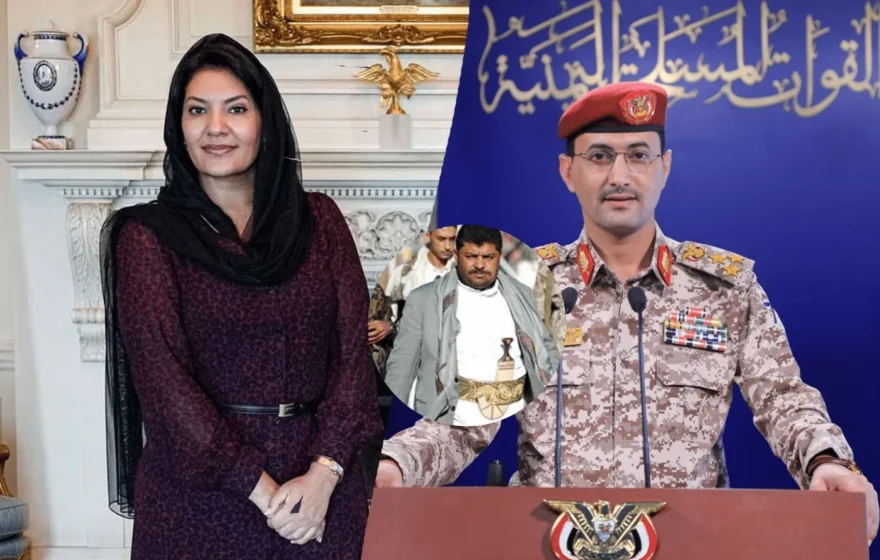
Saudi Arabia’s ambassador to the United States has urged the world to stop treating the Houthis as a local Yemeni problem and to confront them now, before a movement she describes as underestimated grows into a far larger threat. In a New York Times opinion article, Princess Reema bint Bandar Al-Saud argued that the world should set a clear goal: to end the Houthis as an armed force. The comparison was deliberately unsettling. The Houthis today, she wrote, are what ISIS was before it seized Mosul in Iraq and proclaimed a caliphate, a terrorist movement the world underestimated until it was too late to contain it cheaply or quickly.
Princess Reema opened her case not with history but with a recent attack on Saudi soil. On 10 October, she wrote, a Houthi missile struck King Khalid International Airport in Riyadh, killing 13 people and injuring many more. She called the strike on a civilian terminal an act of terrorism, pure, simple and evil. She highlighted Ebtehal bint Abdullah, a Riyadh Air passenger services agent who, though injured herself, helped travellers escape and guided paramedics through the building: a missile sent to spread terror, answered by ordinary courage.
She then widened the picture to a years-long campaign. Since March 2016, she wrote, the Houthis have fired more than 1,000 ballistic missiles and drones into Saudi Arabia. She also cited United Nations investigators who say Houthi engineers have taught Al-Shabaab fighters in East Africa how to make bombs and modify drones, suggesting the group’s expertise is already travelling beyond Yemen.
Two points gave that argument global reach. The Houthis, she said, have threatened to close the Bab al-Mandab Strait, between Yemen and East Africa, through which about 10 percent of world trade passes; even a credible threat would ripple through shipping costs far beyond the Red Sea. Strikes on Saudi energy facilities in October, she noted, helped push oil prices back above 100 dollars a barrel, so attacks in the Gulf can be felt in household budgets worldwide.
Her most troubling charge concerned children. She accused the Houthis of making schoolchildren as young as 10 chant Death to America and of sending thousands of children into combat. The United Nations has long documented child recruitment in Yemen’s war, and in 2022 the Houthis signed a UN action plan pledging to end it, a commitment monitors say has not been fully honoured. The war began when the Houthis seized Sanaa in 2014, forcing the recognised government into exile, and a Saudi-led coalition intervened in early 2015; more than a decade on, it has created one of the world’s worst humanitarian crises.
Her proposed response was practical. Every country, she argued, should designate the Houthis as a terrorist organisation, as the United States already has, so the label carries legal and financial consequences. Governments should cut off the group’s money and dismantle its war economy of extortion networks and front companies, stop weapons at sea, and support Yemen’s government to lead the fight itself. Saudi Arabia, she said, has closed its financial system to the Houthis, while Yemeni forces, backed by Saudi air support, have seized more than 750 tonnes of weapons bound for the group. ISIS, she noted, was defeated by local forces backed by a coalition of more than 80 nations.
The Mosul parallel does much of the work in her argument. In June 2014, ISIS fighters overran Mosul, Iraq’s second largest city, within days, despite facing far larger Iraqi forces on paper, and its leader soon proclaimed a caliphate across parts of Iraq and Syria. The years of costly warfare that followed explain why she warns against underestimation. Critics will rightly note that the Houthis and ISIS are different movements, and that a parallel drawn for urgency can blur those differences; her implicit answer is that the comparison is about trajectory, not identity: a group dismissed while it builds missiles, networks and revenue, and uses pauses in fighting to rearm, should not be assumed to stay contained.
That question of timing is what her article asks other capitals to decide. A Yemeni-led political settlement, she wrote, remains the goal, and ending the Houthis’ armed campaign is, in her view, the only path to it. Whether governments accept that sequence, or treat designation, sanctions and interdiction as steps to be taken gradually, will decide whether her warning is remembered as foresight or as advocacy unheeded: act together, early and with a shared objective, or risk learning, as after Mosul, how expensive it is to confront a movement only after it has shown what it can do.
