Pakistan has told the United Nations that the veto power held by five countries should be abolished, or at the very least severely restricted, arguing that its misuse has left the Security Council unable to act when the world needs it most. The call came during a General Assembly debate on the use of the veto in New York, where Pakistan’s envoy said a recent United Nations report had shown that this privilege only hinders efforts to end wars. Gul Qaiser Sarwani, Counsellor and Political Coordinator at Pakistan’s Permanent Mission to the UN, insisted that reform must be comprehensive, democratic and equitable.
“Let us be clear: the problems cannot be the solution,” Sarwani told the Assembly, capturing the heart of Pakistan’s argument in a single line. His point was not simply that the veto is used too often, but that a tiny group of states uses it to protect rivalries and narrow interests, while the wider membership of 193 countries lives with the consequences. When one permanent member can block a resolution even when almost every other member of the Council supports it, he argued, the body charged with maintaining peace and security becomes a stage for deadlock instead of a guardian of peace.
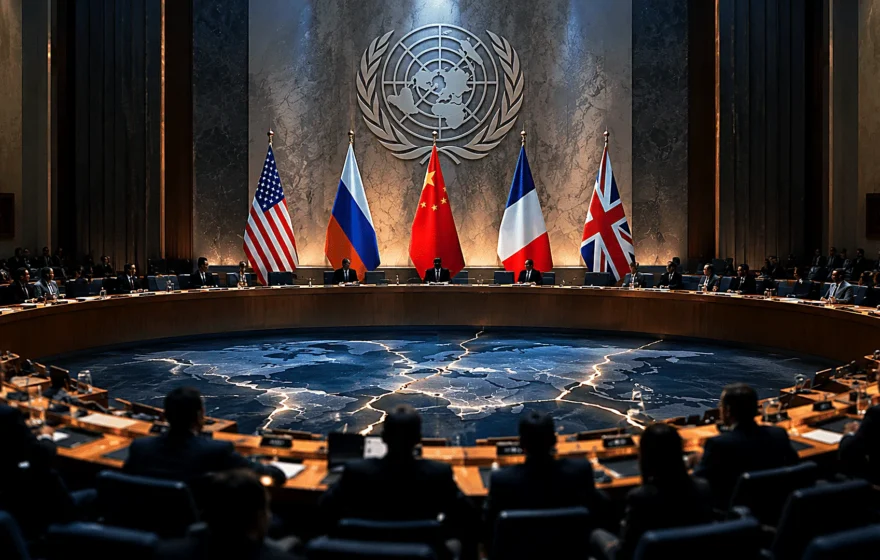
The veto belongs to the five permanent members of the Security Council: the United States, Russia, China, France and the United Kingdom. It was written into the UN Charter in 1945, when the founders believed keeping the great powers inside the new organisation mattered more than anything else, even if that meant giving each of them the power to stop the Council in its tracks. The Council has fifteen members in total, with ten elected members serving alongside the five permanent ones, but only the permanent five hold the veto, and a single negative vote from any one of them defeats a substantive resolution outright.
Sarwani warned that this misuse does more than delay individual decisions. It undermines the effectiveness of the Security Council and damages the credibility of the United Nations as a whole, he said, because it hands the permanent five unmatched influence throughout the UN system. When the Council is paralysed, wars grind on and civilians pay the price, while the Assembly debates crises it cannot resolve through the body designed for that purpose. Pakistan also pointed to the unique legitimacy of the General Assembly itself, with its universal membership and democratic decision-making, arguing that it must be able to respond when the Council cannot act.
That is why Pakistan reaffirmed its support for General Assembly resolution 76/262, adopted in April 2022, which requires the Assembly to meet within ten working days whenever a veto is cast in the Security Council, so member states can debate the decision in the open. The measure does not overturn a veto, and Pakistan does not pretend otherwise, but it forces an explanation into the daylight and gives the wider membership a formal chance to hold the vetoing state to account. Sarwani stressed, however, that any steps to restrain the veto must remain consistent with the UN Charter, a reminder that reform must be negotiated within the organisation’s rules rather than simply declared.
The sharpest part of Pakistan’s position concerns what should not happen next. Alongside the Uniting for Consensus group, which Pakistan leads together with Italy, Islamabad opposes the creation of any new permanent seats on an expanded Council. The rival campaign comes from the G4 group of India, Brazil, Germany and Japan, which has pressed for permanent membership, and Pakistan’s envoy argued that adding more permanent members and extending veto privileges would only deepen existing inequalities, perpetuate historical privileges, create new centres of power and increase the risk of institutional paralysis. A Council with more vetoes, in other words, would be a more crowded version of the same problem.
Instead, Pakistan wants a larger elected membership with a bigger role in the Council’s work. A bigger elected tier, Sarwani argued, would make decision-making more democratic and would act as an effective check on the veto, because elected members answer to the wider Assembly through regular votes rather than holding their seats for life. Pakistan itself was elected as a non-permanent member of the Council in 2024, and its argument carries the weight of a country that has sat at the table as an elected member. The message is to expand the part that is chosen and accountable, not the part that is permanent and unchallengeable.
The honest difficulty facing Pakistan’s demand is that the veto cannot simply be voted away, since any formal change to the Charter would need the consent of the very countries that hold it. That is why the debate keeps returning to restraint rather than removal: voluntary limits, clearer explanations, and the Assembly’s power to debate every veto in public. Those tools may look modest beside a call for abolition, but Pakistan’s strategy is to keep using them to make the cost of a veto visible, and until the Council can act when wars demand action, the case for restricting the veto will keep returning to the Assembly floor.
