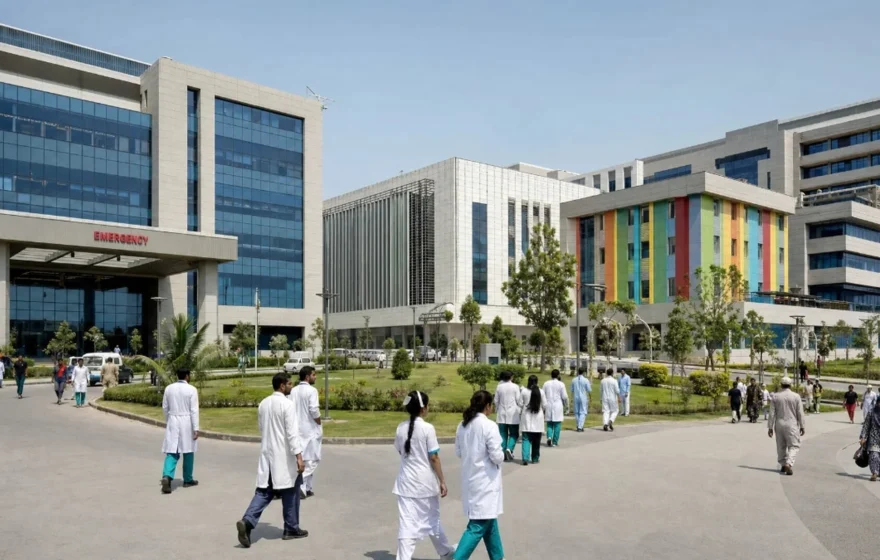
Punjab has cleared close to Rs18.78 billion for a new medical district in Lahore that is meant to give patients far better access to specialist treatment for bones, spines and long-term recovery. The Provincial Development Working Party approved the scheme at its eleventh meeting of the current financial year, and the project will be built around the Sharif Institute of Orthopedics, Spine and Rehabilitation in the provincial capital. The price tag, put at Rs18,786 million in the official meeting record, makes it one of the largest single health schemes approved in that sitting, and a sign that the province wants dedicated capacity for conditions that need months of careful treatment rather than a short hospital stay.
The meeting was chaired by Dr Naeem Rauf, chairman of the Planning and Development Board in Punjab, and it approved ten schemes across different sectors with a combined value of about Rs60 billion. The board’s secretary, Rafaqat Ali, its chief economist, Dr Farrukh Naveed, other board members and officers from the departments concerned were present. That matters, because the working party tests a proposal before money is committed, and a scheme that survives it has cleared an important hurdle even though construction still lies ahead.
At the heart of the scheme is a straightforward idea. A patient with a badly healed fracture, a damaged spine, or a disability after an accident or illness often needs more than one kind of help: an operation, then physiotherapy, then assistive equipment, then follow-up over many months. When those services are scattered across different hospitals, or are available only in a general orthopaedic ward already full of trauma cases, patients wait, travel, or go without the rehabilitation that would let them walk, work or live independently again. A district built around orthopaedics, spine care and rehabilitation should bring those stages together in one place.
The same sitting also cleared other projects that show where Punjab’s development spending is pointed. Three centres of excellence are to be set up at Shahdara in Lahore, covering advanced automotive technologies, modern woodworking and construction. The rehabilitation of the Gujrat-Sargodha road was approved in revised form, while the dualisation of the road from the Lilla interchange on the M-2 motorway to Pind Dadan Khan was referred to the federal Public Sector Development Programme. Schemes for industrial estates and solar panels on courts were also cleared, along with position papers on hospital solarisation and more time for the Mahota Dam project. Against that list, the medical district is the largest health commitment of the day.
The approval fits into a longer story about this site. Earlier in the year, the chief minister approved a plan for seven major hospitals to be developed in phases within the Nawaz Sharif Medical District, with a combined capacity of 1,519 beds. That plan included an orthopaedic rehabilitation institute and a fourth children’s hospital, together with burns, genetic and blood diseases, nursing, eye and infectious diseases facilities. The new approval does not by itself build those hospitals, and the meeting record does not say how the Rs18,786 million relates to that wider plan or when each part will open. But it does move the district from announcement towards a funded scheme.
Why such a facility is needed is clear from the experience of patients and doctors in the province. Specialists have warned that back pain is one of the most common complaints in clinics in southern Punjab, yet the region has no dedicated spine-care centre, leaving many people without a proper diagnosis or follow-up. At Lahore’s Jinnah Hospital, the orthopaedic department has long carried a heavy trauma load, while limited facilities have held it back from offering the full range of joint replacement, spine and keyhole surgery. Punjab has also been building paraplegic centres, with a hub at Multan and satellite sites elsewhere, because people who survive a serious injury can still be left permanently disabled without rehabilitation and family training.
It is worth being clear about what this approval does and does not mean. A working party approval releases a scheme into the development programme; it is not an opening ceremony, and the public record gives no construction timetable, no staffing plan and no date on which patients will be admitted. Those details will matter more than the headline figure, because specialist hospitals fail when they are built without surgeons, physiotherapists, nurses and technicians to run them. The province’s recent experience with delays in releasing funds for insured treatment is a reminder that approval and delivery are two different things.
If the district is delivered as planned, its value will show up in quiet ways. Waiting lists for spine and joint surgery in Lahore’s big public hospitals should ease, because some of the most complex cases will have somewhere else to go. Patients who now travel to the capital repeatedly, for a consultation, then an operation, then rehabilitation, may find those stages joined up in one place. And the province will gain a training base for future orthopaedic, spine and rehabilitation specialists. None of that is guaranteed by a meeting minute, but it is the standard against which this scheme should now be measured.
