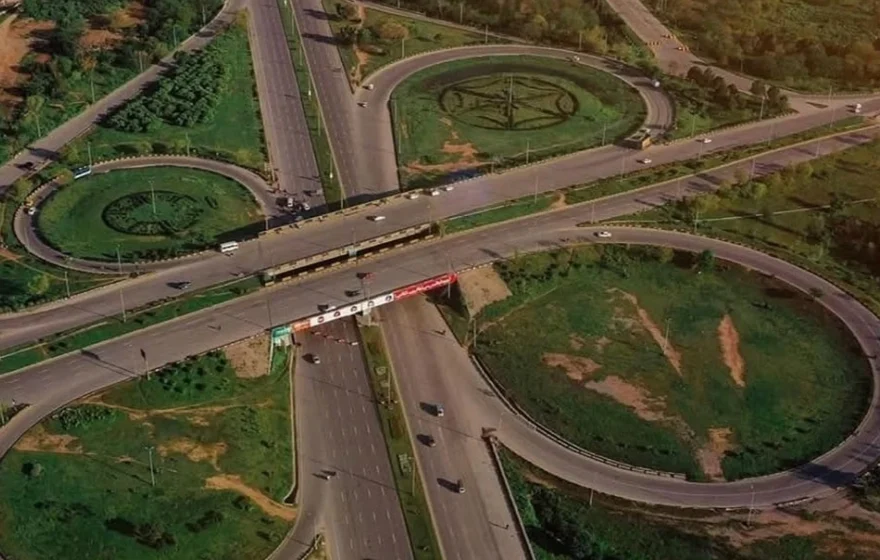
Punjab has moved a long-discussed road upgrade in Jhelum district a step closer to funding, referring a scheme to widen the link between the Lilla Interchange on the M-2 motorway and Pind Dadan Khan to the Public Sector Development Programme. The project carries an estimated cost of Rs20,809 million, or about Rs20.8 billion, and its purpose is straightforward: to ease congestion on a busy route, improve the journey for ordinary commuters, and make it easier for freight to move between the motorway and the towns that depend on it.
The decision was taken by the Provincial Development Working Party, the body in Punjab that examines development proposals before they move forward. It came at the working party’s eleventh meeting of the current financial year, chaired by Planning and Development Board Punjab Chairman Dr Naeem Rauf, with the board’s secretary, Rafaqat Ali, its chief economist, Dr Farrukh Naveed, and officers from the departments concerned also in attendance. That matters, because a scheme of this size touches planning, finance, construction and local administration, all of which need to agree that the numbers add up.
Referral to the Public Sector Development Programme is not the same as construction starting tomorrow, and it is worth being clear about what it does and does not mean. The programme is the federal government’s main vehicle for funding development projects, and a referral puts a scheme in line for consideration at that level, where its cost, scope and readiness are examined again before money is released. For a project already through several rounds of discussion, that step is still significant: it signals that the provincial government has settled on the scheme as a priority and is now seeking the federal funding route.
The road itself is more than a line on a map. The Lilla Interchange connects traffic to and from the M-2, the motorway linking Lahore and Islamabad, while Pind Dadan Khan sits in Jhelum district in a part of Punjab shaped by the River Jhelum on one side and the Salt Range on the other. Settlements in the tehsil have long followed the road through them, so when it is narrow, damaged or congested, daily life feels it quickly. Schoolchildren, traders, farmers and patients travelling for treatment all use the same corridor, and a single road carrying that much mixed traffic is always under strain.
Widening a road, which engineers call dualisation, is not simply about adding another lane for the sake of it. A dual carriageway separates traffic travelling in opposite directions, gives slower vehicles such as trucks and tractors somewhere to go without holding up everyone behind them, and reduces the head-on collisions that single carriageways are prone to. For freight, that separation matters as much as speed, because a truck needs a predictable journey rather than one thrown off by a bottleneck. For families, the benefit is quieter but no less real: a safer, more reliable trip to a hospital or a market.
This corridor has a history that helps explain why local people watch these announcements so closely. In June 2021, the Executive Committee of the National Economic Council approved the dualisation of the route from the Lilla Interchange via Pind Dadan Khan to Jhelum, including two bypasses, at a rationalised cost then put at Rs12.760 billion, with bridges over streams, culverts and retaining walls in its scope. Since then, the corridor has been the subject of repeated debate about funding, with residents and traders at times protesting when work stalled and money appeared to dry up. In 2024, traders and residents demanded that funds be restored, arguing that business had suffered and that patients were among those hit hardest when the road was in poor condition.
More recently, the Punjab government has taken a more direct role in pushing the corridor forward. In late 2024, Rs10 billion was released for the 128-kilometre Lillah to Jhelum dual carriageway, and in July 2026 a review meeting set December as a completion deadline for the wider scheme, while officials discussed shifting poles and widening railway crossings. The new referral, at Rs20.809 billion, should therefore be read alongside that longer effort rather than as a project invented from nothing: it is the latest formal step for a route whose upgrade has been promised, started, delayed and revived over several years, and whose final cost has risen as prices and scope have changed.
What happens next will matter more than the announcement itself. A referral still has to be followed by funding decisions, detailed design work, and a construction timetable that residents can hold the authorities to. The history of this corridor gives people good reason to ask those questions, and to judge the project not by its headline figure but by whether the road is finished, maintained and safe to use. If it is, the gain will be felt in everyday ways: shorter and safer journeys, steadier trade for small towns along the route, and a stronger link between Jhelum district and the motorway network. For now, the decision shows the direction of travel, and the test will be whether the funding follows.
