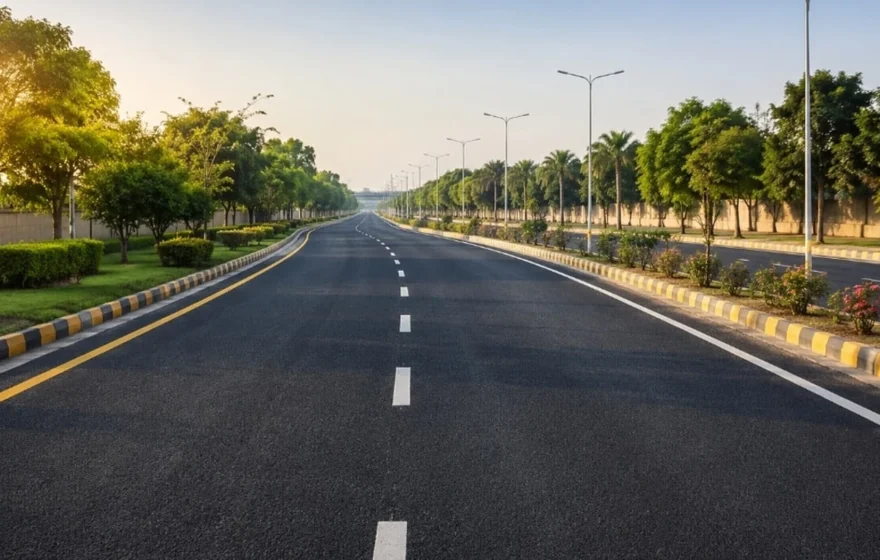
Punjab has cleared a revised plan worth Rs11,989 million to rebuild the Gujrat to Sargodha road in Mandi Bahauddin district, a route that carries people and goods between three busy centres. The decision was taken by the Provincial Development Working Party, the body that examines and approves development schemes for the province, at its eleventh meeting of the current financial year. The road scheme was one of ten projects approved at the same sitting, with a combined value of about Rs60 billion, and it matters because of the part this road plays in everyday life along it.
The meeting was chaired by Dr Naeem Rauf, the chairman of the Planning and Development Board in Punjab. He was joined by the board secretary, Rafaqat Ali, the chief economist, Dr Farrukh Naveed, other board members and officers from the departments concerned. That mix matters, because a road project of this size touches more than one department: planning and finance must be satisfied that the money is justified, while the departments that will build and maintain the road must be ready to deliver it. The approval therefore marks the point at which a revised scheme moves from paper to preparation for work on the ground, rather than the end of the process itself.
The road runs from Gujrat to Sargodha through Mandi Bahauddin, and its importance is easy to understand once the geography of the area is taken into account. Mandi Bahauddin sits between the Jhelum and the Chenab rivers, in fertile farming country where wheat, rice, sugarcane and other crops are grown and taken to market. The town grew up as a grain market, and its name still reflects that history, with mandi meaning market. Farmers, traders and transporters all depend on reliable roads to move produce, and a worn road adds time, cost and risk to every journey. When a road linking three district centres is in poor condition, higher transport costs and delays feed through into prices, deliveries and access to services.
The same road also connects Mandi Bahauddin with the wider transport network of Punjab. From the Gujrat to Sargodha route, travellers can reach the Grand Trunk Road and the Lahore to Islamabad motorway, opening up routes to Lahore, Islamabad and other major cities. For students, patients, workers and families, a smoother road means shorter and safer journeys. For businesses, it means lorries can move more reliably and smaller towns are less likely to be cut off when weather or heavy traffic takes its toll on a weak surface. Rehabilitation here is not simply a fresh layer of tarmac; it is about restoring a road so it can carry the traffic it now faces, year after year, without quickly falling back into disrepair.
The road scheme was approved alongside nine other projects, and the wider package shows where the provincial government is putting its development money. The working party also approved the dualisation of the road from the Lilla interchange on the M-2 motorway to Pind Dadan Khan in Jhelum district, at an estimated cost of Rs20,809 million, a scheme referred to the Public Sector Development Programme. Three centres of excellence in Shahdara, Lahore, were also approved, covering advanced automotive technologies, a modern woodworking service centre and the construction sector, at a combined cost of more than Rs2,900 million. A scheme to upgrade the Punjab Small Industries Corporation’s small industrial estates was cleared at Rs2,750 million, while a revised scheme to solarise district and sessions courts and high court benches was approved at Rs2,610 million.
Healthcare and water also featured in the same meeting. The working party approved the Nawaz Sharif Medical District in Lahore, at the Sharif Institute of Orthopedics, Spine and Rehabilitation, at an estimated cost of Rs18,786 million. It considered the solarisation of tehsil headquarters hospitals, approving a position paper on a change in the type of vehicles to be used, and it approved a position paper seeking more time for the revised Mahota Dam project. Taken together, the ten approvals cover roads, industry, skills, health, energy and water, balancing visible infrastructure with the less visible work of training people and improving public services.
For the people of Mandi Bahauddin, Gujrat and Sargodha, however, the road itself will be the measure of success. Approvals and cost figures are only the beginning, and residents will rightly judge the project by whether work starts promptly, whether traffic is managed sensibly while it is under way, and whether the finished road stays in good condition. A rehabilitated road should reduce journey times, cut vehicle wear and tear, improve safety and make it easier for farmers and traders to reach larger markets. The challenge now is to turn a revised scheme on a meeting agenda into a road that drivers can trust, without long closures that punish the very communities the project is meant to help. If that happens, the close to Rs12 billion spent on this one stretch will have bought far more than a smoother drive; it will have strengthened the link between three important cities and the farming heartland between them.
