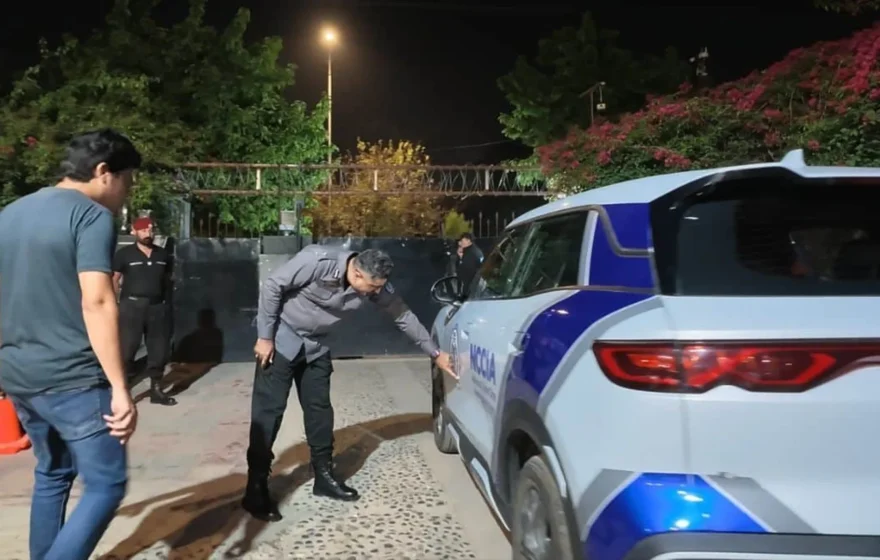
Pakistan’s National Cyber Crime Investigation Agency has added new BYD Atto 2 electric vehicles to its official fleet, giving the country’s dedicated cybercrime body a modern, battery-powered addition. Its director general, Syed Ali Nasir Rizvi, personally inspected the newly provided vehicle, looking closely at its condition, build quality and suitability for the agency’s operational duties. According to an agency official, the point was to make sure the vehicle could meet the agency’s practical needs and help its officers work more efficiently, rather than simply adding another car to a parking lot.
The agency itself shared the development publicly on 27 October 2026, in a post showing the director general examining the vehicle. The Urdu-language message described how he had reviewed the car’s condition, quality and usefulness so it could support the agency’s operational requirements. That emphasis matters, because the NCCIA is not a ceremonial body: it is a working investigative agency, and its transport needs are tied to field visits, coordination with other departments and the daily movement of staff across the capital.
The NCCIA is still a young institution. Formally established on 3 May 2024, it took over from the Cybercrime Wing of the Federal Investigation Agency, which was dissolved as its cases and responsibilities were transferred to the new body. Headquartered in Islamabad and working under the Ministry of Interior, it was given full authority to prevent, investigate and prosecute cybercrime across Pakistan under the Prevention of Electronic Crimes Act. Its remit covers online fraud, harassment, digital blackmail, identity theft, fake websites and social media crimes, and that workload has only grown as more of daily life and business moves online.
Fleet decisions in government departments are rarely just about transport: they signal what an institution considers modern and efficient, and they affect running costs for years. Electric vehicles suit agencies whose work is largely city-based, because daily routes tend to be predictable, vehicles return to a central base, and charging can be planned around that routine. For an Islamabad-based agency, those conditions make an electric car a practical working tool rather than a novelty, provided charging keeps pace with the vehicles.
The vehicle chosen is the BYD Atto 2, a compact electric sports utility vehicle and one of the most visible new electric models in Pakistan. Launched here in January 2026 by Mega Motor Company in partnership with BYD, it is built on BYD’s e-Platform 3.0 and uses the company’s Blade Battery technology. It is powered by a front-mounted motor producing 130 kilowatts and 290 newton metres of torque, draws energy from a 45.12 kilowatt-hour battery pack, and accelerates from rest to 100 kilometres per hour in 7.9 seconds. Its driving range is rated at up to 380 kilometres on the NEDC cycle, and the company has claimed running and maintenance costs up to 75 percent lower than those of a similarly sized petrol vehicle.
The NCCIA has not disclosed further details about how many vehicles it has received or what they cost, and that restraint is worth noting plainly. Without those figures, it is not possible to say how large this addition is or how it compares with the agency’s existing fleet, and any reporting that filled in those gaps would be guessing. What is clear is that the agency chose to publicise the inspection itself, with its director general front and centre, which suggests it wants the addition to be seen as part of a deliberate effort to modernise rather than as a quiet procurement.
That context becomes clearer when the move is placed alongside what other Islamabad institutions have already done. Islamabad Traffic Police had previously inducted BYD Atto 2 vehicles into its own fleet, and in September 2026 Islamabad Police received 50 new BYD electric cars for its Capital Patrol Unit and traffic duties. Prime Minister Shehbaz Sharif handed those vehicles over on 8 September, presenting the keys to Interior Minister Mohsin Naqvi and the then Inspector General of Islamabad Police, Syed Ali Nasir Rizvi, the same officer who now leads the NCCIA. The new 200-strong Capital Patrol force marked the rollout with a flag march from D-Chowk through major roads of the capital, and officials said the vehicles would strengthen patrolling and support greener policing. Briefings put the expected fuel saving at around 34 million rupees a month, which, if borne out, would recover each car’s cost in about ten and a half months.
Seen together, these steps describe a broader shift rather than isolated purchases. Islamabad’s police and traffic institutions, and now its cybercrime agency, are moving in the same direction, towards electric vehicles for urban operational roles, under the same government push for modern, safe and environment-friendly policing. The pattern also reflects BYD’s growing presence in Pakistan, where its cars are increasingly chosen for institutional as well as private use. Their real test will always be operational: whether they are charged, maintained and deployed reliably enough to earn their place. What happens next will be more revealing than the inspection, as observers look for how many vehicles the NCCIA received and whether its charging infrastructure keeps up.
