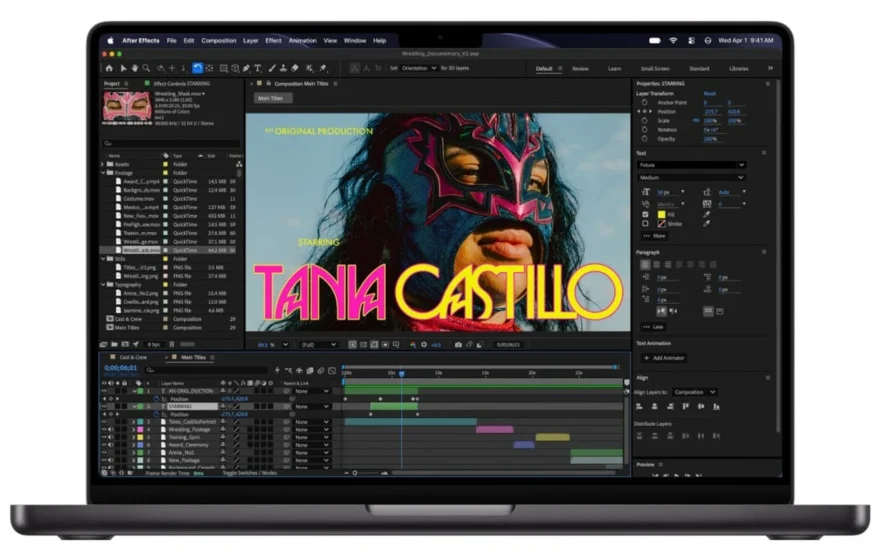
Apple has refreshed two of its most familiar computers at once, bringing its newest M6 processor to the 14-inch MacBook Pro and to the iMac. Both machines gain faster processing, newer wireless connectivity and stronger support for artificial intelligence tasks carried out on the device itself, rather than in the cloud.
The new MacBook Pro replaces the M5 model, which arrived in 2025, so this update comes only a short time after the previous generation. The iMac has waited longer, receiving its first processor upgrade since the M4 version launched in 2024. That contrast matters for buyers, because the desktop refresh closes a wider gap and should feel like a more obvious jump for anyone still using the older model.
The new 14-inch MacBook Pro uses the M6 chip, with a 12-core central processor and a 12-core graphics processor. The processor combines two high-performance cores, four further performance cores and six efficiency cores, a mix meant to give heavy tasks power while letting lighter work run without draining the battery. The graphics side carries Neural Accelerators in every core and supports hardware-accelerated ray tracing, which helps video editing, design work and games.
Apple has also fitted a Dual 16-core Neural Engine to speed up machine-learning work behind image processing, transcription and on-device AI tools. According to the company, the laptop delivers graphics performance up to 30 percent faster than the M5 model, and AI performance up to 25 percent better. Those are Apple’s own figures, and testing will show how they hold up, but they point to a machine for people who expect AI features to run quickly and privately on their own computer.
The MacBook Pro comes with 16GB of unified memory as standard, with options to move up to 24GB or 32GB. The base version offers memory bandwidth of 153GB per second, while the larger options support up to 170GB per second. Storage starts at a generous 1TB, with 2TB and 4TB versions for people who work with large video files or photo libraries.
Connectivity gets a quiet upgrade through Apple’s new N1 wireless chip, which adds Wi-Fi 7 and Bluetooth 6. Faster, more stable wireless matters most where many devices share one network. Apple also claims up to 24 hours of battery life on a single charge, which, if it holds up in real use, would cover a full working day without hunting for a socket.
Much else stays the same. It keeps the 14-inch Liquid Retina XDR display, the 12MP Center Stage camera, a six-speaker audio system and the same ports. It runs macOS 27 and comes in Space Black and Silver, so buyers are paying for speed, battery life and AI capability rather than a new shape.
The iMac update is broader in one respect, because Apple offers two M6 configurations rather than a single chip. The entry-level model uses a 10-core processor, made up of two high-performance cores, three further performance cores and five efficiency cores, alongside a 10-core graphics processor. The higher-end version matches the MacBook Pro with a 12-core processor and a 12-core graphics processor. Both support hardware-accelerated ray tracing, Neural Accelerators in their graphics cores and the same Dual 16-core Neural Engine.
Apple claims the new iMac can deliver on-device AI performance up to five times faster than the previous M4 model. For a family computer, that could mean faster photo organisation, smoother video calls and quicker local search without sending every task to a remote server. The real test will be whether users notice that speed in the apps they open every day.
Both iMac configurations come with 16GB of memory and 256GB of storage as standard, a more modest starting point than the laptop’s. The entry-level model can be upgraded to 24GB, while the higher-end version can take 24GB or 32GB. Apple lists memory bandwidth of 170GB per second for both, including the base versions. Storage can be raised to 512GB or 1TB on either model, and the higher-end iMac also offers 2TB, so buyers with large media collections should think before settling for the base drive.
The iMac also gains the N1 wireless chip, bringing Wi-Fi 7 and Bluetooth 6 to the desktop, plus an optional nano-texture glass finish to cut reflections. Apart from these changes, it keeps the same design as its predecessor, so the upgrade is again about performance rather than a fresh look.
Pricing puts the two machines in different brackets. The 14-inch MacBook Pro starts at 1,999 dollars, while the iMac starts at 1,499 dollars for the 10-core model and 1,699 dollars for the higher-end 12-core version. Pre-orders opened on October 28, with sales starting November 6. The choice between them comes down less to which chip is newer, since both use the M6, and more to how you work: the MacBook Pro for portability and battery life, the iMac for a settled desk and a lower starting price.
