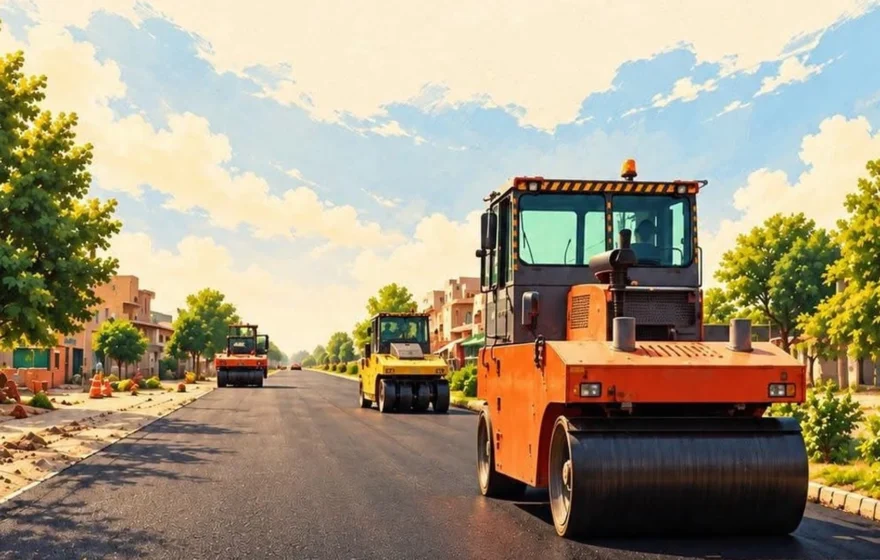
Punjab Chief Minister Maryam Nawaz Sharif has inaugurated a road scheme linking Gujrat and Sargodha through Mandi Bahauddin, a project the provincial government says will make travel easier and trade smoother across a busy stretch of central Punjab. The chief minister reached King Chowk in Mandi Bahauddin during her visit to the district, where the provincial minister for communications and works, Malik Sohaib Ahmed Bharth, briefed her on the Gujrat to Sargodha Road project and its expected benefits for the people who use it every day.
The scheme, put at Rs9.8 billion, covers the construction and rehabilitation of about 94.30 kilometres of road. The work also includes solid shoulders along the dual carriageway section in Mandi Bahauddin district. Shoulders give slow-moving traffic, broken-down vehicles and pedestrians somewhere safe to go, and they help protect the edge of the carriageway from breaking up under heavy use. On a road carrying cars, buses, trucks, tractors and motorcycles, that margin can be the difference between a journey that flows and one that ends in a dangerous squeeze.
The route links three district centres, and it is used by people travelling for work, study, medical treatment and family visits, as well as by traders moving goods from one market town to the next. Mandi Bahauddin sits in farming country between the Jhelum and the Chenab rivers, and its very name recalls its history as a grain market. For farmers in the surrounding villages, a reliable road decides how quickly produce reaches a market, how much of it is damaged on the way, and how much transport costs eat into what a family earns from a harvest.
That is why a project of this kind is judged not by the ceremony that launches it but by the condition of the surface in the years that follow. A newly rebuilt road can cut journey times, reduce wear on vehicles and make it easier for emergency services to reach villages that are otherwise hard to get to. A road that is poorly built or poorly maintained, on the other hand, soon returns to the same potholes and dust that prompted the spending in the first place. The real test will come in the months after the inauguration, when the communications and works department has to turn a promise into a finished, durable road.
The inauguration did not happen in isolation. It came after the scheme had already passed through the province’s planning process earlier in the same week, when the Provincial Development Working Party cleared a batch of development schemes for Punjab. That sequence shows how large public works move in stages, from a proposal on paper, through scrutiny by planning and finance officials, to a formal launch on the ground. The inauguration is therefore best read as the start of delivery rather than the end of the story.
The visit covered more than the road. She also inaugurated the beautification of Sadar Bazaar, completed at Rs6.99 crore, which restored the bazaar’s traditional entrance gate and added tuff tiles, streetlights and a fountain. The Old Grain Market has been rehabilitated at Rs9.70 crore and turned into a park with a memorial and modern facilities. Alongside those works, the University of Rasul has been established at Rs9.79 billion, with academic blocks, a student services centre, hostels and residential units. The chief minister also visited the memorial to the 1849 Battle of Chillianwala.
Taken together, the announcements show how a high-profile visit can bundle roads, town improvements and education projects into a single message about progress. For residents, the bundle can be welcome, because a town needs more than one kind of improvement at a time. A better road helps a student reach a college, a restored bazaar helps a shopkeeper attract customers, and a new university gives young people a reason to study closer to home. The challenge is to make sure that each part of the package is finished to a good standard, and that the smaller works are not forgotten once the headlines fade.
There are also questions that the inauguration itself does not answer. The briefing reported from King Chowk did not set out a completion date for the road works, nor a timetable for each section of the route. Residents along the 94-kilometre stretch will want to know which sections come first, how traffic will be managed while work is under way, and who is responsible if the surface deteriorates soon after it is laid. The credibility of the project will depend on how clearly those practical questions are answered in the weeks ahead.
For now, the inauguration marks a clear commitment. The Punjab government has put a substantial sum of public money behind a road that tens of thousands of people depend on. If the work is carried out well, the benefits will be felt in lower transport costs, safer journeys and better access to markets and services. If it is not, the gap between the announcement and the experience of drivers will be obvious to everyone who uses the road. That is the measure by which this project will ultimately be judged.
