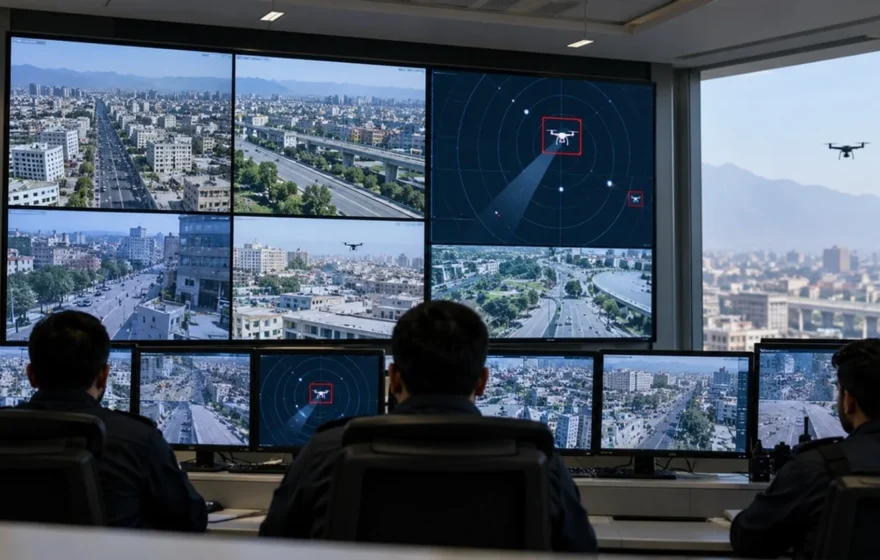
Peshawar’s Safe City Project has taken a major technological step, linking drone and anti-drone systems directly into its central command network in a move police officials describe as the first of its kind in Pakistan. The integration means that unmanned aerial vehicles and the equipment designed to detect them will no longer operate as separate tools but will feed into the same control room that already watches the city’s streets through its surveillance cameras. For a city that waited years for modern surveillance, the addition marks a shift from fixed cameras on poles to eyes in the sky.
According to police officials, the anti-drone system can detect and monitor drones within a five-kilometre radar range, automatically generating alerts and notifying the Safe City control room whenever suspicious drone activity is picked up. That automatic alert is the heart of the new capability. In the past, spotting a small drone over a crowded area or a sensitive building depended on someone happening to notice it and raising the alarm. Now the radar itself is expected to do the noticing, giving the control room a warning while there is still time to respond. The system is designed to watch over sensitive locations, traffic and criminal activity around the clock, helping officers identify potential security threats and terrorist activity before an incident unfolds rather than piecing together what happened afterwards.
The drone surveillance system will operate not only in Peshawar but also in Dera Ismail Khan, Bannu and Lakki Marwat, three southern districts of Khyber Pakhtunkhwa where security pressures have been most acute. Live feeds from Safe City drones will allow officials to monitor field operations in real time, so commanders in the control room can watch an operation as it happens and direct officers on the ground with a clearer picture of what they are walking into. The system will also provide operational support to the Counter Terrorism Department, whose work against militant networks depends heavily on timely and accurate intelligence. In districts where distances are long and terrain is difficult, an aerial view can make the difference between a police party arriving blind and arriving prepared.
The new capability arrives on top of a project that itself took a long time to reach the streets. The idea of a Safe City for Peshawar was first proposed in 2009, alongside similar projects for Lahore and Islamabad, but while those two cities built their systems years ago, Peshawar’s remained on paper through repeated delays. Work finally moved forward under an agreement between the Khyber Pakhtunkhwa Police and the National Radio and Telecommunication Corporation, and the project was formally launched in 2025, with more than 700 cameras installed at over 130 locations across the capital at a reported cost of around Rs2.23 billion.
Those cameras were never intended to stand alone. The command centre was designed as a single platform bringing together surveillance, emergency response and traffic management, and later additions widened its reach, including feeds from cameras along the Bus Rapid Transit corridor. The drone integration is the latest layer in that design, adding a mobile, aerial perspective to a network that was previously fixed to the ground.
It also builds on work the provincial police had already begun in the air. In March 2026, Khyber Pakhtunkhwa Police established what they described as Pakistan’s first dedicated unmanned aerial vehicle division, and police had already deployed anti-drone equipment in response to attacks involving quadcopters in parts of the province. Linking those assets into the Safe City network closes a gap: aerial surveillance now shares the same screens, alerts and command structure as the city’s main monitoring system.
The expansion beyond Peshawar matters because the southern districts named in the announcement face a different challenge from the capital. Police there have often had to cover large areas with limited manpower, and Safe City projects are already underway in those districts, with plans prepared for Tank, Karak and North Waziristan as well. A drone unit tasked from a central control room offers something fixed cameras cannot: the ability to move the camera to wherever the incident is, rather than hoping the incident happens in front of a camera.
There are questions that any expansion of surveillance raises, and they will follow this one too. Residents will want to know how footage is stored, who can access it and what safeguards exist against misuse, and the province has pointed to the planned Khyber Pakhtunkhwa Safe Cities Authority Act as the legal framework that will govern the network. If the drone integration works as described, its value will show up in the ordinary work of policing: faster alerts on suspicious aerial activity, live pictures for officers heading into an operation, and a control room that can see across four districts at once. Peshawar’s Safe City story began as a long-delayed promise of cameras on street corners. With drones and anti-drone radar now wired into its command centre, that promise has grown into something broader, and the southern districts are set to be its next test.
