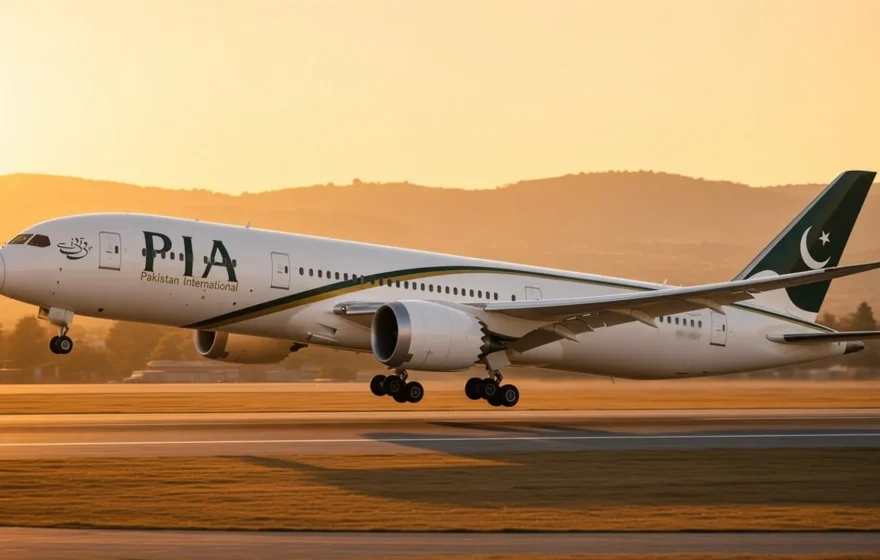
Pakistan International Airlines has taken a step that its passengers will feel in a very practical way. Its first Boeing 787-9 Dreamliner has arrived in Islamabad, flown in from London as flight PK-786, and it is the first aircraft of its kind to join the fleet of any airline in Pakistan. For a carrier rebuilding its network route by route, it means more seats, a more comfortable journey, and, on paper, the ability to fly much farther without stopping.
The aircraft is one of two 787-9s that PIA is taking from Norway’s Norse Atlantic Airways under a wet lease, an arrangement in which the leasing airline supplies the aircraft together with its crew, maintenance and insurance. PIA signed the agreement in October to use the leased jets to add capacity between Pakistan and the United Kingdom, where demand has been strong since direct flights returned.
British authorities closed their skies to Pakistani airlines in 2020, after a fatal crash in Karachi and serious questions about pilot licensing and safety oversight. The European aviation authority lifted its suspension in November 2024, and Britain removed Pakistan from its Air Safety List in July 2025. PIA then resumed Manchester flights in October 2025, returned to London Heathrow in March 2026, and has since added frequencies, with London services rising to seven flights a week from late October and a new Islamabad to Birmingham service due from December 1.
Boeing 787-9 Key Specifications
The numbers behind the new arrival help explain why airlines value this particular aircraft. In a two-class layout, the 787-9 can carry between 250 and 325 passengers, depending on how an airline arranges its cabins, and Norse lists its own aircraft in this family with 338 seats, split between 56 in Premium and 282 in Economy. The jet can fly up to 8,300 nautical miles, or about 15,370 kilometres, without refuelling. It measures 62.8 metres in length, with a wingspan of 60.1 metres and a height of 17 metres, and its maximum takeoff weight is 259,220 kilograms. Its two engines are either the GE GEnx-1B or the Rolls-Royce Trent 1000.
Those figures are worth reading alongside the distances PIA actually flies. Islamabad to London is roughly 6,000 kilometres, comfortably inside the aircraft’s range, and the jet’s reach also covers far longer journeys in theory. Yet specifications alone do not create a route: airlines must still weigh demand, slots, crew, fuel costs and the commercial case, and regulators must approve the operations. The range is best understood as room to grow, not a promise of new destinations.
What Is Different Onboard
What passengers notice first about a Dreamliner is rarely its range, and the 787-9 has several features that set it apart from the older jets it typically replaces. About half of its airframe is built from carbon-fibre composites rather than traditional aluminium, and Boeing says that construction helps cut fuel use by around a quarter compared with the aircraft it usually succeeds. That matters because fuel is one of an airline’s largest costs.
The composite body brings a second, more personal benefit. It allows the cabin to be pressurised at an altitude equivalent to 6,000 feet, which is 2,000 feet lower than on conventional jets, and it allows higher humidity in the cabin. Boeing says that combination reduces tiredness and jet lag on long flights. The aircraft also has the largest windows of any wide-body jet in service, with electronic dimming instead of plastic shades.
What the Range Means for PIA
For now, PIA has said the new aircraft will add capacity on its United Kingdom routes, following its clearance to operate the 787 in Pakistan, and that is the sensible place to start. London and Manchester are proven markets with deep family and business ties, and extra seats there are likely to be filled quickly. The Birmingham service, due from December 1, also becomes easier to support if Dreamliner capacity frees up other aircraft. What matters for travellers is more direct options and a better chance of finding a seat on the day they want to travel.
Looking further ahead, the range figures invite a broader question. On paper, a nonstop flight from Islamabad to New York, a distance of roughly 11,000 kilometres, sits well within what the 787-9 can do, and that has naturally caught the attention of people who remember when PIA flew to North America. It would be wrong, however, to treat a paper range as a route announcement: a transatlantic service would need its own commercial case and approvals. The second leased Dreamliner will be the next test, because a pair of jets gives far more flexibility to protect the schedule. The real measure of success will not be the specifications on a page, but whether passengers find the new aircraft reliable, comfortable and available when they need it.
