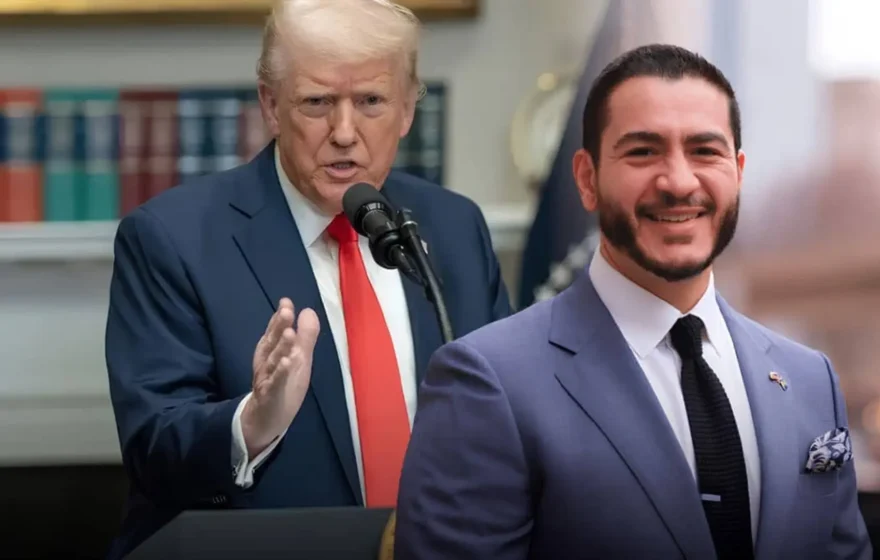
Abdul El-Sayed has moved to the centre of American politics in the final days before the midterm elections, as President Donald Trump has repeatedly targeted the Michigan Democrat on the campaign trail. El-Sayed, a doctor and public health specialist, is seeking the United States Senate seat left open by Senator Gary Peters, and his contest against Republican Mike Rogers has become one of the most closely watched races in the country. With voting set for November 3, 2026, the campaign has turned into a wider argument about health care, foreign policy and the place of Muslim Americans in public life.
El-Sayed was born and brought up in southeastern Michigan, the son of Egyptian immigrants, and his working life has been built around medicine and public health. He studied at the University of Michigan, went to Oxford University as a Rhodes Scholar and completed a doctorate in public health, and later earned his medical degree from Columbia University. After teaching epidemiology at Columbia, he returned to Michigan to rebuild the Detroit Health Department after the city’s municipal bankruptcy.
A Second Run at High Office
This is not El-Sayed’s first attempt to win a major statewide office. In 2018 he ran for governor of Michigan as a progressive candidate, drawing backing from Senator Bernie Sanders and Representative Alexandria Ocasio-Cortez, but he lost the Democratic primary to Gretchen Whitmer. In 2026 he returned to electoral politics, and on August 4 he narrowly won the Democratic primary, defeating Representative Haley Stevens by roughly one percentage point, with about 48.5 percent of the vote against her 47.5 percent. That close result set up a general election contest that both parties now regard as nationally important, since Republicans already control the Senate and Democrats must hold this seat and gain ground elsewhere to win back a majority.
There are real and deep policy disagreements between the two men. El-Sayed belongs to the progressive wing of the Democratic Party and has campaigned for a single-payer health system, often described as Medicare for All, for tighter limits on corporate influence in politics and for a larger government role in health care. On foreign policy he has called for an end to American military assistance to Israel, a position that has divided opinion even inside his own party and has become one of the sharpest dividing lines of the campaign.
Claims Checked Against the Evidence
Yet much of the recent attention has not been about those policy arguments. Trump has repeatedly turned his fire on El-Sayed’s Muslim faith, describing him in harsh terms and questioning his loyalty. At a rally in Port Huron on October 25, he told supporters that he had come to Michigan to stop what he called a jihadist member of the Muslim Brotherhood from reaching the Senate, and he suggested that El-Sayed could not be trusted with classified information. He also linked the campaign to the September 11 attacks and claimed that El-Sayed wanted the United States to be governed under Sharia law.
Those claims have been examined closely by independent fact-checkers, and they have not held up. El-Sayed has repeatedly denied belonging to the Muslim Brotherhood and has publicly disavowed the organisation. PolitiFact investigated Trump’s description of him and found no evidence that he had been a member or that he had advocated violent jihad, rating the claim false at its strongest level. The Associated Press reached a similar conclusion, reporting that there was no evidence of an affiliation. El-Sayed has also said there is no basis for the suggestion that he wants to replace American law with Islamic law, pointing to his stated support for constitutional religious freedom.
Some of the controversy traces back to older material. Republicans have pointed to social media posts from 2012 by his half-sister, Eman Abdelhadi, in which she wrote about longstanding family connections to the Muslim Brotherhood and her mother’s involvement in the early 1970s. El-Sayed has rejected any attempt to transfer those statements to him, noting that his parents separated when he was young and that he was brought up mainly by his father and stepmother. Critics have also cited a statement he signed in 2012 during Egypt’s political crisis, supporting some of Mohamed Morsi’s actions during a constitutional dispute.
The Final Days
Trump has also repeatedly played with El-Sayed’s name, using variations involving Mohammed, although El-Sayed campaigns as Abdul El-Sayed and his full name is Abdulrahman Mohamed El-Sayed. El-Sayed has accused Trump of trying to make his name and religion sound threatening, and after the Port Huron rally he joked that Trump could simply call him senator if he won. He argues that the attacks on his faith are designed to distract voters from health care, fuel prices, groceries and the cost of living, a point Sanders has echoed on the campaign trail. Whatever happens on November 3, El-Sayed’s candidacy has already turned Michigan into a national debate about progressive politics, Israel, Muslim-American representation and the limits of religious attacks in election campaigns. If he wins, he would become the first Muslim elected to the United States Senate.
