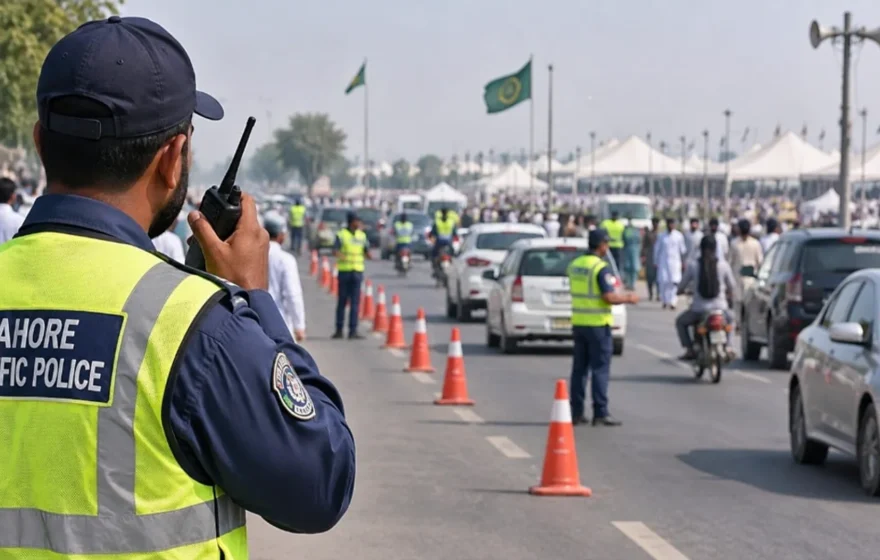
Lahore Traffic Police has announced a comprehensive traffic plan for the annual Raiwind Ijtima 2026, outlining designated entry routes, parking arrangements and traffic diversions for participants travelling from different cities. The religious gathering, one of the largest annual congregations in the country, will take place in two phases, and the plan is designed to keep the huge movement of people and vehicles around Raiwind orderly and safe.
The first phase will run from November 5 to 8, while the second phase will take place from November 12 to 15. The concluding prayers for both phases will take place on Sundays, November 8 and 15, respectively. Those final days are traditionally the busiest, when the largest crowds gather for the closing sermons and prayers before dispersing, and the traffic plan is built around that pattern. Spreading the gathering across two phases already eases some of the pressure, but each phase still brings tens of thousands of participants onto a limited road network, and the police plan treats both phases with the same level of preparation.
Traffic police have designated seven entry routes for participants, including Lahore-Raiwind Road, Sunder Road and Manga Road. Authorities will also establish diversion points at 10 locations to maintain traffic flow. The logic is straightforward: when so many vehicles converge on one area, the worst outcome is for all of them to use the same road. By channelling traffic onto seven routes and diverting vehicles before bottlenecks form, police hope to keep movement steady rather than allowing long queues to build up at a few junctions. Drivers who know their designated route in advance, and stick to it, will do more for the plan’s success than any number of officers on the road.
Parking is a major part of the arrangements. The parking facilities will accommodate 2,800 large vehicles, 5,400 cars and 10,000 motorcycles at designated locations. Those numbers give a sense of the scale involved: this is not a gathering reached mainly on foot, but one to which participants travel in buses, cars and on motorcycles from across Punjab and beyond. Organised parking matters because vehicles left haphazardly along roads quickly narrow the carriageway and create the very congestion the plan is meant to prevent. Participants are therefore advised to use the designated parking areas rather than stopping wherever space appears to be available.
To manage traffic during the gathering, Lahore Traffic Police will deploy 1,103 officers and personnel. The deployment will include seven DSPs, 203 inspectors and senior traffic wardens, and 866 traffic wardens and traffic assistants. Authorities will also deploy 15 lifters and nine breakdown vehicles, a practical detail that matters when a broken-down bus or truck can block a route used by thousands. The presence of lifters means obstructing vehicles can be removed quickly, while breakdown vehicles can deal with mechanical failures on the spot rather than leaving them to worsen congestion. It is the kind of unglamorous preparation that makes the difference between a plan that works and one that falls apart at the first incident.
The plan also sets out approach routes for participants coming from different cities. Those travelling from Gujranwala via GT Road will use the Kala Shah Kaku Interchange on the motorway to reach Raiwind. Those coming from Faisalabad and Sheikhupura will use the Faizpur Interchange, while participants from Okara will travel through the NFC Interchange on Ring Road and Raiwind Road. Publishing these routes in advance allows travellers to plan their journeys, choose the correct interchange and avoid adding to traffic on roads meant for other cities. It also helps local residents, who can plan around the expected movement and use alternative routes where necessary.
Police will provide traffic updates through Rasta FM, the Rasta mobile app and social media platforms throughout the event. That channel matters because a traffic plan is only as good as the information that reaches drivers while they are travelling. Road closures, diversions and congestion points can change during the day, and timely updates allow participants to adjust their routes rather than driving into a jam. Travellers are encouraged to check updates before setting out and to follow the instructions of wardens on duty, whose job is to keep the whole network moving rather than to favour any single route.
Large religious gatherings test a city’s traffic management in ways that ordinary rush hours do not. They combine enormous numbers, emotional significance, tight schedules around prayers and a road network that was not designed for such peaks. Lahore’s plan for Raiwind Ijtima 2026, with its seven entry routes, ten diversion points, large-scale parking and more than a thousand deployed personnel, is an attempt to meet that test with organisation rather than improvisation. Its success will depend on two things: the discipline of the police deployment on the ground, and the willingness of participants to follow the designated routes, use the designated parking and heed the updates. If both hold, the journey to and from Raiwind should be as orderly as the gathering itself deserves.
