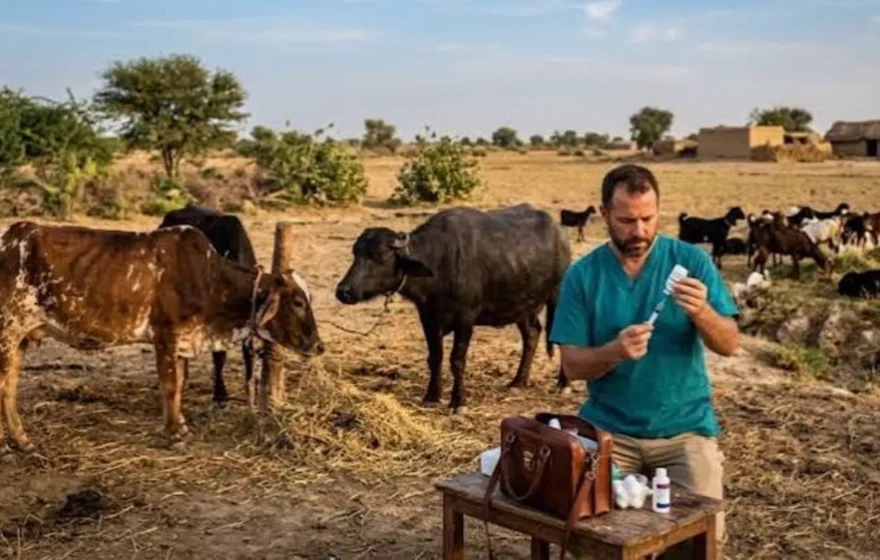
The Sindh government has taken a major step towards modernising the livestock sector, improving cattle breeds and increasing milk and meat production, with the successful completion of the province’s first embryo transfer experiment. The experiment was carried out through a collaboration between the Sindh Livestock Department and the private organisation FoneGrow at the Sindh Institute of Animal Science, and it marks the beginning of a new era of scientific cattle breeding in the province.
Livestock Minister Muhammad Ali Malkani briefed Chief Minister Syed Murad Ali Shah on the successful experiment and the project behind it. The chief minister said the advanced technology would help develop superior cattle breeds in a significantly shorter period, explaining that a process which traditionally took around 30 years to improve livestock breeds could now be completed in just five years with the help of this technology. That single comparison captures why the experiment matters: breeding better animals has always been a slow business, limited by the natural pace of reproduction, and any technique that shortens the cycle from decades to years changes what farmers and governments can plan for.
Embryo transfer, in plain terms, allows the genetics of a superior female animal to be spread far more widely than natural breeding permits. Instead of one high-quality cow producing one calf at a time, embryos from that animal can be placed in other cows, producing more offspring with the same desirable traits in a shorter period. Applied carefully, it can raise milk yields, improve meat quality and strengthen resistance to disease across a herd, and across a province, much faster than selecting and cross-breeding over successive generations. For Sindh, where livestock supports the livelihoods of large numbers of rural families, those gains translate directly into income, nutrition and resilience against the pressures of climate and feed costs.
To expand the initiative, the Sindh government has placed an order for 132 embryos of the Red Sindhi and Guzera cattle breeds. Red Sindhi is one of the region’s best-known dairy breeds, valued for its milk production and its ability to cope with hot conditions, while Guzera is a hardy breed with a long history in South Asia and Latin America. Choosing these two breeds signals that the programme is not chasing novelty for its own sake; it is building on animals already suited to local conditions, and trying to multiply their best qualities more quickly. The order of 132 embryos is a first step rather than a finished programme, but it shows the government intends to move from experiment to expansion rather than letting the result sit as a laboratory success.
The collaboration behind the experiment is also part of the story. Government livestock departments bring scale, veterinary networks and access to farmers, while a private partner like FoneGrow brings technical expertise and equipment. Partnerships of this kind are increasingly common in agricultural science, where the cost and complexity of modern breeding techniques make it difficult for either side to succeed alone. The Sindh Institute of Animal Science provides the research base, and if the programme grows, it could become a training ground for veterinarians and technicians who will carry the technique to districts across the province.
There are, of course, questions that a single experiment cannot answer. Embryo transfer requires skilled staff, reliable cold chains, careful record-keeping and follow-up on the calves born through the programme, and its benefits only appear if farmers can afford and manage the improved animals. The technology must also be explained clearly to farming communities, many of whom will reasonably want to see results in their own herds before committing to it. The government’s next challenge, therefore, is not scientific but practical: turning a successful trial into a service that reaches small and medium farmers, with transparent costs, veterinary support and honest information about what the improved breeds can and cannot deliver.
If that transition is handled well, the implications reach beyond Sindh. Pakistan’s livestock sector is one of the largest parts of its agricultural economy, and better breeds mean more milk and meat from the same number of animals, easing pressure on feed and land. Other provinces will watch Sindh’s programme closely, and success there could encourage similar work elsewhere. For now, the province has shown that a technique once confined to advanced breeding centres can be carried out locally, with local institutions and a local partner. Compressing thirty years of breeding progress into five is an ambitious claim, and it will be tested by the calves born from those 132 embryos. But the first step has been taken, and in agricultural science, that first successful experiment is often the hardest one of all.
