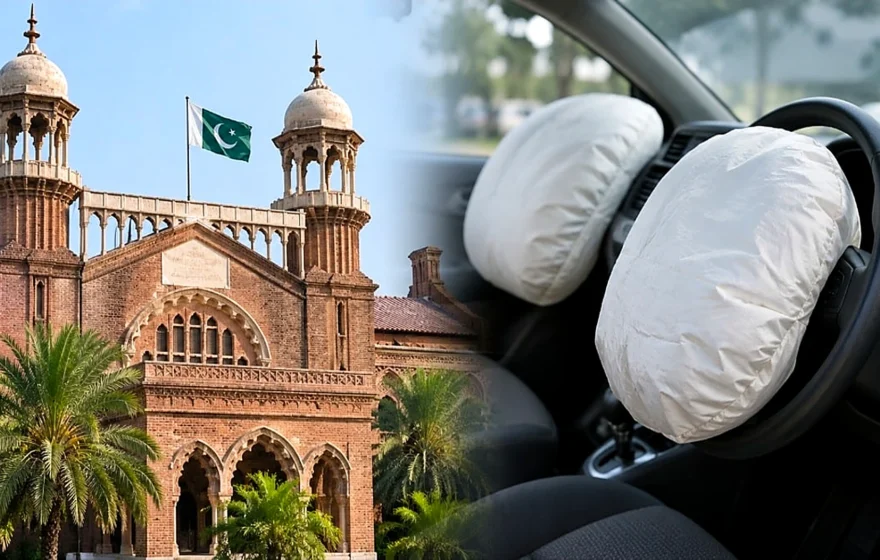
The Lahore High Court has sought responses from the federal and Punjab governments over a petition demanding mandatory safety features in small cars sold in Pakistan, reviving a case that has been before the courts for seven years. Justice Ajmal Zahid heard the public interest petition, which a non-governmental organisation filed in 2019 against car manufacturers for allegedly selling vehicles without essential safety equipment, including functional airbags. The court has now directed the respondents to answer, after years in which, the petitioner says, replies were repeatedly not filed despite notices.
The case began with a tragedy. The petition followed the death of the son of former federal minister Qamar Zaman Kaira in a road accident, and it alleged that the airbags in the vehicle involved in the crash failed to deploy. It claimed that similar incidents have caused other deaths across the country. For the families involved, the question is not abstract: when a car crashes, does the equipment designed to save lives actually work, and was it fitted in the first place?
During Tuesday’s hearing, the petitioner’s counsel, Advocate Safdar Shaheen Pirzada, argued that most cars manufactured and sold in Pakistan lack essential safety features, including airbags and rear seat belts. Small cars dominate the market because they are affordable for middle-income families, yet they are often sold with a thinner list of safety equipment than the same manufacturers offer in other markets. Airbags, anti-lock brakes, rear seat belts and stronger body structures add cost, and in a price-sensitive market there is commercial pressure to keep that cost down. The petition contends that the saving is made at the expense of lives.
Pirzada told the court that the respondents had failed to submit their replies despite receiving court notices over the past seven years. Seven years is a long time for a public interest case to wait for answers, and the delay itself has become part of the story. The court’s decision to press for replies now, and to require responsible officers to appear with their reports, signals impatience with that drift.
The lawyer asked the court to direct the respondents to provide detailed records of accidents involving defective or missing safety equipment and to compensate the victims’ families. That request, if granted, would create an evidence base: how many crashes involved cars whose airbags failed, or which had no rear seat belts, and what happened to the people inside? Compensation would also acknowledge that families who lost loved ones in cars that lacked expected protection deserve more than sympathy.
Pirzada also urged the court to order the country’s two major car manufacturers to install essential safety features in their vehicles at their own expense. That is the most far-reaching part of the petition, because it would shift the cost of safety from the buyer to the producer. Manufacturers would argue that added features raise prices and put cars beyond the reach of the very families who need affordable transport. The court has not decided that argument yet; it has adjourned the hearing for two weeks and directed responsible officers from the respondents to appear with their reports.
The respondents include the federal government through the Engineering Development Board, the Punjab government, the provincial transport secretary, the inspector general of police and two car manufacturers. The breadth of that list reflects how many parts of the state touch vehicle safety: the board that oversees engineering standards, the provincial government that registers and regulates transport, the police who enforce road rules and investigate crashes, and the companies that build the cars.
The case also sits within a wider debate about road safety in Pakistan, where crashes claim thousands of lives each year. Driver behaviour, road design, enforcement and vehicle condition all play a part, and no single reform will solve the problem alone. But vehicle safety is the part of that debate where the state can act most directly, by deciding what must be fitted before a car is allowed to be sold.
What happens in two weeks will therefore matter beyond this one hearing. If the respondents file detailed replies, produce accident records and set out a plan for mandatory safety features, the case could become a turning point for car buyers across the country. If replies are again delayed, the court will face a choice about how firmly to press a matter that has already waited seven years.
