Karachi is about to get a full taste of South Korea. From November 13 to 15, the city will host K-Festival 2026, a three-day celebration of Korean music, food, fashion and technology at Lucky Mall. The festival is being organised by the South Korean Embassy’s office in Karachi together with the Korea Trade-Investment Promotion Agency, known as KOTRA, and it promises something for everyone, from devoted K-pop fans to families simply curious about a country whose dramas, music and beauty products have found a loyal following across Pakistan.
The festival has been planned as a proper showcase rather than a simple exhibition. Nine stalls will display Korean cosmetics, food, household goods, car accessories and electronics, letting visitors see and try products usually only glimpsed on screens. There will also be K-Beauty and K-Lifestyle corners, where visitors can explore the skincare and style trends that have made Korean beauty famous worldwide. Many will enjoy the chance to try on a hanbok, the elegant traditional Korean dress, and pose for photographs.
Big names from Korean business will be part of the event. Samsung Electronics and Lotte Kolson are among the major companies taking part, joined by fourteen local distributors and vendors who already bring Korean products to Pakistani shelves. Their presence underlines a simple point: this festival is not only about music and costumes. It is also a trade showcase, where Korean brands can meet Pakistani consumers face to face. For a city as commercially restless as Karachi, that mix of culture and commerce is likely to draw crowds well beyond the usual K-pop audience.
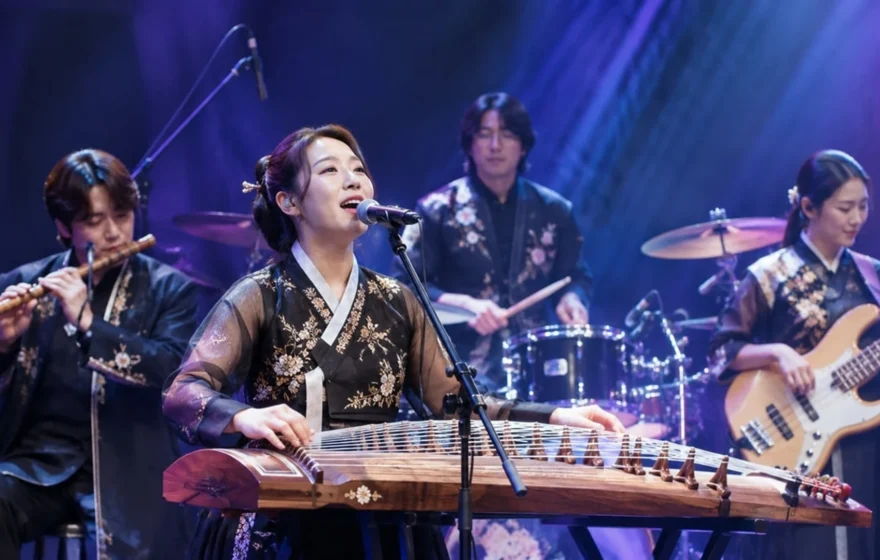
Music, though, will be the beating heart of the three days. The headline act is nuMori, a South Korean band flying in to perform live on Sunday, November 15. The festival’s opening ceremony, followed by the band’s performance and a K-pop competition, will begin at 4:30 in the afternoon, and organisers expect the hall to fill quickly. Formed in 2016, nuMori plays what is known as electro gugak, a striking fusion that weaves traditional Korean sounds together with K-pop and rock. Their music draws on samulnori percussion and pansori vocal styles, blending them with psychedelic rock, blues and electronic beats, producing a sound that is at once deeply Korean and unmistakably modern.
The band’s reputation has travelled well beyond Korea. nuMori has gained recognition on the international stage and has received an invitation to perform at the Kennedy Center in the United States, one of the world’s most respected performing arts venues. For Karachi’s music lovers, the chance to hear that sound live, in their own city, is a rare one. The band will also represent South Korea at the Arts Council of Karachi’s World Culture Festival, performing on November 16 at around 8 in the evening.
Young performers from Karachi will get their own moment in the spotlight too. The festival will host a K-pop competition called KTS: Karachi to Seoul, in which nine teams chosen through preliminary auditions will compete in singing and dance categories. The three best teams will take home Korean electronic products as prizes. For the young dancers and singers who spend hours perfecting their routines, it is a genuine stage, and organisers expect it to be one of the most energetic parts of the weekend. It reflects a community that has grown steadily over the past decade, as Korean dramas stream into Pakistani homes and K-pop groups command enormous online followings among teenagers and young adults.
The cultural side of the event sits on top of a relationship that has been building for more than four decades. Pakistan and South Korea established diplomatic relations in November 1983, and the partnership has grown steadily since. Bilateral trade between the two countries stood at 1.69 billion dollars in 2022, according to South Korea’s foreign ministry, and Korean investment in Pakistan had reached a cumulative 5.75 billion dollars by 2020. Korean companies such as Samsung, LG, Lotte and Kia are familiar names in Pakistan, while KOTRA has long worked to connect Korean businesses with Pakistani partners.
That history is part of why the festival matters beyond its entertainment value. According to the embassy, the event aims to introduce Korean products and culture to the people of Karachi while strengthening cultural ties and people-to-people exchanges between Pakistan and South Korea. Trade figures and investment totals tell one part of the story, but festivals like this one tell another: they are where ordinary people actually meet another culture, taste its food, hear its music and try on its clothes. For many visitors, K-Festival 2026 may be their first direct encounter with Korean life, and first encounters tend to stick.
As November 13 approaches, the festival looks set to be one of the season’s most talked-about events in Karachi. Whether visitors come for the K-pop, the cosmetics, the hanbok photographs or simply out of curiosity, they will leave with a clearer picture of a country that has become an important partner for Pakistan, and a reminder that the relationship between the two nations is now measured not only in trade and investment, but in songs, stories and shared evenings as well.
