A legal challenge in the Lahore High Court has put Punjab’s automated traffic fine system under the spotlight, with a petitioner arguing that motorists across the province are being punished for offences committed by other people’s vehicles. The application, filed as part of an already pending constitutional petition, asks the court to order transparency, human verification and a proper remedy for drivers who receive fines they do not owe.
The plea was moved by Advocate Azhar Siddique through a civil miscellaneous application. It alleges serious flaws in the way the e-challan system identifies vehicles, warning that fines are landing on innocent owners because the system trusts a number plate reading alone, without checking whether the vehicle in the photograph actually matches the one registered against that plate.
Two cases in the application show how easily the system can go wrong, according to the petitioner. In the first, a resident of Gujrat received five e-challans for traffic violations recorded in Lahore, even though his 2018 model car was never in the city at the time. He told the court that he had travelled from Naran to Gujrat, and that the photographs attached to the challans showed a different model of car altogether. In the second case, a lawyer’s vehicle was hit with four e-challans adding up to Rs. 11,000.
The application argues that identifying a vehicle only by its number plate, without verifying its make, model and colour, makes such mistakes almost inevitable. A plate can be misread, especially when it is dirty, damaged or in a non-standard format, and a cloned or duplicate plate can send another driver’s violations straight to an innocent owner’s record. The petitioner also contends that printing an officer’s name on an e-challan does not prove that anyone independently checked the violation before the fine was issued, since the process runs largely without human involvement.
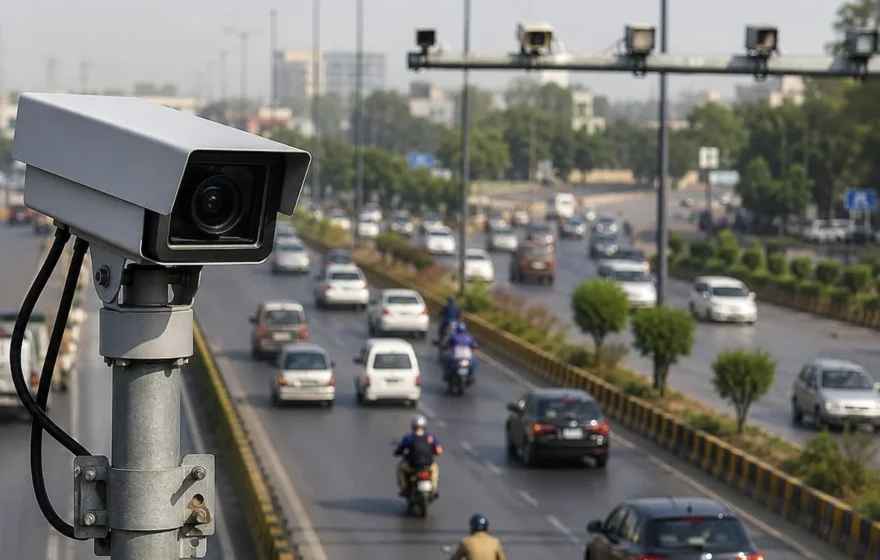
That last point goes to the design of the system itself. Punjab’s e-challans are generated by the Punjab Safe Cities Authority, created under the Punjab Safe Cities Authority Ordinance of 2015 to run the province’s surveillance and automated enforcement network. In Lahore, more than 8,000 cameras watch the main roads and intersections around the clock. When a camera detects a violation, such as jumping a red light or speeding, it reads the number plate using automatic number plate recognition software, matches it against the vehicle registration database, and generates a digital fine. An SMS is then sent to the registered owner, usually within one to three days. No traffic warden needs to be present, and no officer reviews the challan before it is created. That automation lets the system process thousands of violations a day, but it is also the reason a single misread plate can become a fine before any human being has looked at the evidence.
Under the current fine schedule, a motorcycle owner pays Rs. 2,000 for most camera-detected offences, while a car under 2,000cc pays Rs. 5,000, and larger vehicles can face fines of Rs. 10,000 to Rs. 20,000. Repeat offenders face steeper penalties, and accumulating 20 penalty points within a year can suspend a licence. The application warns of a further consequence: unpaid fines can lead to a vehicle being confiscated and can block ownership transfers and token tax payments, leaving a wrongly fined motorist unable to sell a car or renew its documents until the disputed fine is cleared.
The authorities have acknowledged the problem in part. The Punjab Safe Cities Authority runs an online review facility on its portal, echallan.psca.gop.pk, where motorists can challenge a fine they believe was issued in error, upload photographs of their own vehicle and registration papers, and ask for the challan to be cancelled. According to the authority, a review that confirms the fine was a mistake leads to its cancellation within 24 hours. The scale of the system is enormous: Lahore’s traffic police have recently taken unpaid e-challan cases to court, with pending fines reported to be approaching 800,000.
Against that background, the petitioner is asking the court for more than the correction of individual fines. He wants the court to ensure that the system is transparent and accountable, that a human being verifies a violation before a fine is imposed, and that motorists have a way to challenge a wrong challan. Technology, he argues, should make life easier for citizens, not punish them without proper checks.
The Lahore High Court has not yet ruled on the application, and no date for a hearing has been reported. But the case arrives as automated enforcement expands across Punjab, with camera networks now operating in Rawalpindi, Faisalabad, Multan, Gujranwala and other cities beyond Lahore. How the court responds will matter well beyond the two motorists named in the application. If it orders stronger verification and a clearer route for appeals, it could reshape a system that touches hundreds of thousands of drivers. If it leaves the present arrangements untouched, motorists will keep relying on the online review portal, and on checking the photograph attached to every fine, to prove that the car in the picture was never theirs.
