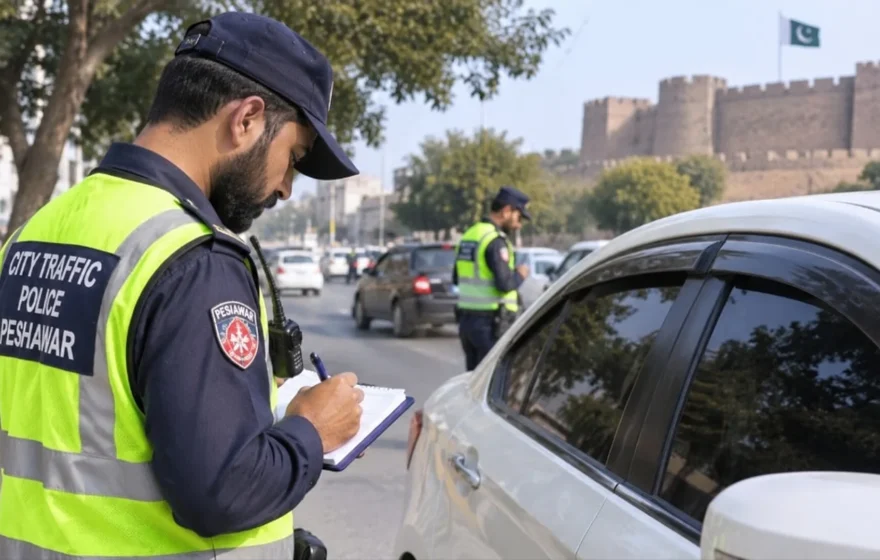
City Traffic Police in Peshawar have fined 3,301 people in an enforcement drive against four of the most common traffic violations on the city’s roads: black-tinted windows, flashing lights, unregistered vehicles and fancy number plates. The crackdown was carried out through checkpoints in different parts of the city, and it is the latest in a long series of operations against the same set of offences, which officers say cause problems for road safety, security and vehicle identification.
According to a press release issued by the police, the operation was launched on the directions of Chief Traffic Officer Dr. Zahidullah, with personnel deployed at checkpoints across Peshawar. Officers stopped vehicles, checked their documents and fittings, and took action on the spot where a violation was found. In many cases the offending fittings were removed from the vehicle on the spot, alongside the fine.
The breakdown shows where the problem is concentrated. The largest group was drivers using black-tinted windows, with 1,601 people fined, followed by 1,201 people caught driving unregistered vehicles. A further 296 people were fined for fancy number plates, while 203 were penalised for installing flashing lights. Together, the four categories account for all 3,301 fines imposed during the operation.
Police said the unauthorised flashing lights, tinted films and fancy plates found during the checks were removed from the vehicles, and fines were imposed on those who had broken the regulations. Removing the fittings matters as much as the fine: a driver who pays a challan but keeps the tint or the lights can be stopped again the next day for the same offence. Taking the equipment off at the checkpoint is meant to make the enforcement stick.
Chief Traffic Officer Dr. Zahidullah said traffic personnel would continue enforcing the law and take legal action against violators without discrimination. He urged residents to follow the traffic rules and cooperate with the traffic police, stressing that the law applies equally to everyone. That message of even-handed enforcement matters, because these operations are often met with complaints that influential drivers are waved through while ordinary motorists are fined.
Each violation causes a different kind of problem. Black-tinted windows are treated mainly as a security concern: when a vehicle’s windows cannot be seen through, officers at a checkpoint cannot tell who is inside or what is being carried. That is why crackdowns on tinted glass in Peshawar have often been linked to security operations. In 2013 the district administration imposed Section 144 in the city declaring vehicles with tinted glasses illegal, and police impounded 133 such vehicles and 600 unregistered motorcycles in two days.
Fancy number plates cause a different difficulty. A plate that uses a non-standard design or font, or carries a name or title instead of the registration number issued by the excise department, makes it hard for cameras and officers to identify a vehicle. Standard plates exist so a vehicle can be traced quickly, whether after an accident, a traffic offence or a crime, and anything that defeats that purpose draws the attention of the police.
Unregistered vehicles are the third category, and the numbers suggest the problem remains widespread. An unregistered vehicle has no official record tying it to an owner, making it effectively invisible to the system. Peshawar has seen repeated drives against such vehicles, including a 20-day crackdown launched in April 2024 on unregistered vehicles plying the Grand Trunk Road.
Flashing lights, the fourth violation, are usually fitted as decoration or to imitate emergency vehicles, and they can dazzle or distract other drivers at night. They are part of a wider pattern of unauthorised fittings, such as pressure horns, that traffic police have targeted in past operations, with confiscated equipment sometimes dismantled in public as a warning to others.
The fines depend on the vehicle. The fine schedule published by Peshawar Traffic Police, as read in October 2026, lists tinted or covered glass at 1,500 rupees for a car, an unregistered vehicle at 3,000 rupees, an illegal number plate at 1,000 rupees, and high beam or dazzling lights at 1,000 rupees. The schedule is headed as a proposed list, so the amount printed on a driver’s challan is the one that counts.
Whether this drive produces a lasting change will depend on what happens after the checkpoints come down. Peshawar’s traffic police have run operations of this kind many times before, yet the same four violations keep reappearing. In March 2021, for example, the department fined 868 people in a month for unregistered motorcycles and tinted windows. The larger figures now do not necessarily mean the problem has grown; they may simply mean the enforcement was wider. What they do show is that a single operation, however large, is only a pause in the pattern. Sustained enforcement, applied without exception, combined with a registration process drivers find easy to use, is what will decide whether the next drive finds fewer than 3,301 people to fine. For drivers, the practical lesson is simple: register the vehicle, carry the standard plate, and remove the tinted film and flashing lights before the next checkpoint does it for them.
