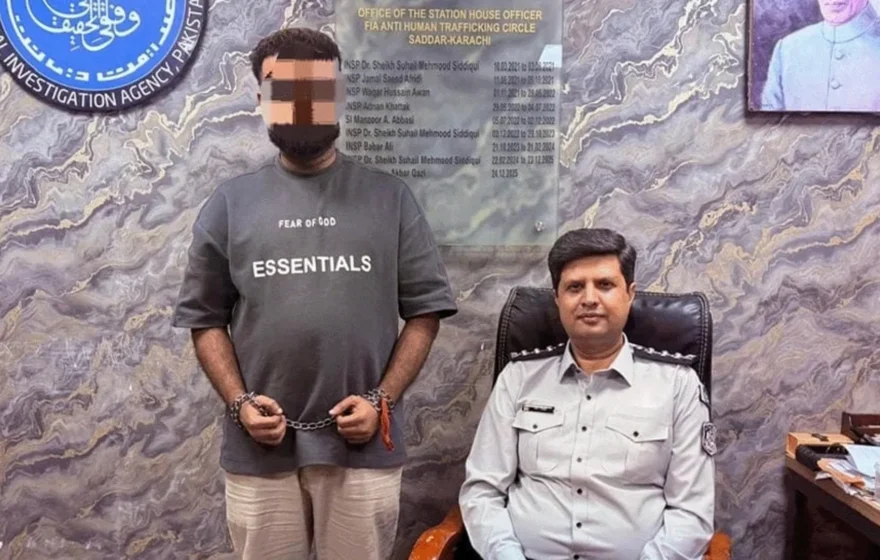
The Federal Investigation Agency has arrested a man in Karachi accused of taking around seven million rupees from forty-nine people by promising them Umrah visas, airline tickets and travel packages that never materialised. The agency said the suspect issued fake tickets and hotel vouchers instead, leaving families who had saved for a religious journey with neither a pilgrimage nor their money back.
The agency’s Anti-Human Trafficking Circle in Karachi identified the arrested man as Ishtiaq Ali, of Karwan-e-Safar Travel and Tours. According to the agency, Ali collected approximately seven million rupees from forty-nine people promising to arrange their Umrah travel, but failed to provide the services he charged for. When the travellers pressed him, investigators said, he handed them tickets and hotel vouchers that turned out to be false.
A case has been registered against the suspect under Sections 406, 420 and 109 of the Pakistan Penal Code. Section 406 covers criminal breach of trust, Section 420 deals with cheating and dishonestly inducing a person to hand over property, and Section 109 covers abetment.
In a separate operation, the same circle arrested another man, Shahzad Baloch, who had been wanted in a human trafficking and visa fraud case registered in 2014. The agency said Baloch was named in the first information report of that case and had been declared a proclaimed offender after repeatedly failing to appear in court. According to the agency, he was part of an alleged network that sent Pakistani citizens to the United Arab Emirates on fake visas in exchange for money.
The two arrests underline how often the promise of travel abroad, and especially of a religious journey, is used to defraud people in Pakistan. Umrah holds a special place in the lives of millions of Pakistanis, and for many families the journey is the result of years of saving, which makes pilgrims easy targets for agents who ask for payment in advance and then disappear, delay, or hand over documents that collapse at the first check.
The Federal Investigation Agency has been warning for months that Umrah visas are also being misused for illegal migration to Europe. Its immigration wing at Karachi airport now intercepts two or three groups every week attempting to use Umrah travel as a cover for reaching Europe. In one recent case, five passengers were referred to the Anti-Human Trafficking Circle after secondary screening, four returning from Northern Cyprus and one from Algeria. Those from Northern Cyprus told investigators they had paid agents between eight hundred thousand and one point eight million rupees each, while the passenger from Algeria said he had paid one point five million.
In another recent case, two brothers from Sialkot returning from Saudi Arabia were stopped at Karachi airport after officers found suspected fake Italian residence permits and exit stamps. They had travelled on Umrah visas in early October, and investigators said one point two million rupees had been paid to an agent said to be based in Italy, with a plan to travel onward to Kosovo and then enter Italy illegally. The Kosovo authorities refused them entry.
The scale of the problem is visible in other recent operations. In the Multan zone, the agency arrested seven suspects in separate cases in late October, including a man from Khanewal who allegedly took one point eight nine one million rupees for arranging Umrah visas for a family, only to provide fake visas.
The pattern in almost every case is the same. An agent approaches people who want to travel, often through a relative or a trusted contact, and asks for a large payment upfront, part through a bank account and part in cash. The victims are told their visa is being processed, then given tickets or vouchers that look convincing until they are checked. By the time the fraud is discovered, the agent has often stopped answering calls or has vanished altogether. Airport immigration staff also use document checks, including ultraviolet light examination of permits and stamps, to expose forgeries before a traveller boards a flight.
For intending pilgrims, the lesson is practical. A genuine Umrah package should come from a licensed operator, and the visa, ticket and hotel booking should all be verifiable independently before any large payment is made. Travellers can check their visa status through official Saudi platforms and confirm a ticket directly with the airline, while a demand for full payment in cash, a refusal to give receipts, or a price far below the market rate are all warning signs.
The arrest of Ishtiaq Ali will not, on its own, end a trade that has grown around the hopes of pilgrims and job seekers alike. But it shows complaints are being acted on, and that the agency treats these cases as organised fraud rather than private disputes. For the forty-nine people named in this case, the recovery of their money and the outcome of the trial will matter more than the arrest itself. For everyone else planning a journey, the case is a reminder that a cheap promise from an unknown agent can cost a family its savings and its pilgrimage.
