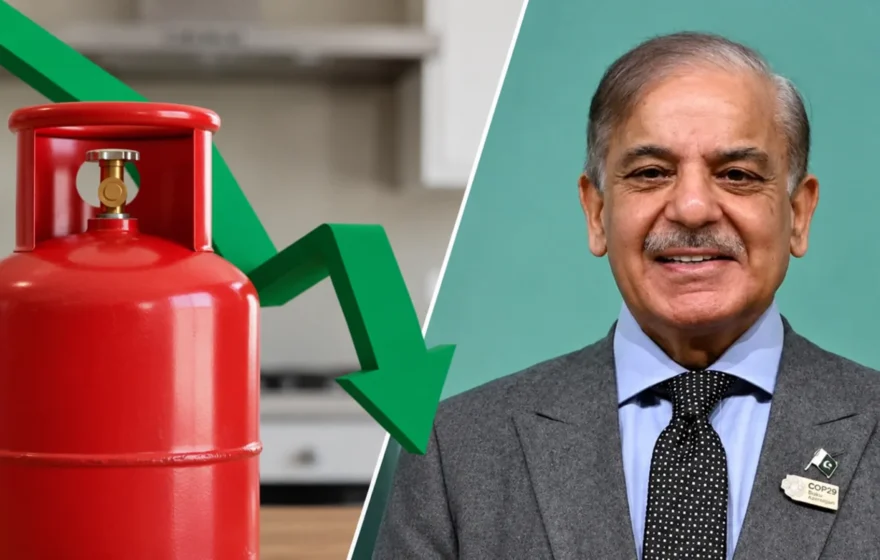
Prime Minister Shehbaz Sharif has declared the end of the LPG mafia, saying the groups that made billions of rupees from the cooking gas trade for decades no longer control it. The era of the mafia is over, the prime minister said while chairing the federal cabinet meeting on Wednesday, according to a video shared by the Government of Pakistan. From now on, the import and supply of liquefied petroleum gas will be handled with competition and transparency.
Under the new system, state-owned companies such as Pakistan State Oil and PARCO will bring in the fuel, the first auction of locally produced LPG will be held next week under camera supervision, and importing companies will post their landed costs on their websites. It is the most far-reaching change to Pakistan’s LPG market in years, and it comes after a supply crisis pushed the price of a domestic cylinder to more than double the official rate.
How the New System Works
Under the new LPG policy approved by the cabinet, four state-owned firms, PSO, Pakistan LNG, SSGC-LPG and PARCO-LPG, will resume imports through government-to-government and business-to-business deals, and have already received supply offers from Saudi Arabia and Oman. The discretionary quota system, which handed out import and supply rights to influential groups, is being abolished. Local producers will instead sell LPG through open auctions in lots of five to ten tonnes, monitored by OGRA and the Petroleum Division. The base price will be linked to Saudi Aramco’s monthly contract price, and OGRA will stop issuing LPG price notifications.
The state importers will work out the monthly price on an import-parity basis, using the Saudi Aramco contract price plus the actual premium, freight, insurance and taxes they paid the month before.
Ten percent of locally produced LPG will be reserved for state marketers supplying remote areas such as Gilgit-Baltistan, while the remaining ninety percent will be sold through monthly auctions at a floor price five percent below the import-parity benchmark. The LPG Pricing Committee set up in 2017 will be wound up, and marketer margins will rise from Rs35,000 to a minimum of Rs50,000 per tonne as an adjustment for inflation. The auctions will be run under camera supervision, with the results made public, so the process can be checked rather than taken on trust.
What This Means for You
The prime minister said the profit from the auctions will go to the national treasury and be used to subsidise LPG for ordinary people, through a fund for households eligible under the Benazir Income Support Programme. Producers will deposit the difference between the local and imported LPG prices into a dedicated public account, audited by the Auditor General, and the money will finance targeted subsidies for vulnerable consumers through the BISP scorecard. In effect, the premium that used to flow to quota holders will now flow to the public purse and back to poor households as cheaper gas.
The change comes after cylinder prices shot up to as much as Rs7,200 in the open market, more than double OGRA’s notified rate of Rs3,296 for an 11.8 kilogram cylinder. The immediate cause was a supply shock: on October 17 the Gabd-Rimdan and Taftan border crossings with Iran were closed, cutting off imports of roughly 7,000 tonnes of LPG a day. Pakistan’s annual LPG demand is around 2.4 million tonnes, while domestic production runs at only 2,000 to 2,500 tonnes a day, so the loss of Iranian supply hit hard. In some areas the price reached Rs700 to Rs800 per kilogram, against OGRA’s notified November rate of Rs294, and a 12 kilogram cylinder that had cost around Rs4,500 climbed to roughly Rs7,000 within days. Families heading into winter, when LPG use rises sharply, were left cutting back on cooking gas they could no longer afford.
The road to the new policy has not been smooth. On October 29 the prime minister formed an eight-member ministerial committee, led by the petroleum minister, to review the Petroleum Division’s reform package and report back within a month, after dealers and marketing companies protested that they had not been consulted. Earlier, in October, the prime minister had rejected a move to auction LPG produced by state-owned entities without a legal and policy framework, turning down the results of simultaneous auctions held on August 10 by three public-sector producers. Approving those results would have pushed prices up by at least fifteen percent on top of higher winter prices, adding around Rs900 to a domestic cylinder. The cabinet’s approval of a full policy now gives the auctions the legal cover that was missing then.
If the auctions and the state imports increase supply, the gap between official and market prices should narrow, and that is the real test of the new system. Filling-plant prices during the first seven months of 2026 ran Rs60 to Rs79 per kilogram above the OGRA-notified consumer price, and the gap reached Rs158 per kilogram in March. A transparent auction, a published landed cost and a subsidy fund for poor households are designed to close that gap from both ends. Whether they do will be visible in the price of a cylinder in the weeks ahead, and in whether the first auction next week runs as openly as the prime minister has promised.
