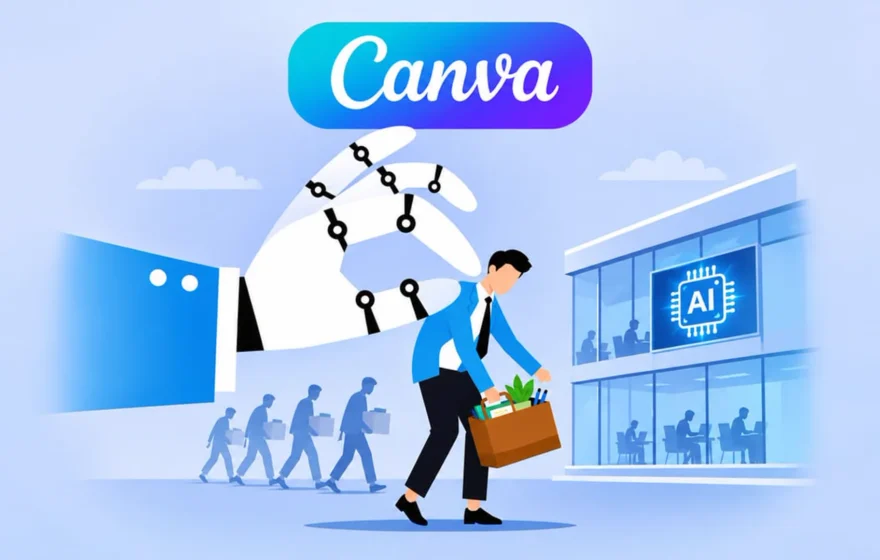
Canva has announced a major restructuring affecting 1,271 employees, or 22 percent of its global workforce, as the Australian design platform faces slowing growth and rising competition from artificial intelligence. The company confirmed the changes on November 4, 2026, in what its co-founder and chief executive, Melanie Perkins, described as the hardest moment in the company's thirteen-year history.
Some will lose their jobs, while others will have their responsibilities changed or be asked to relocate to the company's central hubs. Canva has not said exactly how many will be made redundant, so the figure of 1,271 covers several outcomes rather than a confirmed total of job losses. This is the first redundancy round in the company's history, and a sharp turn for a business that had grown almost without interruption since it was founded in Sydney in 2013.
Why Is Canva Cutting Jobs?
Perkins told staff the company needs to change how it operates after its first slowdown in growth in a decade. In her note to employees, also published on the company's website, she said new technology is transforming what people can create, how they create it, and what they expect from the products they use. The past year, she wrote, had been the company's hardest yet, and the organisation had become too layered and complicated for its own good.
The restructuring comes as AI tools from OpenAI and Google increasingly allow users to create images, presentations and other designs without traditional design software. Canva is investing in its own AI models too, but those efforts have pushed costs up, and the company has cut its revenue growth forecast for 2026 from 30 percent to 20 percent, partly because of rising AI-related spending. The pressure comes from both directions: rivals are using AI to eat into Canva's market, and building AI of its own is expensive.
It is worth being precise about what Canva has and has not said. Perkins did not explicitly blame artificial intelligence for the job cuts, and a company spokesperson, asked directly whether AI was to blame, said the changes were about setting Canva up to build new kinds of products, not about using AI to do the work of the people who are leaving. The reorganisation is not intended to substitute employees with machines, the spokesperson said, and that distinction matters, because the announcement has been widely reported as an AI layoff, and Canva itself is pushing back on that reading.
Design software was one of the first fields where generative AI could produce usable results, and Canva's answer, for now, is to get smaller and simpler.
Major Changes to Teams and Offices
As part of the restructuring, Canva will combine its Product, Growth and Platform divisions into a single organisation, reduce management layers, merge overlapping responsibilities and give employees broader roles, returning to the small teams that Perkins says worked best in its early years. Sydney will become the main location for more product teams, which means some employees will be asked to move, and from January 2027 most hybrid employees will be expected to work from the office two to three days a week.
The company employs more than 5,700 people across 37 countries, including India, and has not disclosed which teams or countries will be hit hardest. In India, the impact is already visible: Mehek Malhotra, who served as Canva's India Content Lead, said in a social media post that she was among those affected.
Laid-Off Employees to Receive Six Months' Salary
Canva has announced a support package for employees leaving the company that is generous by the standards of the technology industry. Departing employees will receive at least six months of salary, including their statutory entitlements, regardless of where they are based. They will also receive twelve months of healthcare coverage where the company provides it, along with continued access to its employee assistance programme, with coverage extending to family members.
The company will let departing employees keep their company-issued MacBooks, and will provide career coaching, interview preparation and one year of LinkedIn Premium. It is also offering grants of ten thousand dollars to eligible departing employees who want to start businesses or community projects, with applications open until December 14. The grants are not automatic; staff must register their interest, and the money is described as support for people trying to get new ideas off the ground, without Canva taking ownership or equity in their ventures.
Whether the package softens the blow will depend on what happens next for the people affected, and on whether Canva's narrower organisation can actually grow again. The company built its reputation on making design easy for everyone, from a small business owner making a poster to a teacher preparing a lesson. That mission has not changed, but the tools people use to design are changing fast, and Canva has decided it cannot meet that change with the organisation it has. The next year will show whether a smaller Canva, concentrated in Sydney and built around AI, can hold on to the users who made it one of Australia's most valuable private companies.
